




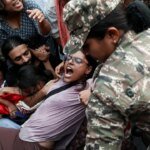

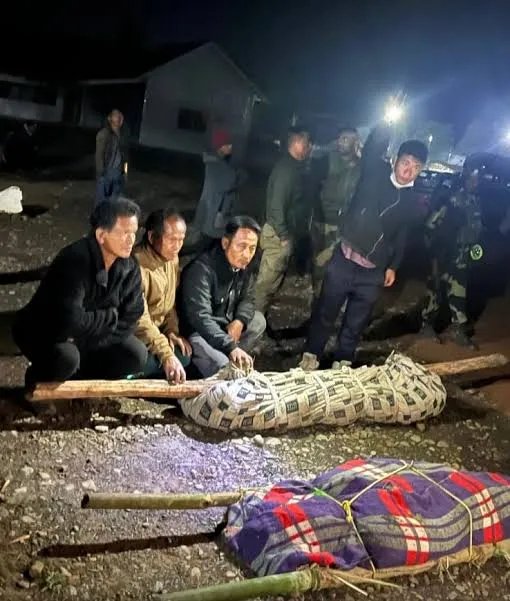
Manipur, India – The loud wails of a 37-year-old nurse pierce the air as she crouches near two coffins to grieve the killing of her infant daughter and five-year-old son in a blast last month.
A woman tries to comfort the mother as dozens of men and women, most of them dressed in ceremonial white, congregate on top of a truck carrying the two coffins and around the vehicle in Tronglaobi town in Bishnupur district of northeastern India’s Manipur state.
Recommended Stories
list of 4 itemsend of list
The last rites of the two children were held on Saturday, nearly a month after an improvised RPG (rocket-propelled grenade) hit their home on April 7, killing the children and wounding their mother while they were sleeping.
Their father, a paramilitary soldier with India’s Border Security Force (BSF), was on duty hundreds of kilometres away in Bihar state when he came to know of the killing. He had been waiting to return home to celebrate his daughter turning six months old this month.
“Just the previous evening, I had called my wife. She gave the phone to our daughter. She hadn’t even learned to speak yet, but she recognised my voice. I was trying to make her say ‘papa’,” the soldier told Al Jazeera.
“I had never imagined it would be the last time I would hear her.”
The killing of the two children is yet another episode in Manipur’s violent ethnic conflict between the predominantly Hindu Meitei community and the mainly Christian Kuki-Zo minority – a conflict that has claimed more than 250 lives and displaced tens of thousands of people since May 2023.
In the remote Himalayan state populated by several Indigenous tribes, the Meiteis had been historically dominating the plains and the valley, including the state capital, Imphal, while Kuki-Zo and Naga, a third major tribe, have been mostly confined to the hills, where their rights over land and public jobs were protected under India’s affirmative action programme by recognising them as “scheduled tribes”.
In April 2023, the High Court in Manipur recommended that the “scheduled tribes” status should also be extended to the Meiteis, who constitute about 60 percent of the state’s 2.9 million people and wield considerable political and economic power.
The court’s remarks angered the Kuki-Zo, who feared losing their protected status. Though India’s Supreme Court called the High Court’s observations “factually incorrect”, the spark was lit, turning the tensions into India’s longest-running ethnic violence, which entered its fourth year on Sunday.
But what began as a war between the Meiteis and the Kuki-Zo has now mutated and deepened into a more complex, multi-actor conflict. A basic question — “Who carried out this attack?” — rarely gets you a clear answer in the state any more.
‘Unknown armed miscreants’
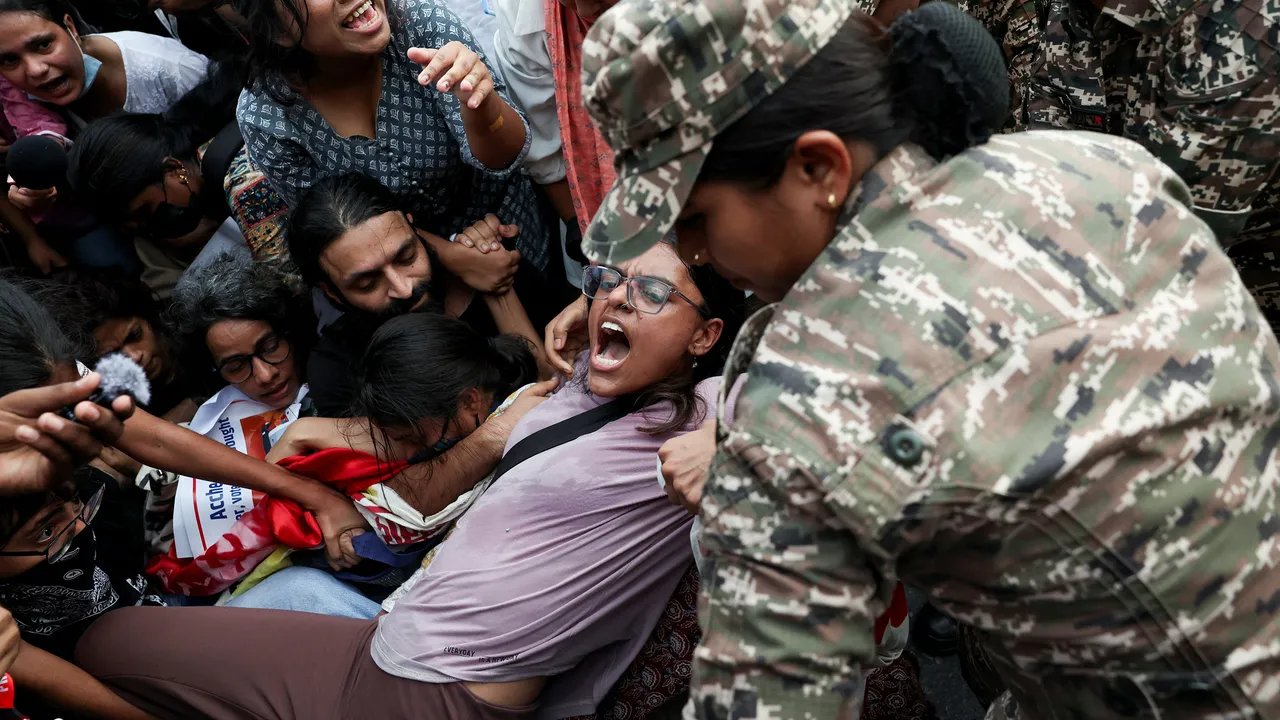
The two children killed on April 7 belonged to the Meitei group. A day later, hundreds of protesters stormed a nearby camp of the Central Reserve Police Force (CRPF), accusing it of failing to prevent the attack.
In a rare act of aggression, CRPF men opened fire, killing three people. The police force later claimed armed suspects had attempted to loot weapons under the cover of the protest — a pattern often reported in the three-year conflict and one that contributed to its escalation. Families of those killed, however, maintain they were unarmed civilians.
As bodies piled up and protests intensified, the state’s Chief Minister Yumnam Khemchand Singh, also a Meitei and a member of Indian Prime Minister Narendra Modi’s Bharatiya Janata Party (BJP), handed the probe to the federally-controlled National Investigation Agency (NIA).
Even without official attribution, many in the valley remain convinced that “attackers from the hills” were behind the April 7 killings, a reference to the Kuki-Zo people.
But the first information reports (FIRs) filed for the Tronglaobi incident – and reviewed by Al Jazeera – record the accused as “unknown miscreants”.
“Unknown”, “unidentified”, or broad community labels such as “Meitei militants”, “Naga militants” or “Kuki militants” form a pattern seen across most cases in more than 12,000 FIRs — related to killings, sexual assault, abduction and arson — registered in Manipur since May 2023 until the end of 2025. Officials say additional FIRs continue to be registered with the same pattern.
With the accused remaining “unknown”, not a single case has resulted in a conviction, compounding the anger and anguish in the state.
In fact, the funeral of the two children was delayed, their bodies stored in a morgue for 25 days, because the family wanted the perpetrators to be identified and punished. They agreed to bury them only after the government assured them of action.
Similarly, the body of Vungzagin Valte, a BJP legislator who was assaulted by a mob in Imphal in May 2023 and succumbed to the resulting injuries in February this year, remains in a mortuary in Churachandpur town, the epicentre of the conflict, as his supporters continue to demand justice for his killing.
In Ukhrul district, a young Naga volunteer, Horshokmi Jamang, was shot dead while patrolling his village last month. Hundreds of volunteer groups have emerged across Manipur after civilians took to arms to guard their villages and lands.
“He wasn’t given a choice, but was ordered by the community. Everyone was told to defend their land,” his 20-year-old wife, Lilychin Jamang, told Al Jazeera. “It was our daughter’s first birthday. We thought he would come back with a cake. Instead, his body came back.”
The FIR into his killing names “Kuki armed miscreants”.
The Naga groups, initially on the margins, got involved in the conflict, particularly in areas where territorial claims, overlapping land boundaries, and long-standing tensions with Kuki-Zo groups intersect.
On March 13, two Kuki-Zo labourers were killed, also in Ukhrul, following the abduction of 21 Naga men by an unidentified armed group.
The labourers, their families say, earned less than a dollar a day and struggled to make ends meet. They had gone out to fix a pipeline when they were allegedly abducted and shot dead.
The FIR names the Naga group NSCN-IM and “unknown militants” from a Naga community, largely based in Ukhrul’s Tangkhul areas. Weeks later, no arrests have been made.
Even the FIRs into the killings of security forces often do not identify the attackers, blaming them on “unknown armed miscreants”. At least 14 people — including a paramilitary soldier — have been killed in the past two months alone.
“Even we cannot be sure whether they were armed village volunteers or individuals linked to insurgent groups,” a police officer told Al Jazeera on condition of anonymity because he was not authorised to speak to the media.
In cases where the officials have alleged the use of explosives, alluded to conspiracies, or invoked “anti-terror” laws, the identities of the accused have not been established.
“We don’t even know who killed him. We have no closure,” the grieving wife of a BSF constable killed by a stray bullet during clashes between the armed groups told Al Jazeera.
‘Boys have gone rogue’
Meanwhile, chaos has worsened the violence in Manipur, with several armed groups linked to Meitei, Kuki-Zo and Naga factions operating in overlapping territories, often with competing claims.
Security officials report sporadic gunfire, abductions, extortion and targeted killings, without being able to attribute the crimes to a group. In such an environment, repeated references to “unknown or unidentified assailants” reflect not just investigative gaps, but the fragmentation of violence itself.
Across the restive state, confusion persists over who is a civilian, who is affiliated with armed groups, and where those lines are blurred. The violence is no longer defined by a single front, with experts saying each community blames the other — a dynamic that perpetrators exploit to sustain the violence.
A highly-placed source within a Naga armed group told Al Jazeera that even their senior leadership does not always have control over their actions on the ground.
“Many of our boys have gone rogue,” the source said. “There is no clear command anymore. Even we don’t always know who is carrying out these attacks.”
A similar sentiment is echoed by sources within the armed groups in both the valley and the hills. They say some of their cadres are increasingly acting independently, not always at the instruction of their leadership.
Security officials say their investigations often point to multiple actors — armed groups, militias, and village volunteers — but attribution remains difficult.
“There is involvement of insurgent groups from all three sides — Meitei, Kuki and Naga,” a senior official said. “But on the ground, it is extremely difficult to differentiate.”

Weapons widening the crisis
Security officials say the violence in Manipur is closely tied to the availability and circulation of weapons in the state. Thousands of firearms were looted from police and paramilitary armouries in the early months of the conflict and remain in circulation.
“The availability of weapons has fundamentally changed the nature of the Manipur conflict,” an official in Manipur said on condition of anonymity because he was not authorised to speak to the media. “It is no longer limited to organised insurgent groups — a wider range of actors, both underground and overground, old and new, now have access to firearms.”
Despite repeated claims by the authorities of restoring normalcy and recovering looted weapons, there is little clarity on the extent of weapons still in circulation. In case after case, perpetrators remain unidentified.
Even security officials privately acknowledge the absence of a clear protocol to end the violence, as the situation increasingly shifts from a law-and-order problem to a “counter-insurgency” challenge.
“The scale of weapons in circulation, the number of armed insurgents — from both proscribed and unproscribed groups — and the blurred lines between civilians, volunteers, and insurgents have altered the nature of the conflict,” a senior security official told Al Jazeera on condition of anonymity because he was not authorised to speak to the media.
Manipur also shares a 1,600km (994-mile) border with Myanmar, a military-ruled country undergoing ethnic unrest and instability for years.
Along the porous India–Myanmar border, weapons move through informal networks shaped by terrain and conflict.
Sources within networks that are opposed to Myanmar’s military government told Al Jazeera that since 2023, large consignments of weapons have been routed to underground groups in Manipur.
Indian security forces say they are operating under extremely challenging conditions, across difficult terrain and multiple fronts.
“There are not enough men to guard every stretch,” a senior official told Al Jazeera on condition of anonymity because he was not authorised to speak to the media.
Meanwhile, the police have been given more powers under stringent laws such as the Unlawful Activities (Prevention) Act (UAPA), which allows authorities to act against individuals suspected of involvement in “terrorist” activities, including preventive detention.
Officials warn that in a sensitive border state like Manipur — with thousands of weapons in circulation and multiple armed factions operating — the situation, if not contained, could pose a serious risk to India’s internal security.
‘Mess they have created’
Even after three years of conflict, more than 58,000 people remain internally displaced across Manipur and are living in relief camps spread across the state, according to government data.
As hopes of their return diminish with each passing day, many of these camps have turned into long-term settlements.
Families say they survive on extremely limited means, often with little access to stable income, healthcare or sanitation. Several residents described struggling to secure even two meals a day.
Testimonies from inside the camps point to persistent fear and insecurity. Residents and local organisations report repeated instances of violence, including sexual assault and killings, with limited accountability.
Children growing up in these camps have seen their education disrupted for years. Aid workers and local observers warn that prolonged exposure to violence and instability is increasing their vulnerability, including the risk of recruitment by armed groups.
“In many cases, children are affected psychologically and physically,” said Letminlen, an aid worker in Churachandpur.
“Many children have expressed a desire to join armed groups and pick up weapons because it is glorified and that is all they see around them,” Letminlen noted. “There is very little rehabilitation support from the government for the children, who are among the worst affected. If this continues, we could be looking at an entire generation growing up exposed to violence, trained in weapons, and further radicalised.”
India’s BJP-led government has been criticised for its inability to contain the Manipur crisis.
Prime Minister Modi visited the state for the first time in September last year – more than two years after the conflict broke out. While the government maintains that restoring normalcy remains a priority, critics say there is no clear plan to end the killings and that a lack of accountability continues to deepen mistrust among the communities.
GK Pillai, a former federal home secretary who oversaw the security operations in India’s northeast, told Al Jazeera the situation in Manipur reflects a “breakdown of political direction and coordination among the state institutions”.
“Basically, the government has not decided what to do. It is a mess they have created, and they don’t know how to resolve it,” he said.
“That is why the security forces cannot operate with clear mandates. Otherwise, our forces, be it the army or the Assam Rifles [paramilitary], are very capable of bringing an end to the insurgency and recovering weapons, but they cannot act in isolation without clear orders from the government of India.”
Pillai said political considerations were shaping the absence of a clear direction to end the conflict.
“The government will not give clear directions to protect its political interests due to the upcoming [state] elections,” he said. “And as far as the truth of this conflict is concerned — who perpetrated it — the government does not want the truth to come out.”
The conflict, said Pillai, has hardened identity positions, making reconciliation difficult without sustained political engagement.
“The Meiteis are the largest community and have to reach out to the other communities,” he said. “The weaker party cannot be expected to start a dialogue and surrender.”
Al Jazeera reached out to a BJP spokesperson for their response to the allegations, but did not receive one.
Meanwhile, violence continues and investigations stall as a growing number of cases with “unknown assailants” define the conflict. Accountability remains elusive, and families are left to grieve without clarity — or closure.