








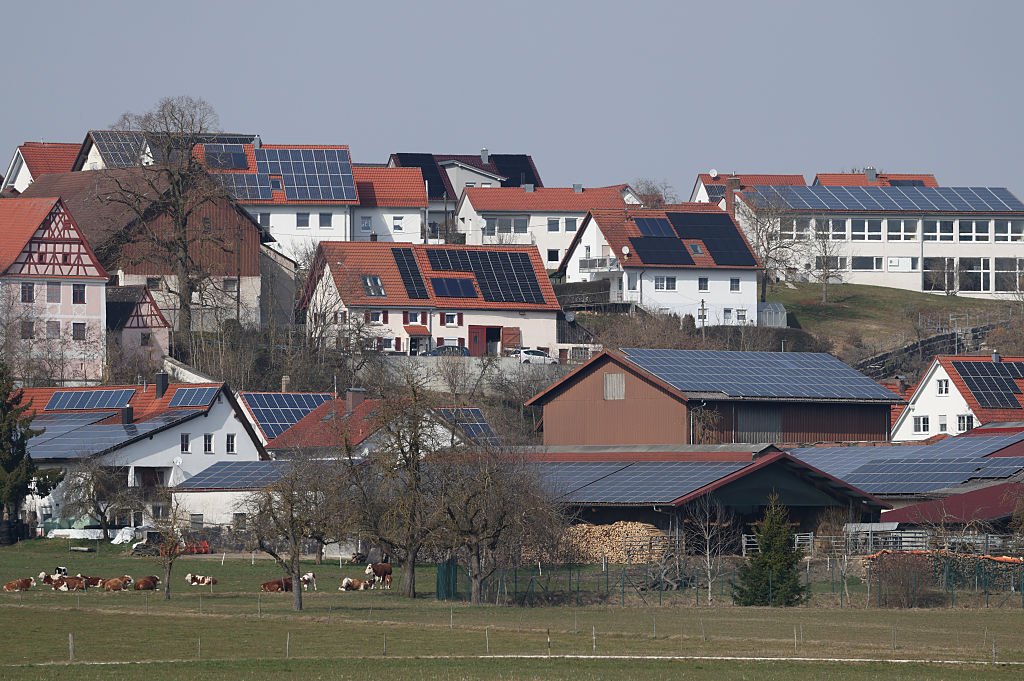
The solar power sector is betting on an alliance with battery producers as Europe’s underdeveloped power grid increasingly becomes a limiting factor, deployment stagnates, and Brussels seeks to claw back market share from China.
“Unplug your solar panel,” German energy economist Lion Hirth urged during the last weekend of April as the wholesale electricity price plunged to a negative €500 per megawatt limit on day-ahead trades.
The situation, where large consumers are in effect paid to draw electricity from the grid, reflected a massive glut of uncontrolled devices relentlessly feeding power into a network ill-prepared to handle it.
Something seems to be going badly wrong with Europe’s solar success story, which has enjoyed years of double-digit increases in deployed capacity – until now.
Flatlining
“Despite all the solar growth, in 2025 the sector dropped off,” said Francisco Beirão, the interim president of the industry association SolarPower Europe, at their annual summit in Brussels on 5 May. Last year, Europeans installed 0.7% fewer solar panels than in 2024.
Stagnation is happening “at a high level but which is still insufficient for Europe’s needs and its objectives,” he added. In the first quarter of 2026, German solar installations dropped by 6% compared to the same quarter in 2025.
With the industry facing the prospect of stagnation, the EU’s pushback against China’s stranglehold on the solar supply chain – with more than 80% market share across the entire journey from polysilicon to PV panels – could not have come at a worse time.
From 1 November, the EU will exclude projects using Chinese inverters – the interface between solar panels and the grid – from EU support. Brussels supported at least a fifth of solar deployment in the bloc last year, and the clampdown is expected to drive up costs by several percentage points at least.
The conflict has also played out within the lobby groups vying to represent the sector. The largest trade association, SolarPower Europe, has 18 Chinese firms among its members, including the huge Huawei.
But some of the handful of European firms still active in a sector they once promised to dominate have teamed up outside the main lobby group with support from the competing, made-in-EU solar association ESMC – specifically to lobby against Chinese competitors.
Trouble at home and abroad
China’s dominance of Europe’s solar supply chain has undoubtedly driven down costs, but could prove to be a poisoned chalice as the bloc becomes more combative in its efforts to shield domestic firms from state-sponsored overcapacity.
Beijing has slammed Brussels for what it calls “discrimination” against its firms. Huawei, already embroiled in a multi-level lobbying scandal, has called its exclusion from European-funded projects a violation of free-trade principles.
The solar PV industry is also facing persistent challenges in key European markets. In the wake of the Spanish blackout, the local grid operator and right-wing politicians were quick to blame the country’s solar power boom – an allegation that was largely, but not entirely, disproven by the definitive investigation.
French would-be solar developers are seen as competitors to the country’s nuclear ambitions – in 2025, far-right lawmakers pursued a moratorium on new solar projects. Although the push was ultimately voted down, the far-right National Rally (RN) is considered a serious contender for the 2027 presidential race.
Even the home of the Energiewende, Germany, is in the midst of a clampdown on renewables build-out, with Energy Minister Katherina Reiche of the Christian Democrats pursuing subsidy cuts for new solar panels where they are held responsible for overloading local grids.
Batteries to the rescue
SolarPower Europe is now betting on batteries to bail them out. “Solar plus storage,” is the lobby group’s new slogan.
The combination of solar panels and batteries for on-grid storage can “deliver on the energy trilemma: affordability, sustainability and security of supply”, Beirão said in Brussels.
A report commissioned for the trade association’s summit suggests that ramping up on-grid battery storage eightfold to 600 GWh by 2030 could – assuming the target of 600 GW of solar capacity is met – reduce Europe’s annual energy bill by €53 billion.
Among other benefits, SolarPower Europe claims its ‘Solar+’ scenario would also halve power system operating costs and cut the average spot-market electricity price by 14%.
“Solar has saved Europe more than €8 billion since the start of the crisis,” said Walburga Hemetsberger, the association’s secretary-general. “This big number could have been even bigger if we had more solar.”
(rh, aw)