









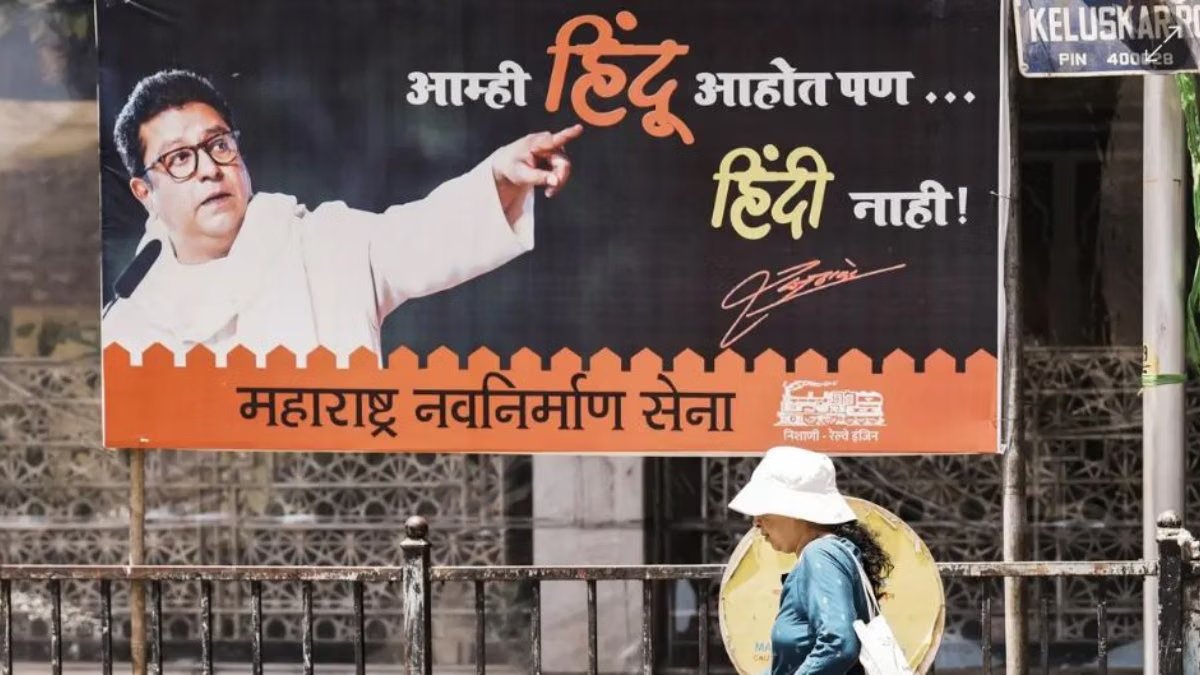
Mumbai: The Maharashtra government has stayed a Hindi language examination after the Maharashtra Navnirman Sena (MNS) warned of launching an agitation and the Shiv Sena UBT (Uddhav Balasaheb Thackeray) alleged “attempts to impose Hindi on the state’s employees”.
The row follows a notification regarding a Hindi proficiency exam for gazetted and non-gazetted government employees, scheduled for 28 June. The move drew criticism from regional language activists such as Marathi Abhyas Kendra president Deepak Pawar, along with the opposition, who questioned the need for such a test when Marathi is the official language.
The exam was scheduled at four centres in Mumbai, Pune, Nagpur and Chhatrapati Sambhajinagar, according to a 9 April press release by the Directorate of Languages. A Marathi exam for the same categories is scheduled at these four centres on 21 June.
The official website of the Directorate of Languages states the purpose, nature, and methodology of implementing the Hindi language examination, tracing the policy back to the constitutional mandate and administrative need.
Provisions under Articles 343 and 345 of the Constitution state that “Hindi as the official language of India” came into effect from 26 January 1965. Even prior to this, Hindi was already used in official work in some states. Therefore, the aim was to ensure that “officers and employees become proficient in the use of Hindi for official purposes.”
To enforce this, the then Bombay government made it compulsory, via its 1951 resolution, for government employees to clear a Hindi language examination within three years of their appointment. Non-compliance carried consequences like withholding annual increments and even ineligibility for government service after a certain date.
Over time, the system evolved into structured tiers and exemptions were also introduced—for example, those who had already studied Hindi (school/university level), those whose mother tongue is Hindi and technical staff and older employees above the age of 45 need not take the exam.
Following a government resolution on 10 June 1976, Maharashtra mandated Hindi language examination for state employees. Currently, the exams are held twice a year, with thousands of government employees appearing each time.
Cabinet Minister and Shiv Sena (Eknath Shinde) leader Uday Samant paused the Hindi exams. “I will also evaluate if this Hindi language exam is necessary. If it is necessary, we will continue it or do otherwise,” Samant, who is also the Minister for Marathi Language, told reporters.
These language exams have been conducted every year since 1976, he said. “Now, I will go through the rules from the 1976 resolution and check if they are required in today’s world in 2026.”
Also Read: Why Shiv Sena (UBT) is opposing Maharashtra minister’s renaming proposal for Mumbai’s KEM Hospital
The language row
The MNS reacted sharply, with its spokesperson Sandeep Deshpande accusing the government of trying to impose Hindi “through the backdoor” and warning of protests at exam centres if the test proceeds.
“Today, we are telling everyone that learning Marathi is compulsory, including rickshaw and taxi drivers and everyone in public service. Conversely, you are telling all gazetted and non-gazetted employees to learn Hindi and take Hindi exams. For what?” he told reporters Wednesday.
He alleged that the decision aimed at pleasing leaders in Delhi and claimed it reflected a broader attempt to promote Hindi in non-Hindi-speaking states. “Are we here to serve the ‘bhaiyas’ (a term used to describe people from the Hindi region) or send them to Uttar Pradesh?”
He urged all officers and employees not to take these exams and issued a warning. “If the government makes these exams compulsory, then whatever happens outside the exam centres will be the responsibility of the government.”
Echoing similar concerns, Pawar said that such tests were unnecessary and unwarranted in a Marathi-speaking state. “The first question is how many officers of the Maharashtra government interact with how many Hindi-speaking people? If these people they interact with have newly come from outside, they must learn Marathi.”
Stating that the Marathi Abhyas Kendra is not as powerful as the MNS, Pawar said that the Kendra will oppose these exams along with the MNS, Shiv Sena and all other Marathi language activist groups and organisations.
Jumping on the wagon, Shiv Sena (UBT) took to social media platform X saying that the decision to conduct a Hindi language proficiency test was inexplicable.
Maharashtra’s identity, it said, is rooted in Marathi language and culture.
“A question is being raised as to whose interests are exactly being served by the attempt to impose Hindi on the state’s employees. By granting classical language status to Marathi on one hand, while imposing a decision to make Hindi mandatory on the other, this duplicity will not be accepted by Maharashtra,” the opposition party said.
(Edited by Tony Rai)