







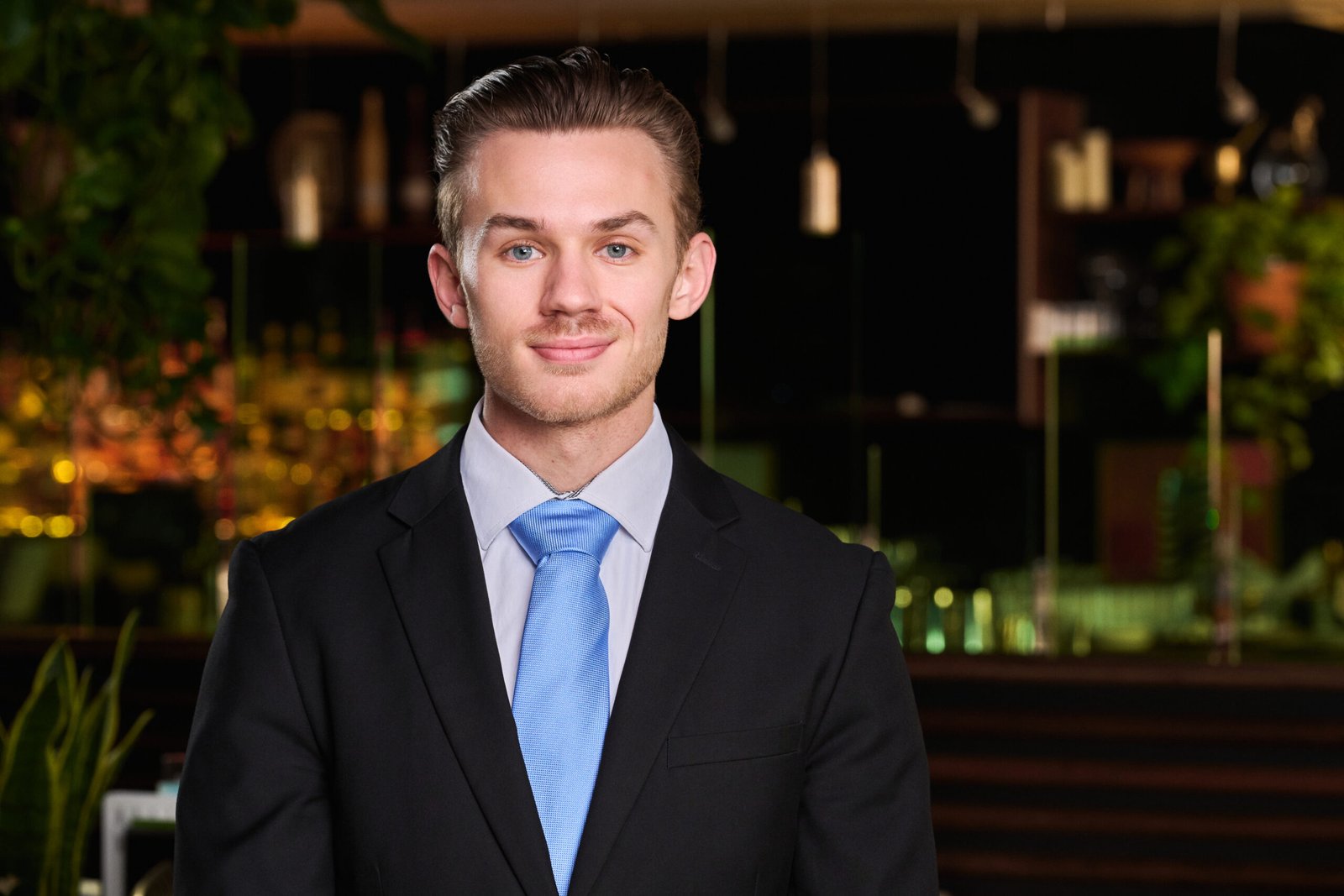
It was while applying to colleges that Thomas Hancock-Bacon realized the importance of approaching problems through an interdisciplinary lens.
“I initially wanted to pursue organic agriculture, but I came to understand that if I wanted to create change at scale, I needed to engage with the systems that enable it. That meant learning how capital flows and how policy shapes outcomes,” he says.
That perspective stayed with Hancock-Bacon and guided his academic, professional and personal development throughout his time at Arizona State University.
During his time at ASU’s W. P. Carey School of Business, the Turken Family Outstanding Graduating Senior — who is graduating with dual degrees in finance and business sustainability — founded ASU’s Ethnobotanical Club, served as president of the T.W. Lewis Ambassadors, and was involved in Scholars of Finance, the Undergraduate Investment Group, Sustainable Business Students, and the Politics & Leadership Club. His Barrett, The Honors College thesis focused on agrivoltaics in Arizona and examined how farmers can remain economically viable amid increasing land-use pressure from energy development.
“Across these efforts, my goal has been consistent: to use business and finance as tools to support communities whose livelihoods are deeply tied to the land,” Hancock-Bacon says.
Following graduation, the Gilbert, Arizona, native will serve as a Peace Corps sustainable agricultural facilitator in Jamaica before pursuing a career in sustainable development.
“If I have learned anything during my time at ASU, it is that the best paths are not always straight,” Hancock-Bacon says. “What matters more is developing the ability to navigate complexity with intention, curiosity and a willingness to build something that does not yet fully exist.”
In celebration of his upcoming graduation, we caught up with Hancock-Bacon to learn more about his ASU experience.
Question: What’s something you learned while at ASU — in the classroom or otherwise — that surprised you or changed your perspective?
Answer: Studying abroad had one of the biggest impacts on my perspective. Being in places like Amsterdam and Barcelona allowed me to step outside of the American context and see that there are many valid ways to structure life, work and community. It made me question the emphasis we often place on constant productivity and optimization. I saw cultures that prioritized community and quality of life differently, and that experience reshaped how I think about what sustainable systems should look like — not just environmentally, but socially.
Q: Why did you choose ASU?
A: ASU offered the flexibility to explore and build across disciplines while still developing strong technical skills. After realizing I needed to understand finance and policy to create meaningful change, ASU became the place where I could pursue that path while staying connected to my interests in sustainability and agriculture. The combination of opportunity, scholarship support and access to programs like Barrett, The Honors College, ultimately made ASU the right place for me to grow into the kind of thinker and practitioner I wanted to become.
Q: Which professor taught you the most important lesson while at ASU?
A: Teaching Professor Thomas Martin had one of the most significant impacts on my development. Through his courses and mentorship, he helped me move from purely visionary thinking to structuring ideas that could actually be implemented. He pushed me to take abstract concepts and translate them into tangible outcomes, a skill that has shaped how I approach my work today. Jack D. Furst Endowed Professor of Finance Sunil Wahal also helped ground me in the technical side of finance, creating a balance between creativity and rigor that has been essential to my growth.
Q: What’s the best piece of advice you’d give to those still in school?
A: If you feel unsure or uncomfortable, you are probably in the right place. Growth rarely feels clear in the moment, and some of the most valuable paths are the ones that do not make immediate sense. Follow what genuinely interests you, and then use your time to build the skills that allow you to pursue it effectively. Let your instincts guide your direction, but rely on discipline and effort to make that direction real.
Q: What was your favorite spot on campus, whether for studying, meeting friends or just thinking about life?
A: Much of my time was spent moving between different spaces and commitments. However, I always appreciated places like the Secret Garden and the Walton Center for Planetary Health — particularly its courtyard, which offered a sense of intentional design and reflection. More than a specific location, my way of resetting often happened off campus through yoga, working out or spending time in nature. That balance was important in maintaining perspective throughout a demanding academic experience
Q: If someone gave you $40 million to solve one problem on our planet, what would you tackle?
A: I would focus on transforming agriculture to better integrate with natural systems. Agriculture occupies a significant portion of the Earth’s land, and while it is highly productive, it often comes at the expense of ecological health. By investing in multiuse systems such as agrivoltaics, agroforestry and controlled-environment agriculture, we can maintain productivity while restoring ecosystem functions. The goal would be to create systems that not only feed people but also support biodiversity, improve resilience and generate long-term value for both society and the environment.