







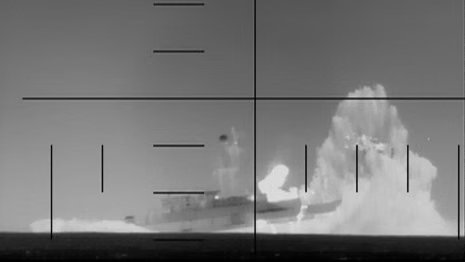
The distress call came in to Sri Lanka’s maritime rescue coordination centre just after 5am. The ship in trouble, they determined, was well within Sri Lanka’s obligation for rescue, being just over 19 nautical miles off the coast of the southern city of Galle.
The navy swiftly mobilised and, by 6am, the first search and rescue boat was on its way, another soon close behind. It was hard to see through the thick morning mist but officers onboard kept their eyes peeled for a ship in the distance.
Instead they found a spooling slick of oil on the sea’s surface. Dozens of survivors held on to life rafts and bodies bobbed in the waves, but the vessel was nowhere to be seen. IRIS Dena, an Iranian warship on its way to a friendly port call in Sri Lanka, already sat on the bottom of the Indian Ocean.
It had taken under three minutes for Dena to sink after it was struck by the world’s most powerful torpedo, a Mark 48, launched by the US navy nuclear-powered submarine USS Charlotte lurking silently nearby. At least 84 people onboard were killed – their bodies were repatriated to Iran this week – in an attack that brought the US war on Iran to the Indian Ocean.
The ship was more than 3,000km (1,864 miles) away from the Gulf and not on an active mission when it was hit by the US submarine, leading to comparisons to the sinking of the Belgrano, an Argentine ship controversially attacked by a British submarine in a defining moment of the Falklands war in 1982.
Dena had been invited to the region by India, to take part in the pomp and splendour of an international fleet review in the eastern port of Visakhapatnam. A routine event for the navies of the world to show off their ships and share training exercises, Iran was one of more than 70 countries that participated over the 10 days, alongside the US, Australia and Russia. Three days later, the US and Israel began bombing Iran.
The attack on the warship left senior military figures and analysts in the region stunned, provoking fears that Donald Trump’s Middle East war will have wider ramifications for the geopolitically sensitive Indian Ocean region.
Iran called the attack an “atrocity” but the Trump administration was insistent that Dena was a fair target. In a press conference, the US defence secretary, Pete Hegseth, did not disguise his glee as he said Dena had thought it was safe until it died a “quiet death”. That same week, Trump boasted of the strategy by the US military to strike, rather than capture, about 50 Iranian ships in the conflict. “They like sinking them better,” said the US president, chuckling.
India’s former chief of naval staff, Adm Arun Prakash, said the attack on Dena was legal as it took place in international water but was nonetheless “shocking” on multiple fronts.
“The US navy could have sunk this ship anywhere on the way back to the Persian Gulf,” said Prakash. “We are supposed to be friends and partners of the USA. To bring the war to right to our doorstep was a perverse act.”
The ethics of targeting a ship that had about 130 people onboard, was in the region as a guest of India and posed no immediate threat to the US, “leaves a very bad taste in my mouth”, he added.
“It’s a bit of treachery of the US to attend a peaceful function side-by-side with Iranian navy, where there’s a lot of camaraderie, and then the moment the Iranian ship pops out of harbour, it’s sunk,” he said. “They could have delayed this action to spare India this embarrassment.”
While the Iranians claim the ship was unarmed, Indian and Sri Lankan navy officials say this was highly unlikely. “None of our warships have ever left port without its ammunition outfit,” said Prakash.
R Adm Sarath Weerasekara, the former chief of staff of the Sri Lankan navy, agreed: “All the warships must carry their designated weapons. Whenever they go out into international waters, they will be on full alert.” But armed or not, he said the targeting of Dena showed a worrying disregard by the Trump administration of post-second world war conventions and agreements, particularly on the ethics of warfare.
A similar debate has raged over whether the US had a responsibility to pick up survivors after the attack. Weerasekara was among three senior navy officials who told the Guardian it was standard practice to help to save survivors of such attacks, though he acknowledged this was more difficult for a nuclear submarine that operates in stealth. “It’s very clear, the US was supposed to pick up those survivors and they should have. That’s the Geneva convention,” said one retired Indian navy three-star admiral.
The Sri Lankan government has insisted it acted with “humanity” in its response to the incident, as the small island nation has sought to avoid being caught up in the wider politics of the US-Israeli conflict with Iran. However, questions have been raised over the delay by Colombo in giving the Iranian ship permission to dock, which left it a sitting target in the Indian Ocean.
After the international fleet review, officials say Iran had requested permission from Sri Lanka to make a friendly port call on the way home. It had three ships in its flotilla; IRIS Dena, a support ship IRIS Bushehr and a landing ship, IRIS Lavan. The Lavan was later granted permission to dock in India instead, after it experienced technical difficulties en route.
Though a port call was standard procedure in the past, the US war on Iran made this a highly precarious geopolitical situation for Sri Lanka. Even as Dena and Bushehr set sail for Sri Lanka, the official permissions for it to come to Sri Lanka’s shore had still not been granted by the government.
It was still not approved by 3 March, as Dena reached the outskirts of Sri Lanka’s territorial waters. According to Weerasekara, the ship was left waiting for more than 11 hours, a delay that would prove deadly by the morning of 4 March.
“We did not take any prompt action,” said Weerasekara. “We could have saved those lives also. This has been discussed in the security council and yet no action has been taken.” In the aftermath of the attack, Sri Lanka agreed to allow Bushehr to dock late on 4 March, amid fears it too would be hit.
The attack has raised particularly difficult questions for India over the presence of a US submarine operating so close to its territory without any knowledge, and that no heads up was given for the attack, despite the close defence ties between Delhi and Washington.
Over recent years, India has sought to project itself as the superpower and great defender of the Indian Ocean, amid efforts by China to get a greater foothold over one of the world’s most geopolitically important seas. Yet Weerasekara was frank that this incident had undermined these efforts. “India is a defence partner of America so it is a shame that they don’t know that a US submarine is at its backdoor,” he said.
Sushant Singh, a former Indian army officer and defence analyst, described the incident as a “humiliation” for the Indian government of the prime minister, Narendra Modi. “This sends a signal to the larger region that India is not that influential in the Indian Ocean region, not even close to its own shores,” he said. “It shows the Trump administration doesn’t take India seriously at all.”
The retired Indian V Adm Shekhar Sinha had been particularly shaken by the demise of Dena. Sinha attended the international fleet review in Visakhapatnam, saw Iran’s cadets line up proudly on Dena and had exchanged a conversation of niceties with the Iranian naval commander, who had said how much he was enjoying being in India.
“All’s fair in love and war,” said Sinha. “But it’s very upsetting to think that a week later, many of them were dead.”
He too said the incident had troubling implications for India and the security of the Indian Ocean. “It’s clear we need to relook at Indian Ocean security and underwater surveillance,” he said. “If an American submarine is floating in the Indian Ocean so close by and we did not know, then we better buck up.”