








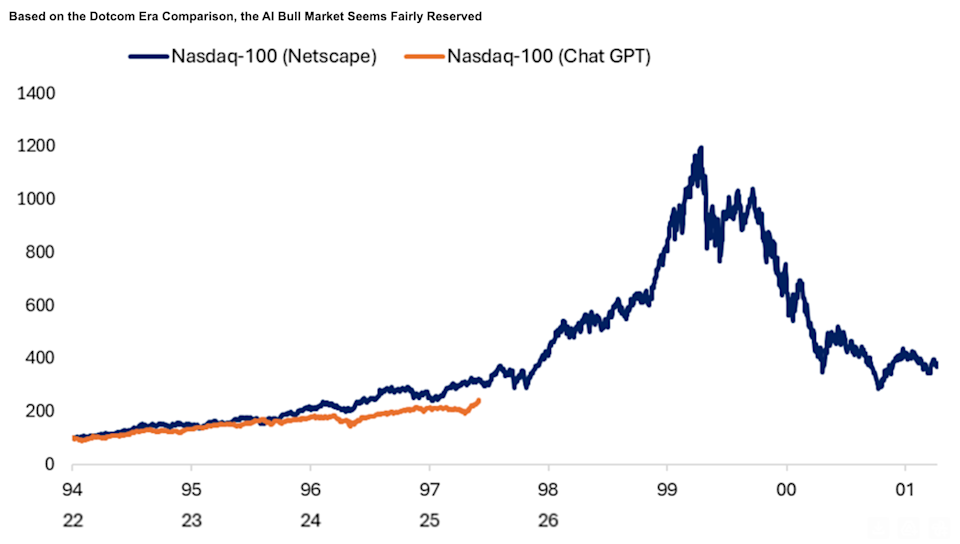
For all the worries about an artificial intelligence bubble, the Nasdaq 100’s (^NDX) advance still seems relatively tame compared to the exuberance of the dot-com-era run-up and crash, LPL Financial chief equity strategist Jeff Buchbinder said.
The comparison of the current AI boom and the dot-com era is reasonable, the strategist noted. When comparing the Nasdaq 100 (NQ=F) returns at the start of the dot-com bubble (pinned to the launch of Netscape) and those starting with the launch of OpenAI’s ChatGPT, the patterns are broadly similar.
However, the Nasdaq 100’s more than 140% gain since the launch of ChatGPT is still a long way off from the index’s 1,090% return at the dot-com bubble’s peak in March 2000, Buchbinder said.

The two moments are fundamentally different for several reasons, Buchbinder argued.
The leaders of the AI build-out are financing their growth with internal cash flow, not “speculative capital raising,” and their business models are more diversified, Buchbinder said.
At the same time, valuations are more grounded. The tech sector peaked at 58 times forward earnings in March 2000, versus a roughly 25x multiple today. Initial public offerings this time around are also much larger, with large revenue streams and clear paths to profitability.
Finally, the AI build-out is centered around infrastructure, while adoption has “barely begun,” with “strong balance sheets of the infrastructure builders … paving the way for many AI adoption winners to materialize in the future,” Buchbinder said.

Some strategists have pushed back, noting that the amount of debt issuance by hyperscalers has ballooned as the companies have taken on more debt to fund the $725 billion in capital expenditures projected for 2026.
Global AI spending is set to rise from $340 billion in 2025 to around $3 trillion in 2035, according to Oxford Economics. Such a rise would mean that AI’s share of total tech spending would grow to 23% from less than 4% today.
“In our previous enterprise AI surveys, there was no convincing evidence that AI was serving as a catalyst to displace humans. There is now,” UBS analyst Karl Keirstead wrote in a client note on Monday. He noted that 42% of respondents said AI will cause them to somewhat or significantly reduce hiring, up from 31% in October 2025.

BNP credit analysts recently noted that AI hyperscaler credit supply risk is “now well-flagged,” or priced in.
“We’re not saying history will repeat and that the Nasdaq 100 will be up another 900% before crashing,” Buchbinder said.
“We are simply making the point that the current stock market trajectory is more rational than you might think, and this may be more like 1997 than late 1999 or early 2000.“