







Iranian Foreign Minister urges BRICS nations to denounce U.S.-Israeli military aggression amid tensions in the Middle East and oil supply concerns.
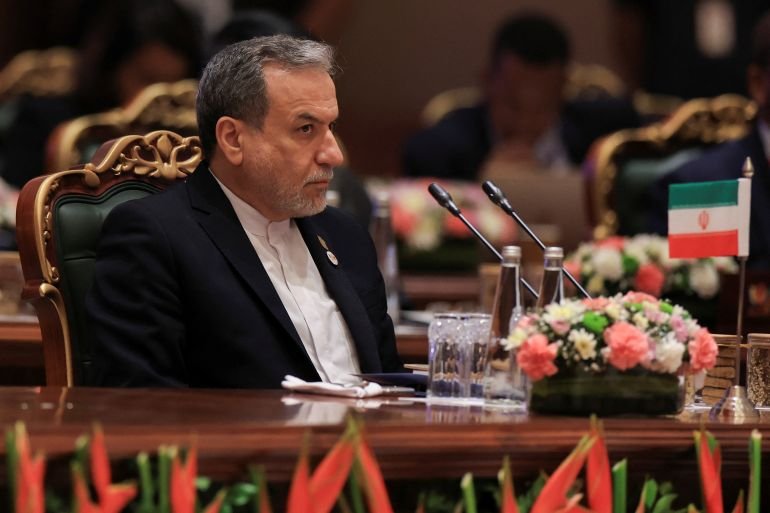
Iran’s Foreign Minister Abbas Araghchi has urged fellow BRICS nations to denounce what he termed violations of international law by the United States and Israel. This call comes as the two-day BRICS meeting is held in New Delhi, India, with the ongoing conflict in the Middle East and a looming fuel crisis as top agenda items.
In his remarks, Araghchi accused the United Arab Emirates (UAE) of direct involvement in military actions against Iran, marking a rare occasion for Iranian and Emirati officials to share a venue since the onset of hostilities led by the U.S. and Israel against Iran at the end of February.
Araghchi referred to Iran as a “victim of illegal expansionism and warmongering,” urging the members of the BRICS+ alliance—which includes Brazil, Russia, India, China, South Africa, Egypt, Ethiopia, Indonesia, Iran, and the UAE—to resist what he described as “Western hegemony and the sense of impunity that the U.S. believes it is entitled to.”
He called on these nations, along with the broader international community, to explicitly condemn the actions of the U.S. and Israel. The Iranian semi-official Mehr news agency reported that he later reiterated that the UAE’s involvement in aggression against Iran was direct.
In response to the attacks from the U.S. and Israel, Iran has carried out military strikes on U.S. military assets located in Gulf states, including the UAE. As of now, it is unclear how representatives from the UAE and other BRICS+ nations reacted to Araghchi’s statements.
The Indian Foreign Minister Subrahmanyam Jaishankar, who is hosting the meeting, stated that the gathering occurs during a notably volatile period in international relations. Ongoing disruptions in Gulf shipping routes and the strategic Strait of Hormuz are contributing to instability in oil and gas markets, which is increasing pressure on energy-importing nations such as India.
India’s Ministry of External Affairs has condemned a recent attack on an Indian-flagged vessel off the coast of Oman, describing it as “unacceptable.” All sailors aboard the ship were successfully rescued by the Omani authorities. The ministry further expressed concern over the continued targeting of commercial shipping and civilian mariners, although details about the perpetrator of the attack remain undisclosed.
Araghchi also stressed that the Strait of Hormuz remains accessible to all commercial vessels collaborating with the Iranian navy. The conflict has compounded challenges for the Indian economy, which relies significantly on energy and fertiliser imports from the Middle East, and has created uncertainty regarding India’s economic outlook.
India, which ranks as the world’s third-largest oil importer, typically sources around half of its crude oil through the Strait of Hormuz—a critical passage for roughly 20 per cent of global oil supplies in times of peace.
India is set to host a summit for BRICS leaders later this year, where foreign ministers are also scheduled to meet with Indian Prime Minister Narendra Modi. However, with notable divisions regarding the ongoing war in the Middle East, it remains uncertain whether the BRICS, which functions on a consensus-based approach, will produce a joint statement at the conclusion of the meeting.
Kazem Gharibabadi, Iran’s Deputy Minister of Foreign Affairs for Legal and International Affairs, commented to the Press Trust of India that one member country had advocated for a narrative condemning Iran, complicating consensus-building efforts within the bloc. He noted that it is crucial for India’s chairmanship of BRICS to be successful, stating, “It is not a good approach to send a signal to the world that BRICS is divided.”