






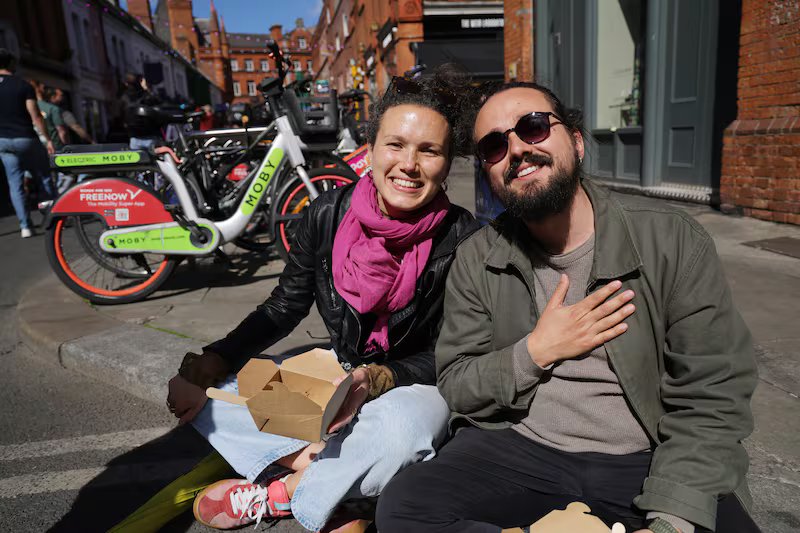
When Charline Clain and Sebastian Cruces strolled around the sunny centre of Dublin last Saturday afternoon, they were surprised to find the outdoor seating they used to frequent at Ciss Maddens bar on Drury Street was no longer there.
“That’s what we were just talking about because we saw that the terrace has disappeared,” says Clain, a project manager, sitting on the kerb outside Ciss Maddens eating a cookie.
“I don’t want to promote the consumption of alcohol or whatever but I think that, personally I am from France, and we have a lot of terraces and it doesn’t mean to drink alcohol but just to be able to sit outside.”
Clain and Cruces are among the thousands of people who flock to Drury Street on sunny days, a pastime that has been jokingly dubbed “Drury Duty” by some content creators on TikTok. As a result of pandemic-era outdoor dining rules, combined with the partial pedestrianisation of the street, Drury Street has experienced a huge influx of young people hanging out on the pavement to people-watch, eat, drink and chatter. Among a certain age group in Dublin, it is more desirable to sit on the pavement of Drury Street than on a barstool elsewhere.
The practice is not without its detractors, however, as one trader on the street complained on Saturday of a 50 per cent decrease in business on sunny days. The trader did not want to be identified, saying when they had spoken out about the matter before they had received abuse online. Other traders, such as designer Helen McAlinden, have previously praised the lively atmosphere and “buzz”, but have also complained that business has been affected by customers being unable or unwilling to battle through the crowds to get to her women’s clothing store.
Last year, a debate flared up over the function of the street after signs were erected urging the public not to sit on the kerbs.
The argument has arisen once again after Dublin City Council revoked the outdoor licence of Ciss Maddens, which pub owner Paul Keaveny described as “surprising”.
Keaveny said he was hoping to engage with the council on the matter.
A spokesman for the council said it welcomed “the vibrancy and energy that Drury Street brings to our city centre and we recognise how important it is as a social space, particularly for younger Dubliners”, but it had a responsibility “to ensure that all public spaces remain safe, accessible and enjoyable for everyone – businesses, residents and visitors alike”.

Those who enjoy using the street have different views. Clain suggests outdoor seating licences could help visitors who have accessibility issues.
“Not everyone can sit on the floor like this. I think it’s a pity, especially for the summer season,” she says.
Cruces agrees, adding: “I actually work in tourism and I always recommend these streets because they can see the vibes and what the culture in Dublin is. It’s way more than just drinking outside, but the vibes on the street. We don’t really get a lot of days with sun so when they don’t give that option to sit outside and just like have some drinks and chatting with your family and friends, it’s sad.”
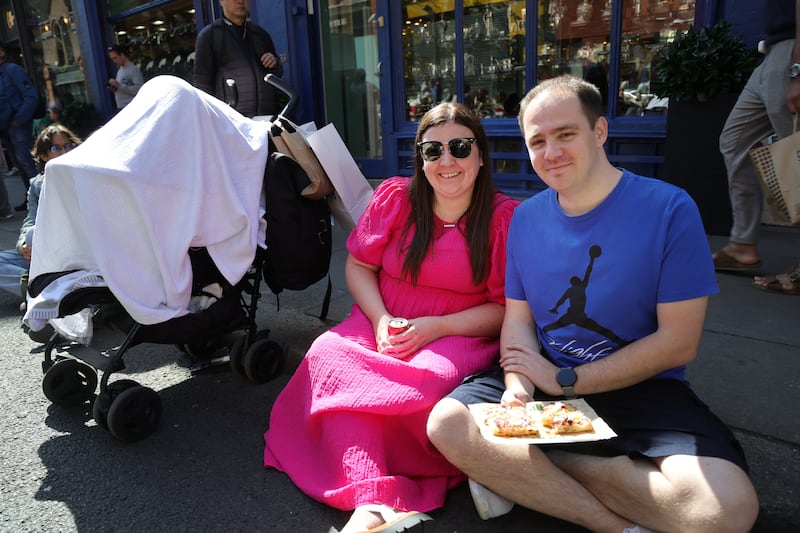
Kelly Hogan from Tallaght is also sitting on the pavement of Drury Street, with her baby in a buggy and her partner Declan Kenny.
“We never really come into town that often but it’s somewhere to sit because it’s a lovely day,” she says.
“It’s nice to have a bit of atmosphere around. Even if you are not talking to them yourself it’s nice to be able to see people.”
She believes there is a lack of design for outdoor areas in Dublin.
“We don’t really get the sun so a lot of places don’t really focus on outdoor places. A lot of places focus on indoor areas and when they have the sun, then everyone tries to sit out and squeeze in wherever they can.”
Sitting a metre away from Hogan is David Coutts from Cork, who agrees there are few areas in Dublin designed for sitting outside.
Although Coutts enjoys sitting on the kerbside drinking a spritz, he would rather have more outdoor seating options.
“To be honest, if Dublin’s urban planning was better I’d prefer a courtyard like any other major European city but this is what we have so this is what we have to make do with.
“In Dublin, the streets are so tightly packed. I think more streets should be pedestrianised, we should be given the opportunity to enjoy the outside world.
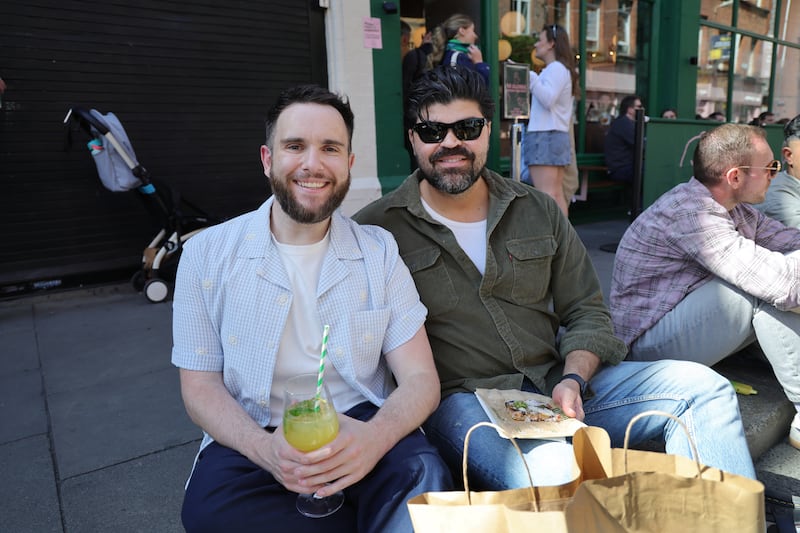
“I would say the idea of being outside rather than in a smoking area or a bar is much better, it’s more lively.
“But also because we get so little sun or we get so little outside time. I have seasonal [affective] disorder especially in wintertime, so any time that I can get outside on any occasion, having a drink or having some food, is a really good thing,“ he says.
Tatiana Gaitan moved from Colombia to Dublin two years ago as a student because she wanted to improve her English. She also finds the winters in Ireland “hard”.
“Today is actually my first day in Drury Street after a long time so I’ve come here by myself. I am alone, I got a drink and I am enjoying the sun, there are a lot of young people, not only young people but most of them are young people,” she says.
Another attraction for the student is that “you can easily make friends” on Drury Street.
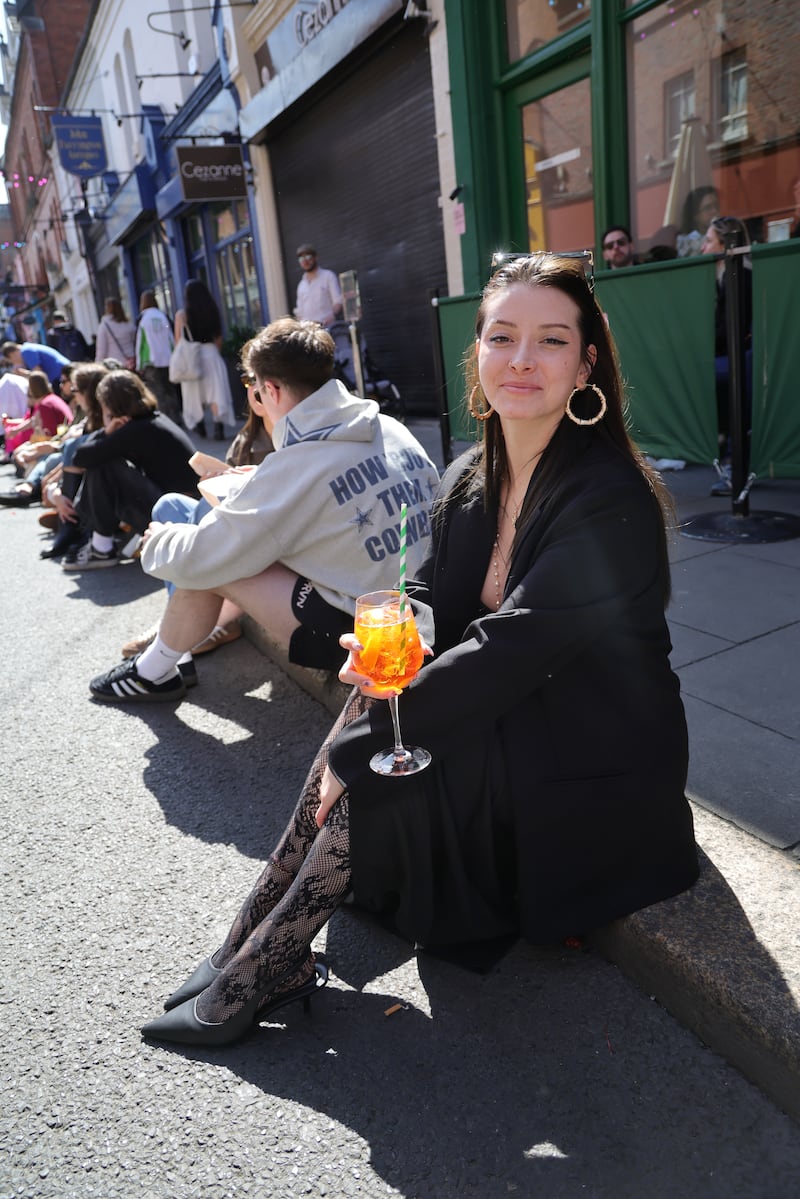
She would rather see Drury Street become a dining street than a commercial one.
“I think it’s just for drinking, just to try to enjoy a little bit of sun, because some of the places around [the street] are a bit more fancy to drink inside of the stores, [but] I think here is open to everyone,” she says.
“There are already streets that are commercial. So I think this place is just to relax.”
Other socialisers, such as Naoise Collins, who is also sitting on the pavement, thinks the mixed-use independent retail and dining is an attraction.
“I really like George’s Arcade and Silverworks [a jewellery workshop], there’s lots of different things to do and lots of small shops that you can pop into.”
According to Collins, who is in the city centre with her mother and sister, the culture of sitting on the pavement “attracted us to stay around for longer than we were planning to. We’re probably going to pop into more of the shops than we were planning to because we got some food and got to hang out.
“To sit and people-watch here is nicer than the likes of Temple Bar, which is a lot more condensed touristy stuff, whereas here it’s more independent shops that are nice to pop into.”
There is a small number of residential properties on Drury Street. One of the residents , Darragh*, has been living there since the mid-2000s, and says: “It was never a place where you would get a full eight hours of uninterrupted sleep.
“If I was looking for that I would have moved out years ago.”
Although the popularity of the street has been on the rise in the last five years, Darragh believes “people might be over-determining” Covid as a reason for that.
“I can feel sympathy for the young kids, because when I was their age, I was in a position where I could go out, get my own apartment and that’s not really an option for a lot of young people these days.
“They don’t have the kind of third space that many of my generation had access to. And then, socialising in Dublin, having pints in pubs, is tremendously expensive.”
He says he likes the vibrancy of the area, as well as looking outside his window and seeing happy socialisers.
“I was chatting to one of my neighbours last night and asking her perspective.
“She said that sometimes the sound can be a little bit annoying, but what else is there in Dublin city centre that serves as a space for young people? It can be annoying sometimes, but mostly it’s a good thing.”
[ All hell wouldn’t break loose if Irish people were allowed a few cans in the parkOpens in new window ]
Darragh also said antisocial behaviour is “very rare on the street”. He says: “I stopped some person from robbing somebody, but, you know, that person was clearly a thief and wasn’t part of the set who would be socialising on the street. That’s the only thing I saw.
“I mean, generally, people are very, very nice to each other on Drury Street,” he says, although he did add that drinkers could be more responsible by picking up their rubbish on the street.
“But that’s kind of Dublin City Council needs to put out more bins,” Darragh says.

On the parallel South William Street, Andrea Horan, owner of Tropical Popical nail salon, believes the council has a lot to do with how Drury Street became a congested hub of socialisation.
“South William Street used to be a hive of activity. Now – due to a number of issues, from semi-pedestrianisation to dereliction to vacancy to speculation about proposed hotels going in South William Street, and there’s loads of cultural spaces that used to be there and provided life on the street – that’s all gone,” she says.
“South William Street, even though it’s one street away from Drury Street, has taken a complete nosedive. Our street is dead, and that is an issue for us, I suppose, after hours, because the best way to have safety on the street is to have a noisy, active street.”
[ Letters: Ireland is not like other countries when it comes to public drinkingOpens in new window ]
She also feels there is an acute lack of spaces catering for young people in Dublin city centre.
“We’ve taken all the services that cater for these people who are trying to find their tribe. They’re young, and they’re gathering in a city that belongs to them, trying to find their own tribe, and a buzz in a city that is consistently pushing them out via price and via services.”
Horan believes an overlap of issues has led to the street becoming overrun with people to the point of dysfunction.
“We’re seeing the lack of planning, the lack of spaces, the lack of culture for young people, and the cost-of-living crisis, evidently, coalescing on this street, which is then having an adverse effect on businesses, which isn’t fair either.”
“A city needs to work for everyone, and it can’t just work for businesses. It has to work for people to gather and to live, but it does have to work for the businesses as well,” she says.
*Name has been changed