







In the last US Senate hearing before Kristi Noem’s ouster, some of the fiercest criticism the homeland security secretary received came not from outraged Democrats, but from an ally of Donald Trump.
“What we’ve seen is a disaster under your leadership, Ms Noem, disaster,” said Thom Tillis, the senior Republican senator from North Carolina, at the outset of a 10-minute skewering of the secretary he dubbed a “performance evaluation”.
Tillis has become known in Congress for giving people and policies he does not like such treatment in recent months, after he achieved something rare for Republicans: freedom from worrying about what Trump thinks of him.
After Tillis broke with the president on his marquee spending bill in 2025, Trump threatened to back a primary challenger to Tillis, and the senator quickly announced he would not seek re-election. Since then, he has adopted the persona of the Senate GOP’s internal critic, taking public issue with poor choices made by the Trump administration, though never the president himself.
“I’ve joked a number of times with people that say: ‘Well, you’re being more outspoken now that you’re not running.’ I use the line: ‘No shit, Sherlock,’” Tillis said.
“When I disagree, I disagree. Now I just have fewer constraints on the wordsmithing I have to do before I say something. That’s the reality of it.”
Tillis’s denunciations of administration officials he thinks should be fired and policies that should be dropped have put him firmly in the Senate’s small camp of Republican dissenters in recent months, alongside Alaska’s Lisa Murkowski and Maine’s Susan Collins.
He called for Noem’s resignation after immigration agents killed two US citizens in Minneapolis, then took her to task when she appeared before the judiciary committee on which he sits, just before Trump fired her. Tillis has been similarly critical of Stephen Miller, the powerful White House aide and architect of the president’s mass deportation campaign, and continues to block the nomination of Kevin Warsh, Trump’s pick to lead the Federal Reserve, because he objects to the justice department investigating the central bank’s current chair, Jerome Powell.
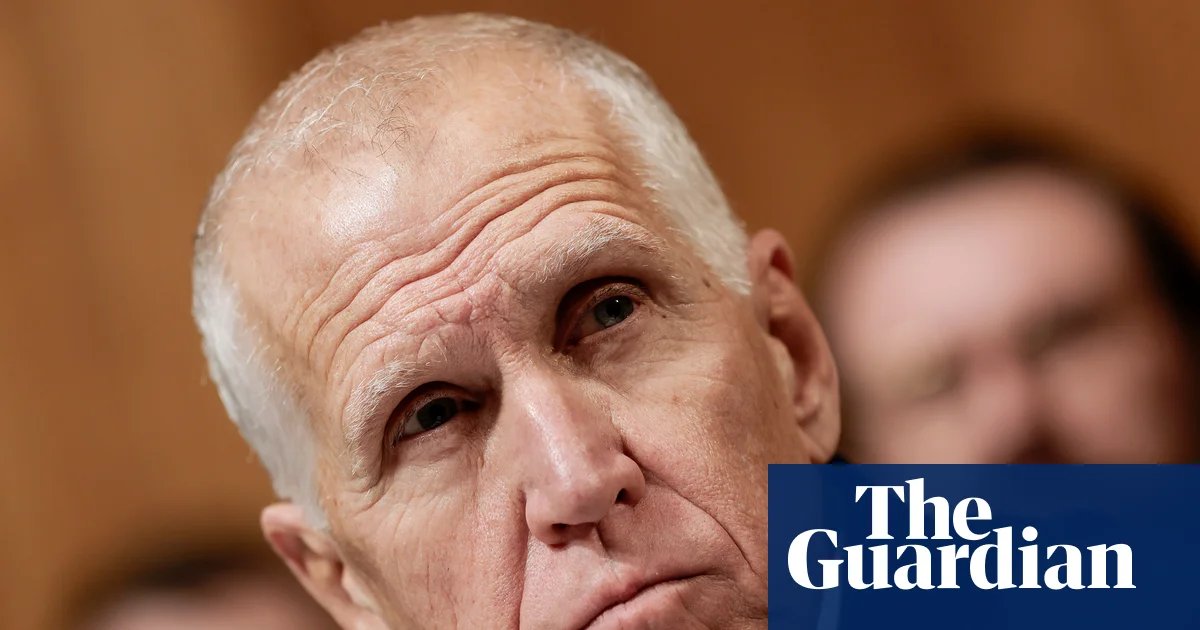
It’s all music to the ears of Senate Democrats, who are hoping to wield voter disenchantment with Trump to retake the chamber’s majority in the November midterm elections, and must win Tillis’s seat in North Carolina to be successful. But Tillis, a 65-year-old with a southern drawl, cropped gray hair and a fondness for bolo ties, has made clear that the point is to help Trump – not the opposition.
“I decided, by just making the decision not to run for re-election, I can speak truth to a president that I hope goes down in history as the most successful Republican president in the history of this country,” Tillis said on the Senate floor in January.
“He has that potential, if he starts to recognize advice that he’s getting that I think is bad advice and won’t age well.”
It’s a tough needle to thread in a Republican party where allegiance to Trump is mandatory to succeed, and the threat of presidential retaliation hangs over those who speak out. In interviews, advisers to the senator and observers of his career say a unique convergence of political factors has opened the way for Tillis to spend his final months in the Senate disagreeing, with little concern for the consequences.
“Get focused on fixing the problems – that’s always been Thom Tillis’s mantra,” said Paul Shumaker, his longtime political adviser. “He’s now able to be more vocal about it. He’s able to be more vocal about it because he doesn’t have to worry about the dynamics.”
A former management consultant who worked for IBM and PricewaterhouseCoopers, Tillis got his first taste of politics advocating for construction of a bicycle path in the Charlotte suburbs. He served on his town’s board of commissioners, then won election to the statehouse of representatives in 2006.
As the 2010 election neared, Tillis, then the minority whip, set his sights on an audacious goal: taking back control of the chamber from Democrats who had lost the majority only rarely in the prior century. He approached the problem like the consultant he once was, recalls Jordan Shaw, a former longtime aide to Tillis who is now a Republican strategist.
“The tool that he used was an Excel spreadsheet and a PowerPoint presentation, where he took candidates and donors through a very detailed data analysis he had done on each district and each candidate and each member and how much it would cost to take back the house,” Shaw said. “And he was right.”
A red wave crashed across the country that year, as voters turned on Barack Obama’s administration just two years after they swept him into the White House. In North Carolina, the Republican party won large majorities in the statehouse and senate, and Tillis became house speaker the following year. He brought the same data-driven approach to managing the legislature, debuting a coding system for bills that assigned them red, yellow or green labels based on their level of priority, and making staff and lawmakers wear wristbands that read “jobs and economy” to remind them of their priorities. If anyone was off message, Shaw recalled, he’d tell staff to snap the bands against their wrists.
But North Carolina Republicans did not confine their legislating to those two areas. Under Tillis, the party’s lawmakers passed a voter ID law that was at the time among the most restrictive in the country, among a host of reforms to voting that made it harder to cast ballots. They cut funding for education, tightened access to abortions, refused to expand Medicaid under Obamacare and redrew federal and state legislative district lines to cement the GOP’s hold on the legislature, which it still controls to this day.
“The fact of the matter is that he was the speaker of the state legislature at a time when North Carolina took a hard-right turn, became this sort of laboratory of conservative experimentation, broke from decades of bipartisan consensus, and … that’s still the central theme of our politics in the state today,” said Asher Hildebrand, a former Democratic congressional aide and campaign staffer for Obama who now teaches public policy at Duke University.
In 2014, Tillis challenged the state’s Democratic senator Kay Hagan, who was first elected in 2008, when Obama carried the state. On election night, Shumaker recalls telling Tillis that despite expectations in the press that Hagan would win, the data showed that he had the edge.
“You’re a data guy, I’m a data guy. Give me one speech, make it a victory speech,” Shumaker recalls Tillis saying to him. Having no concession speech ready was a risk, but it worked out: Tillis narrowly beat Hagan, and North Carolina has not elected a Democrat to the US Senate since.
Despite the conservative policies he pursued in the state legislature, Tillis gained a reputation as one of the more moderate members of the Republican conference in the US Senate, especially as the Trump era wound on and the party shifted further right.
It didn’t always work out. In 2019, he opposed Trump’s declaration of a national emergency to build a wall along the southern border, which would have diverted millions of dollars from construction projects on North Carolina military bases, then reversed himself weeks later.
Re-elected in 2020 after what was then one of the most expensive Senate races in US history, Tillis gained a reputation under Joe Biden as a Republican whom Democrats could work with. Despite being a major proponent of a 2012 constitutional amendment in North Carolina that banned same-sex marriage, he voted for the 2022 Respect for Marriage Act, which protected those same rights nationwide, a compromise bill to address gun violence and the Democratic president’s $1tn infrastructure bill. In 2023, the North Carolina GOP censured him for those votes.
How deep Tillis’s rebellious streak ran was not obvious at the outset of Trump’s second term. The senator supported all of his cabinet nominees, and only objected when the president tried to appoint Ed Martin, a defender of the January 6 insurrection, to lead the US attorney’s office in Washington DC.
But it was later that year, as the Senate was considering the One Big Beautiful Bill Act, Trump’s proposal to cut taxes while funding mass deportations and other administration priorities, that Tillis made his stand. To partially offset the bill’s costs, Republicans proposed historic cuts to Medicaid, which the senator announced he could not support.
On Truth Social, Trump quickly accused him of speaking out “in order to get some publicity for himself, for a possible, but very difficult re-election”, then insulted him: “Tillis is a talker and complainer, NOT A DOER!” The day after he came out against the bill, Tillis announced he would not seek a third term.
“What do I tell 663,000 people in two years or three years when President Trump breaks his promise by pushing them off of Medicaid because the funding is not there anymore, guys?” an exasperated Tillis later said on the Senate floor.
Reflecting on how his retirement took place, Tillis said it was Trump’s accusation of grandstanding that he could not tolerate.
“That comment alone was just like: I’m not gonna deal with this stuff,” he said. “But to be frank, and the president and I’ve talked about this, I was already moving that direction anyway. It just seemed like the time was right, given our differences.”
The closing lines of his retirement statement offered a hint of how he’d spend his final year-and-a-half in office: “I look forward to solely focusing on producing meaningful results without the distraction of raising money or campaigning for another election. I look forward to having the pure freedom to call the balls and strikes as I see fit and representing the great people of North Carolina to the best of my ability.”
The sort of umpiring the senator had in mind became clear in the months that followed. A member of the Senate banking committee, Tillis said he would not consider any replacement for Fed governor Lisa Cook, whom Trump tried to fire. Though Tillis has spoken approvingly of Warsh, he is holding up his nomination until the justice department ends its inquiry into Powell, a Republican Trump appointed during his first term, and whom Biden nominated for a second term.
And he’s grown outright vitriolic about Miller and Noem, accusing them of providing the sort of “bad advice” that leads Trump astray. For Miller, the outrage was Greenland and comments that the White House deputy chief of staff made that the autonomous territory of Denmark should “obviously” be part of the US.
“That’s stupid, too. And I’m sick of stupid,” he declared at the end of a lengthy floor speech in which he condemned Miller’s comment as both “absurd” and insulting to a Nato ally whose soldiers died alongside Americans in Afghanistan. More recently, he told CNN Miller was a “big problem” for the administration, and should be fired.
When Noem appeared before the Senate judiciary committee earlier this month, his criticism ranged not just from her handling of immigration enforcement – which in Tillis’s view had resulted in the wrongful arrests of too many US citizens – but also her handling of recovery efforts from Hurricane Helene in western North Carolina.
Perhaps, the senator wondered, her decision to kill a dog and goat, then write about it in her memoir, was a harbinger of the poor judgment she’d exhibit as homeland security secretary.
“You decided to kill that dog because you had not invested the appropriate time and training, and then you have the audacity to go into a book and say it’s a leadership lesson about tough choices,” Tillis said.
“At that same lunch hour, you killed a goat. You killed a goat because you said it was behaving badly. You are a farmer! You don’t castrate a goat; they behave badly. You should have probably done that before, but my point is, those are bad decisions made in the heat of the moment, not unlike what happened up in Minneapolis.”
Though his dissent from the administration has limits – Tillis, for instance, did not back any of the war powers resolutions seeking to terminate US hostilities with Iran or Venezuela – the outspokenness has earned him new respect from across the aisle.
“I am not at all surprised that he’s speaking out forcefully,” said Democratic senator Chris Coons, who co-chairs the Senate human rights caucus with Tillis and has worked with him on intellectual property issues.
“When he really went after Secretary Noem, it was clear that the foundation of it was his annoyance at her failure to deliver for the people of North Carolina.”
Tillis acknowledged that data is a driver of his recent discontent, particularly the evidence it provides that some of Trump’s policies are unpopular enough to risk blowing back on vulnerable Republicans. His turning on Noem came in tandem with a decline in Trump’s approval ratings on immigration, while the idea of seizing Greenland and the administration’s tariffs, which he also criticizes, are similarly unpopular.
“We’ve got to focus on the people’s concerns about items on the agenda right now that I think are just not resonating in some of these purple states. It’s that simple,” he said. “It’s a data thing to me. This is not an ideological thing.”
It may also be reflective of how his state has changed since Republicans ran rampant over Democrats 16 years ago. Though no Democratic presidential or Senate candidate has won in North Carolina since 2008, it remains a swing state of fast-growing suburbs filled with college-educated voters who may lean right on economic issues but have little interest in conservative social stances, said Morgan Jackson, a top Democratic strategist in the state.
“I think Tillis has moved away from culture issues largely for political expediency, not to offend those suburban voters that are growing rapidly in the state,” said Jackson, whohas advised Roy Cooper, the former governor running for Senate.
Had Tillis pursued re-election, he may have had problems with North Carolina’s Trump-supporting base. But Shumaker said he still would have been as outspoken as he is today, because his path to victory runs through the state’s large volume of unaffiliated voters.
“We had to have separation on certain issues, or you’re not going to win in North Carolina. That’s the dynamics of winning in North Carolina. So he is where’s he’s always been,” Shumaker said.
Cooper’s race against former Republican national committee chair Michael Whatley will be one of the most hard-fought Senate contests of the year, in conditions that may be the most favorable North Carolina Democrats have experienced since Obama was first elected. But though Tillis has said his goal is to see Republicans elected in swing states, Jackson said his statements could harm Whatley’s campaign, which has thus far focused on his allegiance to Trump and the expected benefits of the One Big Beautiful Bill Act.
“It sort of puts a D and an R on the same side against Whatley, and it undermines Whatley’s credibility when he’s out there championing what an amazing bill that was,” Jackson said.
As for what Tillis will say next, there’s no telling. One thing about him is certain: you will not see his name on a ballot again.
“Oh, yeah,” he replied with a laugh, when asked whether he was truly done with federal elected office. “100%.”