









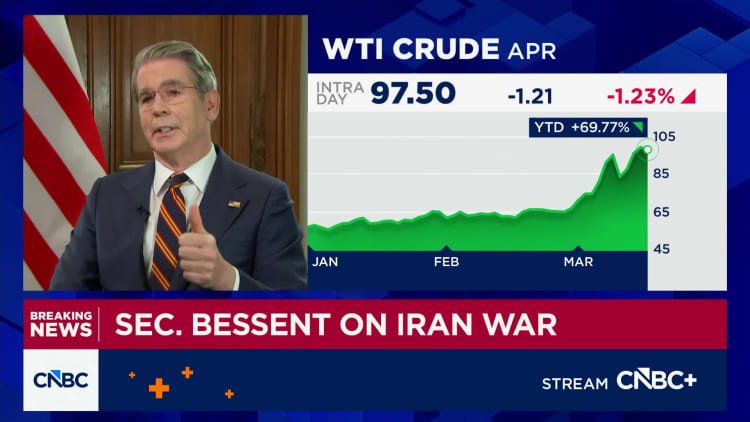

The United States is allowing Iranian oil tankers to transit the Strait of Hormuz, Treasury Secretary Scott Bessent told CNBC on Monday.
“The Iranian ships have been getting out already, and we’ve let that happen to supply the rest of the world,” Bessent told CNBC’s Brian Sullivan in a “Squawk Box” interview in Paris. The Treasury secretary is in France for trade talks with China.
Tanker traffic through the strait has plunged as Iran attacks commercial ships in the Persian Gulf. But the Islamic Republic has continued to export millions of barrels of oil through the narrow sea route despite the large U.S. Navy presence in the region. Iran exports about 1.5 million barrels per day.
The Trump administration believes tanker traffic through the strait will increase before U.S. Navy and allied forces start escorting commercial ships, Bessent said. Tankers that supply India have transited the strait, he said. The U.S. believes some Chinese ships are also making it out of the gulf, he said.
“We think that there will be a natural opening that the Iranians are letting out, and for now we’re fine with that. We want the world to be well supplied,” Bessent said. President Donald Trump is pressuring nations that rely on the strait for oil to help the U.S. protect tankers from attacks by Iran.
A ship loaded with liquefied petroleum gas arrived Sunday in India, a spokesperson for New Delhi’s Ministry of External Affairs told CNBC’s Seema Mody. A second ship is expected to arrive Tuesday, the spokesperson said.
Sources say India is currently waiting for confirmation from Iran that 22 other ships can sail through the Strait. Those vessels are carrying crude oil, liquefied petroleum gas, and liquefied natural gas.
The strait, which connects the gulf to the global market, is the most important trade route for oil in the world. About 20% of global oil supplies passed through the narrow waterway before the war.
Oil prices have surged about 40% since the U.S. and Israel attacked Iran two weeks ago. The war has triggered the largest oil supply disruption in history as exports through the strait have collapsed, according to the International Energy Agency. Global oil supplies are expected to plunge by 8 million barrels per day this month, according to the IEA.
Brent oil prices, the international benchmark, were hovering around $102 per barrel Monday. U.S. oil prices were trading around $95 per barrel.
The Treasury secretary said oil prices should fall “much lower” than $80 per barrel after the war is over. Bessent said he does not know when the war will end but “the world will be safer and we will be better supplied.”
Bessent threw cold water on market rumors that the administration might intervene in oil futures trading.
“We haven’t done that,” the Treasury secretary said. It is not clear what authority the U.S. could use to take such an action, he said.