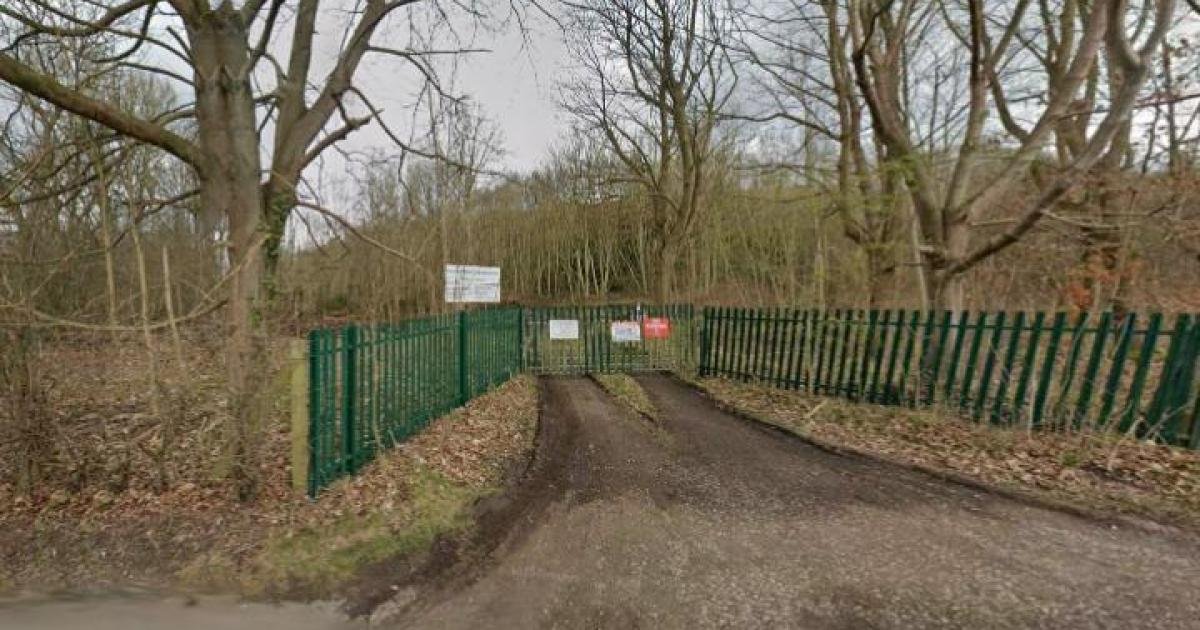
In July 2025, Green Earth Developments (GED) was granted planning permission on appeal to develop a solar farm on top of Tata Chemicals UK’s industrial landfill site, known as Wallerscote Lime Beds.
However, in order to do this, it says it must first dump the builders’ spoil to cap the Wallerscote Road site.
It claims this is to reduce the volume of rainwater seeping through the chemical waste and into the River Weaver.
GED is paid by housing developers to take the spoil, largely made up of soil and demolition materials, though it has consistently refused to disclose what proportion of its revenue comes from this cash stream.
By the firm’s own estimates, it will take around five years to import the spoil on 29-tonne tipper trucks at a rate of around 1,100 lorries every week.
Wallerscote Lime Beds contains a wide range of chemical waste products, many of which are harmful to humans, including asbestos.
For this and other reasons, when planning permission was granted, it included 41 conditions which GED must meet if it wants to proceed.
One of these, known as condition 15a, insists a ‘contamination remediation strategy’ be submitted to Cheshire West and Chester Council (CWAC) to be reviewed and signed off by its planning officers.
If the planners are satisfied the strategy is robust enough, condition 15a could be discharged.
GED has submitted details of its proposed contamination strategy to CWAC, but it has now hit a bump in the road.
The EA, which regulates the site and has a legal right to be consulted in the council’s decision-making process, has stated it is ‘unable to recommend the discharge of condition 15a’ on the basis of GED’s proposed anti-contamination strategy.
It says it would recommend a ‘significantly more intrusive approach’ to sampling the contents of the potentially hazardous chemical waste within the dump.
It also recommends an ‘iterative’ or ongoing approach to monitoring the site, as opposed to a one-time testing exercise.
An EA spokesman added: “We have reviewed the scheme and would advise the applicant (GED) the site must be sufficiently investigated to characterise and assess the future condition of the land such that it must not pose and adverse or unacceptable risk to controlled waters.
“The approach which has been put forwards appears to be acceptable in terms of scope, but we believe significantly more intrusive monitoring points are required to be added to the ground investigation work such that the entirety of the site and waste mass present is investigated, characterised and assessed.
“We additionally advise ground investigation, characterisation, and assessment is an iterative approach such that an initial phase of investigation may have to be complimented by others depending on what is found by way of contamination and potential risks.”
The council has not yet published its decision on GED’s proposed strategy, but as the EA is the issuing agency for Tata’s current licence to operate the site as a chemical waste dump, its recommendations are likely to be taken seriously.
In response to the EA’s recommendation, a spokesman for GED said: “We are committed to working closely with all competent authorities to progress these important works.”
Campaigners against the development have welcomed the recommendations and consider it a modest victory in the battle to stop the soil dumping.
After the EA’s recommendations were made public, Steve Jones, chairman of Toxic Free Tomorrow, said: “We’re not quite opening the champagne just yet, but it is definitely a step in the right direction.
“Our civil engineer, Barry Dixon, has done a huge amount of work on this, and we made his findings available to the Environment Agency.
“We are pleased they seem to be taking them seriously.
“We are also grateful to Winnington and Marbury councillors Felicity Davies, Arthur Neil, Lynne Gibbons, and Phil Marshall, who continue to ensure our concerns are heard by the planning officers.”