







Jones, M. W. et al. Global rise in forest fire emissions linked to climate change in the extratropics. Science 386, eadl5889 (2024).
Cunningham, C. X., Williamson, G. J. & Bowman, D. M. J. S. Increasing frequency and intensity of the most extreme wildfires on Earth. Nat. Ecol. Evol. 8, 1420–1425 (2024).
Cunningham, C. X. et al. Climate-linked escalation of societally disastrous wildfires. Science 390, 53–58 (2025).
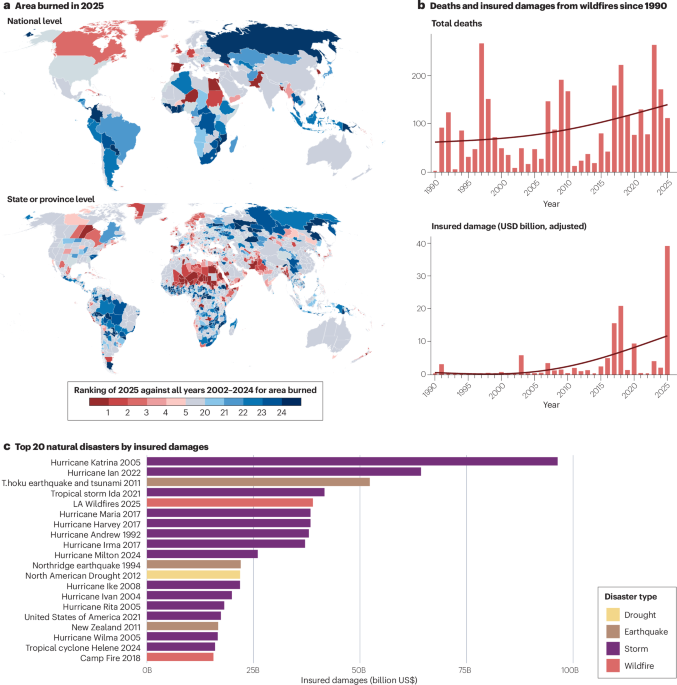
Teymoor Seydi, S. et al. Increasing global human exposure to wildland fires despite declining burned area. Science 389, 826–829 (2025).
Giglio, L., Boschetti, L., Roy, D. P., Humber, M. L. & Justice, C. O. The Collection 6 MODIS burned area mapping algorithm and product. Remote Sens. Environ. 217, 72–85 (2018).
van der Werf, G. R. et al. Landscape fire emissions from the 5th version of the Global Fire Emissions Database (GFED5). Sci Data 12, 1870 (2025).
Kelley, D. I. et al. State of wildfires 2024–2025. Earth Syst. Sci. Data 17, 5377–5488 (2025).
McNorton, J., Moreno, A., Turco, M., Keune, J. & Di Giuseppe, F. Hydroclimatic rebound drives extreme fire in California’s non‐forested ecosystems. Glob. Change Biol. 31, e70481 (2025).
Otto, F. et al. Unequal Evidence and Impacts, Limits to Adaptation: Extreme Weather in 2025. https://doi.org/10.25560/126543 (2025).
Beltrán-Marcos, D., Calvo, L. & Fernández-Guisuraga, J. M. Environmental drivers of burned area and fire severity during the 2025 extreme fire season in the NW Iberian Peninsula. Fire Ecol. 22, 27 (2026).