







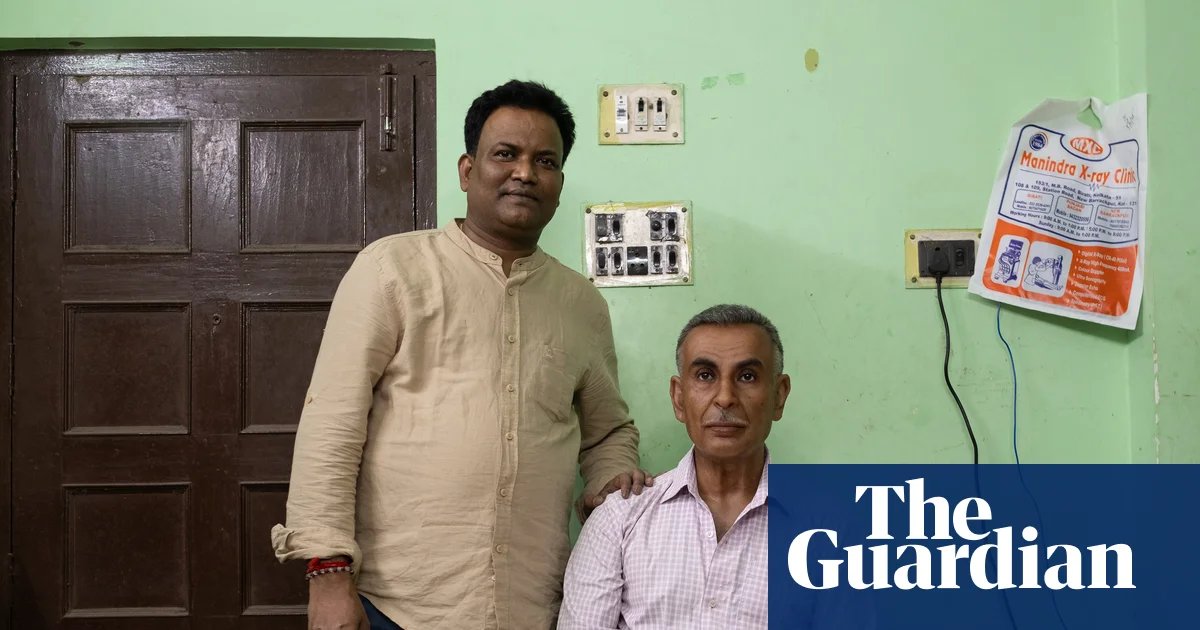
In the north of Kolkata, near Dum Dum Junction, Subimal Das and his staff of 80 work from an old factory-warehouse. Using clay, fibreglass and silicone, they construct extraordinary lifesize replicas of religious icons, cultural figures, cricketers and Bollywood stars.
But the workshop also has a popular new line: custom-made 30kg replicas of the dead, commissioned by family and loved ones.
Widows or widowers are the most common customers at Subi Creative House. They order their dead wife or husband by handing over a photograph to Das and his team. Several months later, they take the replica home.
Among the replicas in the workshop is Mr S Roy of Ranaghat, the city famous for its flowers, in West Bengal. He sits in a chair, dressed in checked shirt and slacks, ready for dispatch. Nearby is Mrs Parija, from the neighbouring state of Odisha. With short, silvery-grey hair and a red bindi, her head is complete but her body not yet fitted. Each figure costs about 2.5 lakh ($2,760). In 2025, customer Samit Kumar had his parents Arun and Hena made and then drove them in an open-top vintage car through a festival in Kolkata.
Das says his customers want to keep hold of their loved one in some way. For many, he says, it’s about managing death and loss. Often dressed in a favourite outfit or sari, the figures stand or sit in the home they once lived, in a familiar spot or chair.
“To the family, they are human – almost human,” Das says. “I tell them I can be as close as possible”. Das aims to make the figures “hyper-realistic”, and he uses real human hair. “They see how we have made [their mother], how she wears her special jewellery … her sari, and they see we have made the eyes perfect, and they and I get very emotional.”
Das studied art in Kolkata after growing up in regional West Bengal. He painted the old Kolkata trams before they were largely decommissioned, and worked in a museum making models. He started his workshop in 2013, crafting figures for festivals and events. But when Covid hit, ravaging India, requests for replicas of the dead rapidly flowed in.
The workshop’s creations, through a western lens, might seem unnerving or macabre, but Hindus typically share a complex understanding of death, the afterlife and memorialisation. Even within Hinduism there are many spectrums of belief and practice: broadly, death is only a period of time before life occurs again, so dying is not an ending.
This makes Das’s factory less strange wax museum – though it has its moments, such as the plastic-wrapped figures ready to be loaded into a customer’s car – and more a touching version of what the Hindi language calls ‘smaran’, or remembrance.
Tapas Sandilya, 67, lost his wife, Indrani, to Covid in 2021. Ten years earlier, they had seen a silicone statue of a renowned Hare Krishna leader in a temple. Sandilya says Indrani loved it. “She said ‘if I die before you, I would like you to have one, like this, of me,’” he says. “We were married for 39 years. I was devastated to lose her and wanted her wish to be made in this way, but it had to be perfect.”
Sandilya, who has begun making silicone models of objects himself, says the model of his wife gives him a sense of calm and “continued togetherness”.
Das’s busy workshop is a dark and noisy space. In a corner, two young workers use their feet to make clay. A huge caveman – for a museum display on prehistoric life – looms over cluttered replicas and moulds of famous Indians, holy men and spirit animals.
Outside is the factory’s tip where used pieces of fibreglass cows, horses and goats are discarded. In a storeroom out back, 1960s Bollywood star Suchitra Sen and the Hindu saint Acharya Srimat Swami Pranavananda Maharaj are kept. Two years ago, workers made a version of the famous West Bengali artist Reba Pal, who is still alive, for a festival. But it is now back at the factory for safekeeping.
Das says his team has made 50 lifesize Narendra Modis, “and of course Virat Kohli” the cricket legend. As for others, the list is long and only limited by one’s imagination. “We have made Gandhi, [Rabindranath] Tagore and Mother Teresa.” Footballers Pelé and Lionel Messi have also been immortalised in silicone, Das says.