




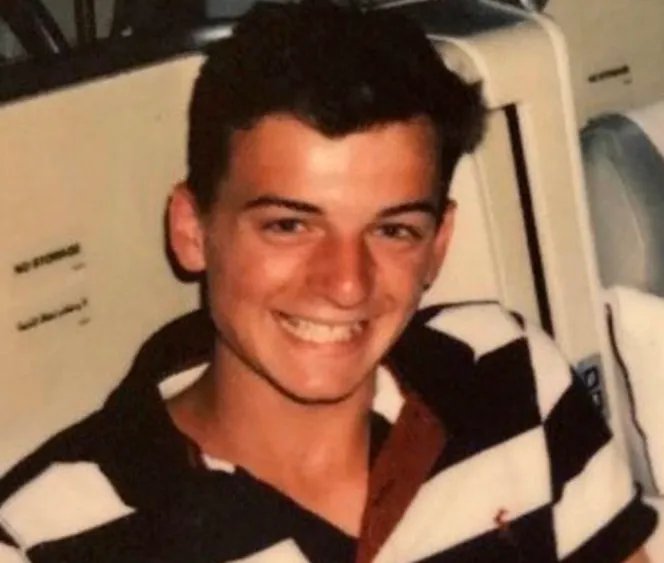
It was a bleak January evening in 2018 and Ben West was packing his bag for school the following day when suddenly he heard his mother scream. The sound was unlike anything the 17-year-old had heard before — it seemed to penetrate his entire body — and his first thought was that she had somehow seriously injured herself. He raced to the source and found his mother in the bedroom of his 15-year-old brother, Sam. After a few seconds trying to make sense of what he was seeing, he was able to process the reality: Sam had attempted to take his own life and was entirely unresponsive.

West remembers what happened next in disordered snatches, some moments hypervivid, others dreamlike. He knows he picked up his brother and then laid him on the floor to begin CPR, while his mother called an ambulance and then began to hyperventilate. Because they lived in a farmhouse in rural Kent, it took the emergency services 20 minutes to arrive, during which time West continued to administer CPR and reassure his mother that it would all be OK, even though Sam’s lips had turned blue. When the first paramedics burst into the house, he remembers putting his youngest brother, Tom, in front of SpongeBob SquarePants, before drifting outside and vomiting in a flower bed.
By this point, more emergency vehicles had arrived and more people were rushing out of them to the urgent crackle of radio chatter. Suddenly, everything made sense. West realised, with a rush of relief, that he was dreaming. “I thought, this isn’t real and I’m going to prove it,” he remembers. He took a photograph on his phone of the chaos outside his house. All he had to do was look at his phone the following morning and the photo wouldn’t exist. “The first thing I did the next day was check my phone. It was still there.” He walked downstairs to find his mother, father and the family GP waiting for him. They explained that Sam was dead. “And that was the first day of the rest of my life.”
I meet West in a café near Waterloo station in London. He explains that he had hoped to become an army helicopter pilot, and went to university to study engineering. Instead, the trauma of losing Sam profoundly rerouted him. He had already thrown himself into campaigning in the aftermath of his brother’s death, leading workshops, giving talks, spearheading campaigns, working with government to try to improve education and support for people struggling with their mental health. But he came to the realisation that this is what he should do full-time. “I decided I was going to come out of university and do this for the rest of my life.”
West is articulate and good-humoured. But he also has a weary, gently careworn air you don’t find in most 25-year-olds. According to the Office for National Statistics, 6,190 people killed themselves in England and Wales in 2024, around 75 per cent of whom were male. And since 2007, the suicide rate has been gradually increasing. These are the trends and numbers that West has set himself against. “I’m well aware that by choosing to do this I’m choosing to suffer and struggle,” he says without self-pity. “And it’s exhausting in a way that a lot of other work isn’t.”
‘The feeling of being cared for can really help’
In January, West helped launch a suicide prevention project called Reasons to Stay. Its premise is simple. People who are in crisis and struggling with suicidal thoughts can visit its website and read randomly selected letters of support, submitted by members of the public, gently urging them to take a moment, to understand that their presence in this world matters, to see that they don’t have to be strong and that there are people out there who have been through similar moments themselves. These letters — and the messages of hope and encouragement they contain — are “designed to interrupt the suicidal thinking” of the individual in crisis. “Because that feeling of being cared for by someone can really help.”
Uptake has already exceeded West’s wildest expectations. After the first month, he says tens of thousands of letters were submitted and have been read over two million times around the world. Already he has received emails from people who say it stopped them from seeing through a suicide attempt. “One person said it was the difference between calling an ambulance or not. They were in a desperate place and needed urgent medical help. They read a letter and decided they would call an ambulance,” says West. “It’s one of those Sliding Doors moments. If they hadn’t read that letter, they could have died.”
One of the letters from Reasons to Stay:
Hi there,
I know things feel heavy right now, but you matter. Take a deep breath, hold on and remember: just taking it one step at a time can carry you through today. It can really help to break things up into tiny steps. If you’re struggling to get up or go outside, what’s the first step you’d need to take to go out? Maybe it’s opening the curtains and putting on some shoes. Then what’s the first step you need to take to do that? Tiny little steps, big wins. I once was where you are now, so I know that it is possible to feel joy again. Thank you for being a part of this world.
John
West explains that, while anyone can submit a letter online, the content of everything is checked by a team of clinical professionals to make sure that no harm is inadvertently done. For example, it can be dangerous to make references to specific methods of taking one’s life. “Talking about the means of suicide, however well intentioned, could be very triggering for someone who is vulnerable in that moment.” Similarly, writing well-meaning but platitudinous words of encouragement — “Everything will be fine” — can often seem dismissive, and may be removed or reworded by the clinical team before publication online.
This need for nuance and a practical understanding of how to engage with people who may be depressed or suicidal speaks to a broader observation that West makes. As a society, he says, we have never been more aware of the concept of “mental health”. It is an obvious and uncontroversial thing for royals, celebrities and politicians to make solemn reference to. We all know that it’s important. But to many people in Britain, it remains a fuzzy concept, desperately short on specifics. “Awareness has never been greater, but understanding is still very limited,” says West. “It’s so surface level.”
A case in point: when the Prince of Wales talked recently of his need to wait until he was in a “calm state” before watching the film Hamnet, with its theme of child loss, it was widely lauded as another example of him talking about his mental health. But there is a huge difference between celebrating the father of young children not leaping at the chance to watch something about a young child dying, and being well informed about the nature of depression, suicide and the help you may be able to offer those in need. As West says, we have never been more aware of mental health in the abstract, but we are still four times more likely to take our own lives than die in a road traffic accident. So awareness alone is clearly not enough.

“The frustration is that ‘mental health’ has become an umbrella term for a vast number of issues,” says West. We should not be surprised, he continues, that so many people today are self-diagnosing their own mental health conditions. “We’ve spent 15 years telling people they should talk about how they’re feeling, and saying that we should have more campaigns around mental health awareness,” he says. But what we haven’t done is increase clinical capacity. “What we’ve done is encourage people to seek help that doesn’t really exist. So we’ve engineered our own problem by doing the easy bit but not the hard bit.”
One of the letters from Reasons to Stay:
Hi stranger
I’m really glad you’re reading this. I’m so sorry that life feels so heavy right now. Feeling this much pain or loneliness can be exhausting, and it isn’t your fault. Even as a stranger, I want you to know you matter. You’re not invisible. If I could, I’d sit with you for a moment. Not to fix things, no questions… I’d just be there. I won’t pretend to know how this feels for you. I only know that moments can shift, sometimes when we least expect it. Not all at once, just enough to breathe a little easier. For now, it’s OK to hold on to whatever brings even the smallest bit of comfort. That’s enough. You’re enough. You’re not alone in this moment. I’m really glad you’re here.
Adele
It is clear that much of West’s desire to educate people about the reality of suicide, and the ways it may be prevented, stems from his own confusion and lack of understanding around Sam’s death. His younger brother had been diagnosed with clinical depression a few months before he took his own life, but when West’s mother quietly explained this to Ben, he did not understand the full implications of what this might mean for Sam. And as Sam withdrew and ceased to be the charming, infectiously funny boy he had grown up with, rather than feel concern, West was upset and resentful. “Suddenly he was this guy who didn’t look us in the eye, didn’t want to be around us, was embarrassed of us,” he says. “How can you be so funny at school with all your friends and then come back here and be such an arsehole?”
‘I was convinced it was my fault’
On the night Sam took his own life, West had argued with him and shouted, “F*** off” when his younger brother left the dinner table and went to his room. “That was the last thing I ever said to him.” Later, West convinced himself that it was these words that caused Sam’s death and struggled badly with feelings of guilt and shame. “I was so convinced it was my fault,” he says. Now he understands — and spends a lot of time trying to explain to people — that there is never a single reason or factor that causes someone to take their own life. He admits that he often wishes that there were, if only so that he could better make sense of why Sam killed himself. “I would absolutely love it if there was a single, obvious cause,” he says, smiling bitterly. “I’ve spent years asking, ‘Why?’ and it’s just crushing. So that would have saved me a lot of wondering.”
Another common misconception he encounters and tries to correct is that, if someone really wants to die, there is very little that can be done to stop them. “But you can be suicidal and not want to die. And that’s one of the biggest things that people don’t quite understand. You don’t necessarily want to die. You just want whatever’s going on to stop, and dying is the only way to stop it.”
There is another popular notion that, because men are so overrepresented in suicide statistics, that they are “not talking” about their mental health or seeking professional support. “But we know from researchers that this isn’t a full picture of what’s going on,” he says. “A lot of men will have the first conversation, get referred and then won’t attend. So the ‘Did not attend’ rate is much higher among men, as is the dropout rate from treatment. And obviously, if you drop out early, then you’re not going to get the full benefit.”
One of the things that strikes you when listening to West talk about his work and his experiences is that so much of increasingly ambient “mental health awareness” discourse encourages an intense focus on yourself and your own feelings. But knowing how to best engage with the mental health of others is just as important. The dangerous temptation, when someone is struggling, is to try to tell them what to do: go for a run, see some friends, get out of the house. “But what people need when they’re in that moment of depression is not someone to come in and take control away from them by saying, ‘Do this. Do that,’ ” he says. “What you’re qualified to do is be whoever you are to them. So if you’re their friend, be their friend. If you’re their mum, be their mum. If you’re their brother, be their brother. Connection is the most important thing.”
Men are underrepresented on the site
He pauses, then describes how, shortly before Sam’s death, he collected his brother from school in the car and they drove home in total silence. He replays the journey in his mind often. “If I could go back, I would say that I have no idea what you’re going through, but I want you to know that I love you and I’m so proud of you and I’m here to help however I can. If you have questions, let’s get the laptop out and google them together. If you want to speak to a GP, I’ll drive you there and sit in the waiting room,” he says. “So your role doesn’t become, ‘How do we fix this situation?’, it becomes, ‘How do we make sure that the process of finding a solution is as easy as possible?’ ”

He says that, for all the impact he believes Reasons to Stay is having, men are still underrepresented on the site. The majority of the letters that have been submitted come from women, but he believes there is something particularly impactful for men about seeing words of encouragement and hope from other men who have come close to the edge but pulled back. He admits working on the project continues to be “bittersweet” because he can’t help wondering whether, if a similar resource had existed eight years ago, his younger brother might have found it and still be here.
For a long time after his death, says West, he was angry with Sam. “I didn’t like him. ‘Look what he did to our family!’ sort of thing. His whole life was defined by death. It was the only thing you remembered about him,” he says. But the more he has learnt about the reality of depression and suicide, the more empathy has replaced his anger. He says that, for all the horror of that gloomy January night, he takes a strange comfort from the final moments they had together while he was performing CPR. “I did everything I could physically do to try to bring him back to life. And I don’t think there’s anything more loving. I reflect on that a lot, whenever I question how much I loved Sam. If there had been a way of breathing my life into him at that moment, I would have done it without a single question.”
Now, he says, he feels remarkably close to his brother. “He’s still so involved in my life. In a weird way, I feel like he’s with me. Every morning, when I log into my computer, I’m doing the work that he’d want me to do,” he says. “And I think there’s something very special in that.”