









Beaver wetland water balance
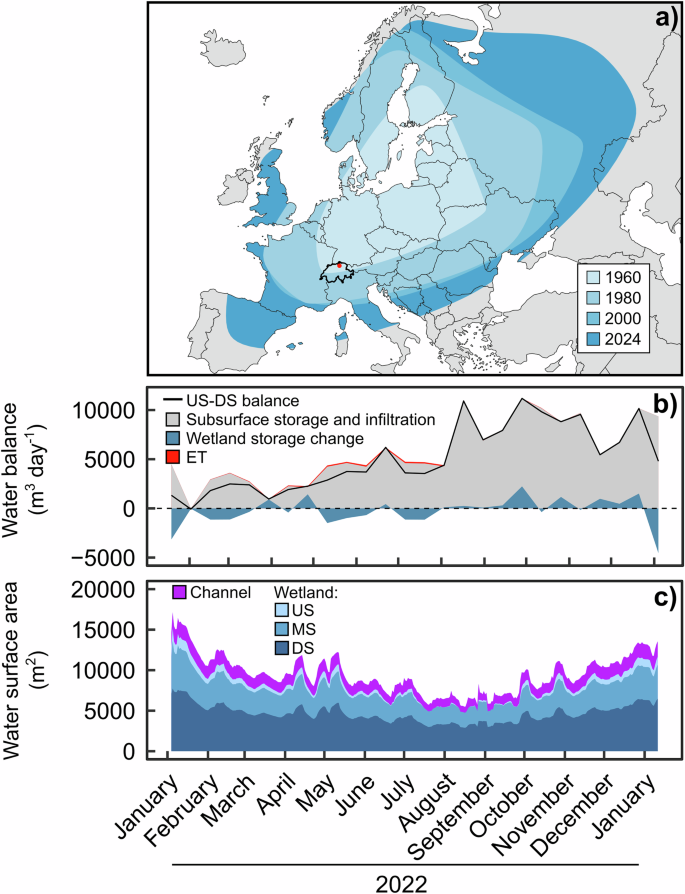
A key control on aquatic mass fluxes and wetland extent is the reach-scale water balance. The distinct seasonal regime of the hydrology in the beaver wetland followed a cycle of peak water extent (January–April), followed by substantial subsurface losses (April–August), and then a gradual return to greater water extent (August–January; Fig. 1b). Along the 800 m beaver-impacted stream reach, we observed substantial and seasonally variable water losses between upstream and downstream, amounting to ~40% of annual inflowing discharge (Fig. 1b; Supplementary Fig. 1), which is consistent with annual water losses of 20–40% over similar distances in other beaver-modified systems11,12,13. Yet, we note a greater uncertainty in water balance estimates during higher discharges ( > 0.5 m3 s-1 at upstream); 11% and 14% of cumulative discharge in upstream and downstream rating curves, respectively, were extrapolated beyond the measured discharge range. Given the magnitude of the observed losses relative to the entire wetland surface area (3.6 ha), they cannot be explained by wetland storage and evapotranspiration alone and are instead primarily attributed to subsurface losses (Supplementary Text 1). The estimated average loss rate of 0.13 m day-1 is high for wetland systems, but physically plausible given the permeable gravel substrate14 and the elevated hydraulic gradients created by the impoundment15. Whilst this estimate is informative as a wetland average, in accordance with many dynamic wetland systems, the actual water losses are likely distributed across a wider range of lateral subsurface pathways that may extend well beyond the visible inundation boundary. These transient hydrological expansions activate lateral seepage and storage processes and could partially subsidise evapotranspiration in the surrounding forest.

a Study site location in northern Switzerland (red point) and observed range of Eurasian beaver habitats in Europe from 1960 to 2024, based on data from the GBIF Backbone Taxonomy dataset (https://doi.org/10.15468/39omei, accessed via GBIF.org on 2024-12-11). b Fortnightly water balance between upstream (US) and downstream (DS) locations. The water balance is partitioned into subsurface storage and infiltration, wetland surface storage change, and evapotranspiration (ET). Positive values denote water losses along the reach. c Daily water surface area in channel, upstream (US), midstream (MS), and downstream (DS) sections of the wetland.
Annual carbon budget of the beaver wetland
Hydrological transformation by beaver activity has profoundly restructured C cycling across the 800 m reach, resulting in a net annual C sink of 98.3 ± 34.4 t C yr-1, equivalent to 26% of total inputs (Table 1; Fig. 2a). In mass flux terms, this sink was dominated by the subsurface retention of DIC, accounting for more than half of all retained fluvial C, with additional contributions from particulate organic carbon (POC) burial (18%), and minor removal of dissolved organic carbon (DOC) (5%). While DOC accounted for a small fraction of total mass flux retention, actual concentrations consistently increased downstream, indicating net production within the wetland despite limited seasonal variation (Supplementary Fig. 2a). In contrast, carbon dioxide (CO2) emissions from exposed sediments were the largest single C loss, though they did not offset the retained fluxes (Fig. 2a).

a Annual dynamics of daily C mass balance revealed seasonal shifts between sink-source behaviour in the beaver wetland, primarily driven by DIC retention and CO2-C emissions. The total C mass balance consists of changes in fluvial DOC, POC, and DIC loads between upstream and downstream locations; emissions of CO2-C from permanently and intermittently inundated sediments, downstream channel water surface, and deadwood in the studied beaver wetland; C in assimilated aquatic biomass. CH4-C emissions are not shown due to their negligible impact on the budget. Positive values denote C accumulation (C sink). Total emissions of b CO2-C and c) CH4-C from exposed sediments (Sediment), wetland and downstream channel water (Water), and deadwood, across the entire beaver wetland. P-values of ANOVA tests and letters of Tukey’s post-hoc tests are shown within panels.
Carbon fluxes other than DOC exhibited strong spatial and seasonal variation, governed largely by dynamic shifts in surface water extent. During spring and early autumn (spring: March–May; summer: June–August; autumn: September–November; winter: December–February), greater inundation expanded the aquatic-terrestrial interface, enhancing subsurface DIC retention and diminishing the extent of aerobic CO2 production. Although biological activity in the wetland seasonally altered DIC concentrations, there was overall a net balance between uptake/precipitation and dissolution/biogenic production of DIC (Supplementary Fig. 2b). As water levels receded in summer, increased exposure of wetland sediments enhanced CO2 emissions, accounting for 93% of total gaseous C losses, while emissions from wetland water and deadwood remained low (Fig. 2b). Although DIC reductions scaled with CO2 emissions from exposed sediments, CO2 emissions peaked prior to the elevated DIC load reductions in autumn. Substantial outgassing of DIC as CO2 was unlikely, as water CO2 emissions were much lower than DIC losses, and the pH range in channel and wetland water (6.65 – 8.59) favoured the consistent dominance of bicarbonate. Thus, the large reach-scale reduction in DIC loads implies that C budgets from previous studies, which did not explicitly couple the C budget and water balance, may underestimate total C retention in active beaver stream corridors8,16. Notably, excluding DIC reductions (122 ± 32 t C yr-1) would shift the system from a net sink to a slight net C source. The DIC sink response was neither strongly impacted by discharge extrapolation beyond the measured range; when excluding DIC load changes for days with discharge estimates exceeding the measured range from salt additions (36 days), the resulting DIC reduction was 103 t C yr-1. Reductions in POC were inferred from modelled sediment deposition rates (Supplementary Text 4) and represent a more uncertain component of the budget. However, the sediment trapping efficiency and reach geometry imply that downstream POC export is likely low relative to deposition.
The average CO2-C fluxes from the beaver wetland did not differ from reference sites in the adjacent forest and upstream channel (t-test: p = 0.30). However, fluxes were redistributed across different ecosystem interfaces, wherein CO2-C fluxes from exposed wetland sediments were higher than from forest soils, and from wetland water and deadwood were lower than the upstream channel and forest deadwood (Supplementary Fig. 3). This supports the interpretation that the wetland’s net CO2 flux was primarily driven by respiration in exposed sediments rather than by aquatic outgassing. Methane (CH4) emissions were elevated over permanently inundated wetland zones, but CH4-C emissions were negligible compared to the annual C balance ( < 0.1%; Fig. 2c). Further, CH4 contributed only ~1% of the system’s global warming potential, based on CO2 equivalent calculations17, confirming that CO2 was by far the dominant GHG. As a whole, the seasonally variable wetland area regulated both C retention and gaseous emissions by modulating hydrological connectivity, vegetation dynamics, and redox conditions.
Beaver-mediated sediment carbon burial and its implications for long-term sequestration
Sediment analyses showed that the beaver-created wetland substantially increased organic (1.5–8.1 times) and inorganic C contents (2.1–14.9 times), compared to adjacent forest soils or pre-beaver floodplain sediments, using a space-for-time approach (Fig. 3a). Both organic and inorganic C content in sediments were highest in permanently inundated areas, reflecting a compositional enrichment that likely results from reduced decomposition rates under anaerobic conditions and the accumulation of inorganic C through microbially mediated DIC precipitation. However, these sediments also showed a greater sensitivity to C mineralisation, reflected in the elevated C reactivity ratios (Fig. 3b). Despite this higher reactivity, both intermittently and permanently inundated wetland sediments exhibited relatively high proportions of stable C fractions (recalcitrant organic C and inorganic C content), indicating strong potential for long-term sequestration.

a Mean C content of pyrolysable organic C (PC), recalcitrant organic C (RC), and total inorganic C (TIC), in forest soils (F), floodplain sediments pre-beaver introduction (Bpre), intermittently inundated beaver wetland sediments (Binter), and permanently inundated beaver wetland sediments (Bperm). b C reactivity ratio representing organic C stabilisation with lower values. I-index = preservation of PC and R-index = contribution of RC in sediments. Sediment and soil interfaces were compared using a one-way ANOVA with Tukey’s post-hoc test, with letters indicating which interfaces are statistically different from one another (p < 0.05). c Projection of cumulative C mass storage of sediment and deadwood C fractions throughout beaver dam construction, complete sediment infilling of wetland, and stabilisation of C storage.
Deadwood storage, accounting for ~45% of the cumulative C storage (2010–2022), originated from a mixed riparian forest inundated following beaver dam construction. This represents a direct transformation of terrestrial biomass into longer lived aquatic and sedimentary C pools, and is likely to be a substantial though variable component of C storage in many beaver-impacted reaches. To contextualise these cumulative stores, we estimate an average annual sequestration rate of 46 t C yr-1, based on 13 years of cumulative C storage, but excluding the deadwood inputs (Table 1). This is notably lower than the independently derived net C balance of 98.3 ± 34.4 t C yr-1 based on annual gaseous and dissolved fluxes, yet consistent with the expectation that only a fraction of the large annual subsurface DIC losses is retained in the wetland as long-term storages through biogeochemical uptake and precipitation14. The fate of DIC entering groundwater remains largely unknown; infiltrated DIC may be conservatively stored in groundwater (decades to centuries), sequester as carbonates, but also propagate into C emissions through surface water18,19.
Projected forward, the combined storage in sediment and deadwood suggests the system could accumulate 1194 t C (10.1 t C ha-1 yr-1) over its estimated active lifespan of ~33 years as actively maintained beaver habitat (Fig. 3c), representing an upper estimate after which the wetland is estimated to approach complete infilling and restrict beaver activity along the reach (Supplementary Text 4). This marks a key transition from annually dynamic, water-coupled C fluxes to long-term burial and stabilisation, establishing the beaver-modified stream corridor as a persistent C sink. Over time, the proportion of labile C will decline through mineralisation, transitioning toward more recalcitrant and stable forms. This eventual compositional shift may ultimately lead to a stable state in long-term C storage, although the timing of this transition remains uncertain.
To benchmark the annual and long-term net C sink in the present beaver-modified system (Table 1), we constructed a counterfactual scenario representing the same stream corridor without beaver modification, combining empirical measurements from the present beaver-influenced system with physiologically and hydrologically constrained estimates of the same reach in its pre-beaver state (Fig. 4). In this scenario, flow would remain largely confined to the active channel, with minimal overbank inundation, negligible hydrological losses, and forested riparian soils (Supplementary Table 1; Supplementary Text 8). Under these conditions, analogous to other temperate headwaters over short distances ( ~ 800 m), C inputs would be limited to forest biomass growth (22.4 t C yr-1), accumulation of coarse woody debris (3.2 t C yr-1), and minor aquatic primary production (0.4 t C yr-1). In contrast to the beaver system’s annual net sink, the counterfactual scenario behaves only as a modest C sink (0.5 ± 1.9 t C yr-1; Supplementary Table 1), in accordance with previous findings from stream-floodplain systems20. When comparing the long-term C sequestration projections, it is evident that beaver-induced hydrological restructuring substantially alters the C storage potential in headwater stream corridors, enhancing C sequestration by approximately two orders of magnitude. By contrast, without such restructuring, these opportunities for seasonal C retention and long-term sequestration remain fundamentally limited.

Black arrows show solute C pathways, white arrow shows POC deposition, and yellow arrow shows deadwood deposition. Gaseous C emissions are shown as blue (water), orange (sediment/soil), and photosynthetic assimilation is shown as green arrows. Values denote t C yr-1 ± one standard deviation.
When extrapolating the estimated long-term C burial rate (Fig. 3c) across all floodplain areas in Switzerland suitable for beaver recolonisation, beaver-driven C burial could offset approximately 1.2–1.8% of the country’s annual C emissions21, achieved solely through a nature-based solution requiring no active management or direct costs (Supplementary Text 9). By comparison, this represents only 2.4–3.6%22 of Switzerland’s total forest area yet contributes an estimated 5–8%22 of the national forest C sink, underscoring the disproportionately high per-area C storage efficiency of beaver-modified floodplains. Here, long-term C burial rate was chosen as the appropriate comparison with national inventories as it represents the net sequestration over decadal to centennial scales, as opposed to the short-term annual cycling.
Regional implications of beaver impacts on the C cycle
The beaver-driven restructuring of subsurface hydrology and riparian connectivity accelerated C cycling across aquatic, terrestrial, and atmospheric interfaces, resulting in a C sink response rarely observed over stream reaches of similar length. This highlights a largely untapped potential to increase C retention in headwaters, where beavers transform stream corridors from passive systems into active control points for C cycling and burial. The beaver-impacted reach in this study is representative of semi-confined river valleys in a temperate continental climate, with the exception of its underlying Rhine gravels that likely enhance subsurface losses. Yet, our estimated stabilised sediment TOC storage (98 t ha-1) was an order of magnitude lower than North American beaver systems (1150–1400 t ha-1)9. Although this difference is likely attributed to lower upstream inputs of TOC, it may also partly reflect the higher sampling intensity and spatial resolution in our study, which captured a greater spatial heterogeneity and included more low-density zones, resulting in lower overall bulk density and therefore C content estimates. A similar pattern emerges for GHG fluxes, whereby our estimates (1.2 mg CO2-C m-2 day-1; 0.09 mg CH4-C m-2 day-1) were substantially lower than fluxes from North American beaver systems (4.9 mg CO2-C m-2 day-1; 0.22 mg CH4-C m-2 day-1)8. Prior GHG measurements have typically focused on boreal, peat-rich environments, where freeze-thaw cycles intensify organic matter mineralisation23. Our study site’s absence of these processes, along with non-peat substrates and presence of alternative electron acceptors (N, Fe, and SO42-) that outcompete methanogenesis, likely explains these lower emissions and strongly suggests current global estimates of GHG fluxes from beaver wetlands may overestimate emissions by excluding more temperate and European regions8. Ebullitive CH4 fluxes was not captured with our monitoring approach, a pathway that can account for up to 70% of total CH4 emissions in wetlands24,25. Yet, even if inferring a 70% fraction of ebullitive fluxes in the present study, total CH4 emissions would still account for <0.5% of the total C mass balance. Thus, the lower organic C sediment and soil contents in the studied ecosystem and upstream contributing area may lower both magnitudes in TOC deposition and C emissions, compared to boreal systems. To refine regional and global assessments, along with future projections of beaver-mediated C cycling, greatly expanded monitoring of temperate European stream corridors is needed26.
Despite uncertainties, the capacity for sediment burial to offset and exceed gaseous C emissions underscores the role of beavers as natural agents for buffering climate change. In comparative terms, our sediment TOC accumulation estimate is more than an order of magnitude higher than targeted C sequestration in agricultural soils from temperate regions27,28. Nonetheless, these beaver-mediated C sinks remain spatially and temporally constrained, limited to headwater stream corridors susceptible to dam construction29 and dependent on relatively short occupation timespans (1–20 years)7. Moreover, dam failure may result in rapid mobilisation and downstream export of deposited sediments, resulting in substantially lower sediment C storages upstream of the breached dam30,31. Erosion of large sediment C stores following dam failure often results in local displacement sediments further downstream, maintaining C storages on a regional scale30. Thus, our projected C storages in the studied beaver wetland are contingent on the system being maintained across 33 years. Yet, we chose to not include dam breaching as a scenario in our C budget estimates, given the stable conditions with intact dam integrity over 13 years, and unknown frequencies and magnitudes of dam failure. Although C deposits generated from beaver activity can persist over millennia32, their stability, especially of inorganic C, remains uncertain following infilling and meadow succession. Moreover, behavioural unpredictability and limited control over site persistence pose challenges for beaver management, contrasting with the greater predictability of engineered stream solutions. The resurgence of beavers at a continental scale provides a timely motivation for understanding both active and legacy beaver impacts on stream corridors, which is essential to fully characterise their impact on aquatic-terrestrial C cycling.