








India’s largest online youth movement has just had its first go at taking things out of reels and into real life.
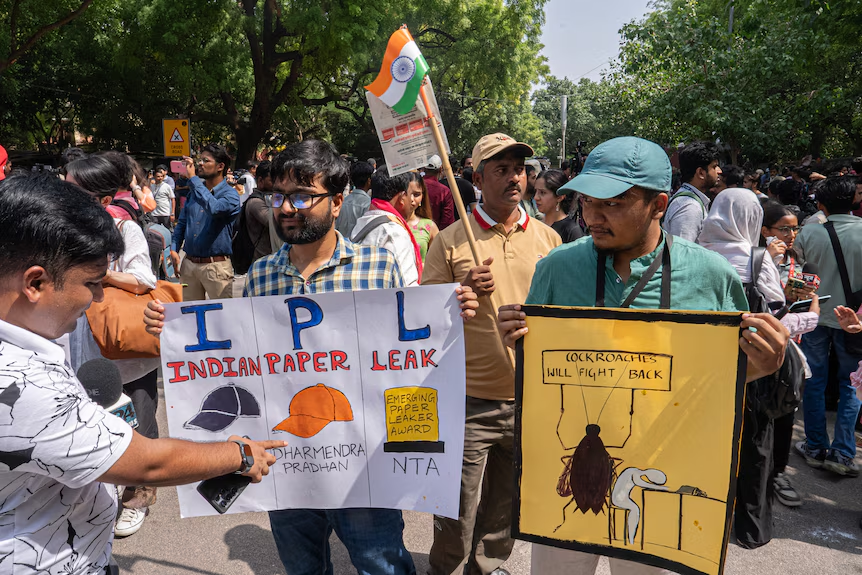
The country’s young people have been pouring support behind the popular online movement of Cockroach Janta Party (CJP) and gathered in the capital city, New Delhi, on Saturday morning local time for their first ever protest.
Cockroach Janta Party (CJP) supporters gathered for a sit-in protest. (ABC News: Bhat Burhan)
They had one ask: the resignation of India’s Education Minister Shri Dharmendra Pradhan.
“We are here to demand accountability from the government who has failed to manage the education system of the country,” Aarav, a CJP supporter said.
Law student Karan Azad, 24, joined the throngs of students chanting for change in Jantar Mantar, a spot in the busy heartland of New Delhi.
“I am very agitated, but glad also that we, the students, are capable of culminating into this movement,” Mr Azad said.
Many people braved the heat in Delhi, protesting wearing cockroach facemasks. (ABC News: Bhat Burhan)
What started as a meme moment has taken over social media and grown into a youth political movement, with the group’s Instagram account attracting more than 22 million followers, more than Indian government party page, the BJP’s followers.
The return of the founder
Hundreds gathered in Jantar Mantar after a dramatic entrance of the movement’s founder, Abhijeet Dipke, who flew to New Delhi in the early hours from Boston, where he is studying to be a political communications strategist.
Abhijeet Dipke leaves Delhi airport. (Reuters: Adnan Abidi)
“Education minister must resign,” Mr Dipke said into microphones as he left the airport to head to the police station and get formal approval to organise a large-scale protest on the same day.
In his hands was an autobiography of Bhimrao Ramji Ambedkar, an Indian social reformer who chaired the first draft of India’s constitution, post-independence.
A not-so-subtle hint to what Mr Dipke has been saying on his online platforms: that the youth of the country “is frustrated” by the BJP government and wants more accountability.
The 30-year-old started the page in a moment of jest and weeks later, as he landed in the country, it was to a gathering of media and police officers.
At the heart of these protests, and calls for the education minister’s resignation, is the recent exam leaks in India’s central education system.
India’s biggest medical entrance exam test, NEET (National Eligibility cum Entrance Test) was scrapped last month after millions sat the test and it was revealed some questions had been leaked.
“Even the bare minimum requirement of being able to conduct examinations for the students, the youth, is not being done properly,” said Ritesh, another protester and CJP supporter.
“We have come here with a hope that this will bring a change,” he said.
Such major entrance exams in India are strict and require months of dedicated learning.
Local media in India has reported alleged cases of self-harm by students following the announcement of a re-test.
Both the Indian education ministry and the BJP were contacted for a comment.
Since the announcement of a new test, to take place this month, the central Indian education department has been facing backlash, and it is this grievance of millions of students that has become a focal point for the Cockroach Janta Party.
Who are the ‘cockroaches’?
The story of India’s newest political mascot, the cockroach, started last month, when the Chief Justice of India, Surya Kant, compared the country’s youth to “cockroaches” in a Supreme Court hearing.
He called young people who tend to lean towards activism “cockroaches” attacking the system, and while Mr Kant was quick to defend his comments after a backlash, the damage was already done.
Aditi Mishra, 28, was among the many students gathered and said she wasn’t surprised by the comments.
“They [the government] are calling the unemployed youth demanding accountability cockroaches,” she said.
Protesters called for the resignation of India’s education minister. (ABC News: Bhat Burhan)
“The government bodies are getting stronger and the people are getting weaker, and weaker.”
Aditi, president of one of the major student unions in India, the JNUSU (Jawaharlal Nehru University Students’ Union), said: “[Government officials] really stomp on us and move on.”
India is grappling with persistently high youth unemployment. Figures released in April indicated the urban jobless rate for people aged 15 to 29 was almost 14 per cent.
“Everyone is desperate and this is what is happening to the youth here,” Ms Mishra added.
As the satirical party page started to gather more significance, the founder, Mr Dipke, decided to shape the momentum of the cockroach fame into something more concrete.
The protest is just the start of the things the CJP wants to focus on, according to chief spokesperson Saurav Das.
“This movement is about seeking accountability,” said Mr Das in an online video statement earlier this week.
He added the “cockroaches” were gathering to voice their frustrations with the current government and system, and wanted to see change take place.
‘With peace and love’
“How long will we live in fear of this government?,” Mr Dipke asked the crowd under a sweltering sun.
Before his trip back to India Mr Dipke had spoken about how his parents had been worried about that he might be arrested when he arrived.
But the event that went on for nearly six hours, went off peacefully.
A notable feature of the entire movement of the CJP, and its transformation from the World Wide Web to the chaotic streets of New Delhi has been the CJP team preparing for a non-violent protest.
Mr Dipke was seen posting days ahead of the protest, urging the millions who follow CJP to take part in a peaceful manner.
“The government is just waiting for one wrong move, to demonise the entire movement and come after us … this is a long battle and we have to be very careful,” he said in a video on his account.
While a protest in India is not a new thing, some of the elements of this one were rare.
The organisers asked people to come with flowers: for the police.
There has been intense security in New Delhi, with both police and paramilitary forces present in busy areas as the protest took place.
One of the CJP supporters, Sonam Wangchuk, an Indian activist, asked people to come with flowers and give them to the police “simply doing their work”.
Another unusual request by the organisers: bring your parents.
Young students tagged along with their parents; a mix of those still studying and some nearing retirement could be seen on the streets of Delhi.
Abhijeet Dipke asked supporters to maintain peace during the protest. (Reuters: Adnan Abidi)
But can this protest today and the larger popular online movement be called a success?
That is yet to be seen.
With the founder back in the country for the moment there will be many eyes on exactly that.
For now, Mr Dipke simply says: “The cockroaches have arrived.”