






Climate risks are rising sharply across the Cambridgeshire and Peterborough region and access to essential services remains deeply uneven, according to a new report that highlights the stark contrast between Cambridge and its rural neighbours.
The draft State of the Region report also reveals that although Cambridge performs strongly on active travel and public transport, large areas beyond the city remain exposed to flooding, reliant on cars and constrained by limited travel options.


Members of the Combined Authority discussed new data from the biannual report, which sets out the evidence to guide investment decisions, strategy and policy, at its board meeting last Wednesday (3 June).
The report, produced by the Combined Authority, brings together data and analysis across eight themes from business and enterprise to health, tackling inequality, climate resilience and nature.
The refreshed publication comes after the Combined Authority agreed to review the evidence twice a year compared with annually previously.
The report describes a region powered by a highly successful, innovation-led economy, but one where growth is unevenly shared.
A council report to the meeting explains: “The CPCA is working with the Cambridge Growth Company and partners in the Oxford Cambridge and Innovation Corridor to maximise the economic potential of Cambridge and the wider region.”
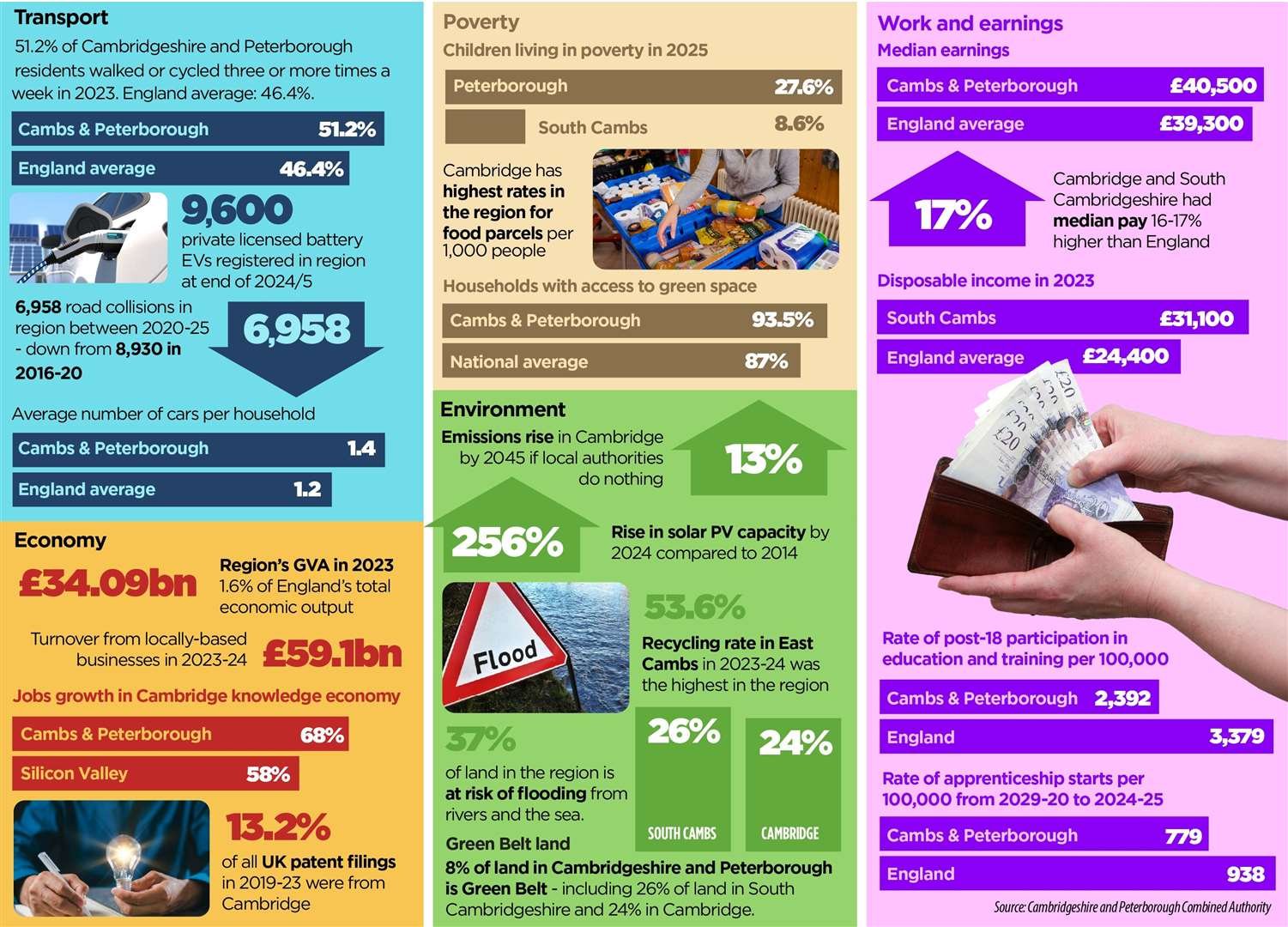
Long-run economic output has risen sharply – GVA in 2023 was 183 per cent higher than in 1998, outpacing England’s 176 per cent – but this performance is heavily concentrated in Cambridge and South Cambridgeshire.

Innovation remains a key strength, with a higher share of innovation-active firms than the national average and Cambridge ranked as the world’s leading science and technology cluster by intensity, although the density of knowledge economy businesses still lags behind international peers.
The number of high-growth firms increased in 2024 but has not returned to its 2018 peak, and productivity gaps within the region continue to widen, with Fenland and Peterborough persistently below both regional and national benchmarks.
On climate resilience, the report warns that risks are rising and unevenly distributed, with large areas exposed to flooding and growing vulnerability to extreme weather.
Emissions have fallen over time, but progress has been slower than in comparable areas due to a more complex decarbonisation pathway shaped by the region’s land-use profile. Renewable energy capacity is expanding rapidly, particularly solar, yet still represents only a small share of national generation.
The report shows that connectivity remains sharply divided between urban and rural areas. Cambridge and Peterborough benefit from stronger access to services and infrastructure, while rural communities face significantly reduced accessibility, especially for walking level trips.

Active travel is well established overall, but participation varies dramatically, with very high usage in Cambridge and far less cycling and walking in more rural and car-dependent areas. Car ownership exceeds the national average and reflects the region’s rural geography, with increasing reliance on private vehicles outside urban centres. Public transport coverage is similarly uneven, concentrated in Cambridge and Peterborough and far more limited in Fenland, Huntingdonshire and East Cambridgeshire.
Digital connectivity has improved markedly, with high levels of full fibre and gigabit availability, though rural coverage continues to lag.
Health outcomes for the region are generally favourable, but the report stresses that this masks deep disparities, with poorer health concentrated in more deprived areas.
Population growth is strong but uneven, placing pressure on housing, infrastructure and land use. Future growth is expected to be driven mainly by areas surrounding Cambridge, particularly South Cambridgeshire, while growth within the city itself is forecast to moderate due to boundary constraints.
Housing delivery reached its second-highest level since 2001-02 in 2024-25, and affordability improved in Cambridge, the report states.
The report highlights the region’s extensive natural assets, including strong access to blue space, but notes that biodiversity remains limited.
Less than nine per cent of land is classified as nature-rich, and while the number of designated local sites has increased, the share under positive conservation management has declined.
The Combined Authority says the report will evolve to “inform policy development, investment decisions, and regional prioritisation”.
“Future iterations will place greater emphasis on improving data integration, enhancing analytical depth, and aligning more closely with national and local policy frameworks. This will support the development of a more dynamic, forward-looking evidence base capable of identifying emerging challenges, and informing long-term inclusive and sustainable growth,” it adds.