








The explosion of British car ownership, from 110,000 private vehicles in 1919 to three million by the end of the 1930s, coupled with the improvement of the road network, ushered in a golden age of motoring for leisure in this country. With it came the need for guidebooks for a new type of traveller: inquisitive, but not intellectual, as much drawn by atmosphere and the experience of simply being ‘somewhere different’ as by antiquarian interests, such as visiting old churches, that had satisfied an earlier generation.
The point was not lost on a young John Betjeman who, from 1930–34, was assistant editor on Architectural Review. Betjeman was a reflex church crawler himself, but his first published collection of verse, Mount Zion (1931) had already demonstrated an ability to combine love of the subject with humour and a sense that the average or mundane could be as fascinating as the first rate. Recognising that there was a gap in the market for guidebooks serving the bright young things pottering off to the Shires at weekends, he persuaded the Shell Petroleum company — which, in less environmentally troubled times, was running advertisements encouraging drivers to fuel their countryside forays with Shell products — to sponsor a series of county guides under his editorship.
Betjeman wrote two of the first volumes, Cornwall (1934) and Devon (1935). They set the tone with imaginative use of typefaces and large black-and-white photographs: a big change from the standard text-heavy approach to guidebook layout up to that time. Cornwall was Betjeman’s favourite county, the subject of much later poetry, yet as a tour guide his book was rather scattergun, with a thin gazetteer. Cheekily, images of rustic types that visiting sophisticates might spot on their visit were superimposed onto a map of the county. Much better was Devon, modifying the jokey approach. It had a weightier gazetteer and an enjoinder to use Ordnance Survey maps to look beyond better-known beauty spots and explore less-frequented areas. It backed this up with inviting photographs of winding, high-banked lanes and bosky avenues, together with very Betjemanesque references, such as Bigbury having some interesting farms.

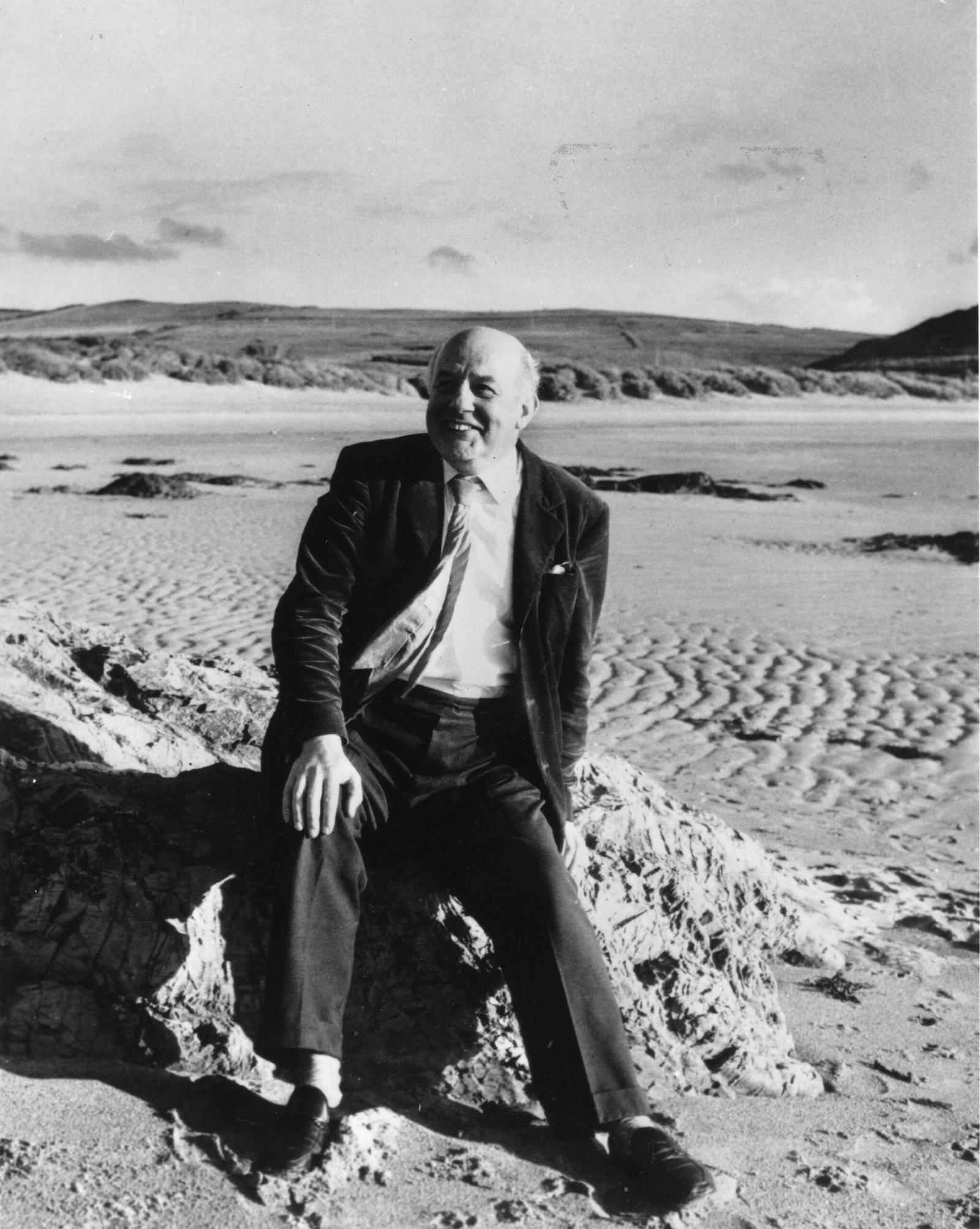
John Betjeman oversaw a quirky, cheeky approach as editor of the Shell series.
(Image credit: Getty Images/Keystone)
In a letter of 1937, Betjeman wrote that the books’ concerns were with ‘handsome provincial streets of the late-Georgian era; impressive mills in industrial towns; horrifying villas in overrated “resorts”’. Yet, because he used his connections to commission an array of gifted writers, artists and historians, the texts were never standardised. Some authors proselytised. Derbyshire (1935), written by Christopher Hobhouse shortly after the Kinder Scout mass trespass, was trenchant about the need to open up the Peaks as a cheap walking pastime for the ‘young men and women of the industrial towns’. Elsewhere, Shell Guides projected the countryside as a place of mystery and adventure, as in Robert Byron’s atmospheric description of Cranborne Chase in Wiltshire (1935): ‘The Salisbury-Blandford road runs through the middle of this wild, lovely bit of country, which is peppered with barrows and haunted by many well-authenticated ghosts, including a pack of hounds’.
Speaking of Dorset, the choice of the English Surrealist Paul Nash to write its volume in 1936 was inspired. Nash took the project so seriously he moved to Swanage for a year. Some years before, he had formulated the ideas of ‘places’, where the ‘relationship of parts creates a mystery, an enchantment which cannot be analysed’. Dorset, with its extraordinary rocks — Stair Hole, Lulworth Cave and the monster-like Durdle Door — had plenty of these. Nash produced more than half the book’s striking images, including of Corfe Castle and Badbury Rings (‘I remember nothing so beautifully haunted as the wood in Badbury Rings’). Even photographs of the churches and tombs had a grainy, elemental essence.
Another choice volume was Oxon (1938), by John Piper, eventually to succeed Betjeman as overall series editor. Piper’s sketch of the prehistoric Rollright Stones transformed them into eerily lifelike dancing rocks, and there were succinct entries on lesser-known villages — ‘Taynton: Roses round the door. Beautiful-Britain Cotswold village’ — and, as with Devon, a suggestion that the traveller was rewarded by going down the side roads.

(Image credit: Alamy)
With their abstract images of green men, stone circles and hill figures, there was an underlying quirkiness about the Shell Guides. Arthur Mee’s ‘The King’s England’ county guides, launched in 1936, had none of their sly humour. A plea for better prices for the county’s pig farmers in the Shell Wiltshire, with a photograph of porkers captioned as ‘quite unperturbed by the bacon question’, would have been unthinkable. Betjeman once claimed, somewhat disingenuously, that the Shell Guides were aimed at the ‘plus-foured weekender who cannot tell a sham Tudor roadhouse from a Cotswold manor’. It might have been better applied to readers of a King’s England, yet you could not accuse the latter of dumbing down. With soft-toned photographs favouring churches, thatched cottages and leafy settings, the 41-volume gazetteer-style series might have slipped into windy Olde England nostalgia were it not for its openness to progress. Middlesex enthused about Alexandra Palace, ‘the birthplace of the public service of Television’; Hertfordshire was delighted by the way that the county’s beauty was made accessible by its numerous roads, making it ‘more and more the Londoner’s playground, with London’s Green Belt running between Greater London and the North Orbital Road’.
The entries were also commendably thorough. The description of St Albans in Hertfordshire ran to more than 20 pages and was illuminating on a cathedral — ‘an arresting spectacle’ — which wouldn’t rank among most people’s favourites. Mee was always alert to setting. Beyond the ranks of history students (and sometimes not even them), the Roman ruins of St Albans are not hugely thrilling, but Mee — ‘One of the green and pleasant places of our land, sloping up to fields and deep woods’ — made them live. The net of information was also cast wide. In Gloucestershire, although the entry for Adelstrop did not mention Edward Thomas’s poem, the reader was told that the attractive surroundings of Adelstrop House were thanks to Humphry Repton, ‘who laid out Russell Square in London and helped to shape Kensington Gardens’.

The King’s England guides by Arthur Mee were a serious, sober affair.
(Image credit: Getty Images/Culture Club)
Quality guidebooks launched after 1945 were not confined to Nikolaus Pevsner’s more specialised ‘Best Buildings of England’ series. Collins’ ‘About Britain’ books arrived in 1951 to coincide with the Festival of Britain. Poet and critic Geoffrey Grigson was general editor of the 13-volume series and, alongside a coloured title page by artists such as Barbara Jones or Kenneth Rowntree, they carried a mix of black and white and colour photos, suggested ‘tours’ with road directions and a basic map, as well as a pithy gazetteer. The volumes divided the country by character not county, hence titles included Lancashire and Yorkshire and Chilterns to Black Country. Their chief strength was the lengthy portrait essay. Grigson himself wrote those for West Country and Wessex, the latter being, in his words, ‘the primal heart of England, if not of Great Britain’. The thatched cottages of its villages were, architecturally, ‘as humble as if they had grown up out of a potato patch’.
The nature writer R. S. R. Fitter wrote the portrait for the Home Counties volume. Already the author of the landmark London’s Natural History, published in 1945, Fitter lacked Grigson’s acerbic touch, although his interest in the temporary wild gardens of war-ravaged parts of London are now a fascinating historical snapshot. The area around St Paul’s was ‘to be stalked scenically from every unexpected angle — across wastes of bomb rubble yellow with ragwort and incarnadined by rosebay willow-herb’. To him, ‘the fields, woods and heaths of the Home Counties’ stood comparison with anywhere in Britain ‘for rich and varied scenery… and a fascinating variety of wild life’.
Readers at the time might have wondered why they were bothering with the mysterious and far off, when there was so much to be seen closer to home.

(Image credit: Alamy)