









Two months ago, I wrote about a new paper testing the core empirical predictions of the degrowth framework and finding them wanting. That paper showed that the doughnut model, the most cited theoretical framework in degrowth literature, fails its most basic empirical test. More economically free countries are not more “imbalanced” across social and ecological indicators. If anything, they tend to perform better.
Now, a new paper in Structural Change and Economic Dynamics by Justin Callais, Vincent Geloso, and Alicia Plemmons pushes this inquiry further. Rather than asking whether capitalism produces bad environmental outcomes in the abstract, the authors ask a sharper question: What actually happens to environmental outcomes when countries undergo major episodes of economic liberalization? The results challenge one of the most persistent assumptions in environmental politics.
From Theory to Episodes
The authors study 49 episodes of major economic liberalization since 1970. These are not marginal policy tweaks. These are countries that substantially opened trade, strengthened property rights, reduced regulatory burdens, and increased economic freedom in ways that are measurable and historically significant.
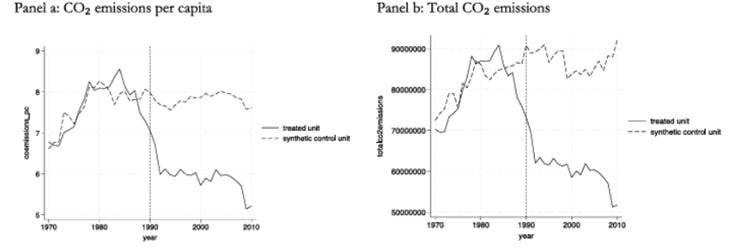
The main analysis uses matching methods to construct appropriate comparison groups, and the authors replicate key results using synthetic control methods on the most extreme liberalizers.
The authors find that GDP per capita rose roughly 16% within ten years of major liberalization episodes. But environmental outcomes did not deteriorate alongside that growth.
There was no increase in total greenhouse gas emissions. Death rates from air pollution fell. In many post-2000 cases, emissions per capita and emissions per dollar of output declined. The authors find these results consistently, across different specifications and different subsets of countries.
This matters because the standard narrative in much of environmental policy is that growth and environmental protection are in fundamental tension. More output means more resource use, more emissions, more pollution. Under this view, economic liberalization, which tends to accelerate growth, should worsen environmental outcomes. The data from 49 real-world episodes says otherwise.
Scale Is Not the Whole Story
The reason for that standard narrative is not entirely wrong—it focuses on what economists call the scale effect. More production can mean more resource use. That’s a real force.
But it’s only one of several forces at work. As countries grow richer, they tend to shift toward less resource-intensive sectors. They innovate, producing more with fewer inputs. And their citizens demand higher environmental quality. Taken together, these forces generate what economists call the Environmental Kuznets Curve: pollution may initially rise during early development but eventually peaks and declines.
The crucial question, and this is where Callais, Geloso, and Plemmons make their most important contribution, is not whether such a curve exists, but what determines where that peak falls. Their argument is that institutions determine the answer.
Growth generated under secure property rights, open markets, and the rule of law tends to reach the turning point sooner and at lower levels of environmental degradation. The EKC’s peak arrives earlier and lower. That is a very different claim from simply saying “growth is fine.” It says that the type of growth matters, and that the institutions underpinning liberalization are themselves part of the environmental story.
Why Institutions Matter for the Environment
The mechanism is worth taking seriously. Property rights force polluters to internalize costs. Pollution often involves nuisance, trespass, negligence, and liability. Those who impose costs on others face compensation claims, legal action, higher insurance premiums, and reputational damage. The result is pressure to reduce environmental harms before regulators ever intervene.
The same institutions that protect property rights also encourage innovation and conservation more broadly. Entrepreneurs have incentives to develop technologies that use fewer resources. Market prices communicate scarcity and encourage substitution. Consumers can reward environmentally responsible firms and punish irresponsible ones. Self-interest, under the right institutional framework, becomes aligned with environmental stewardship.
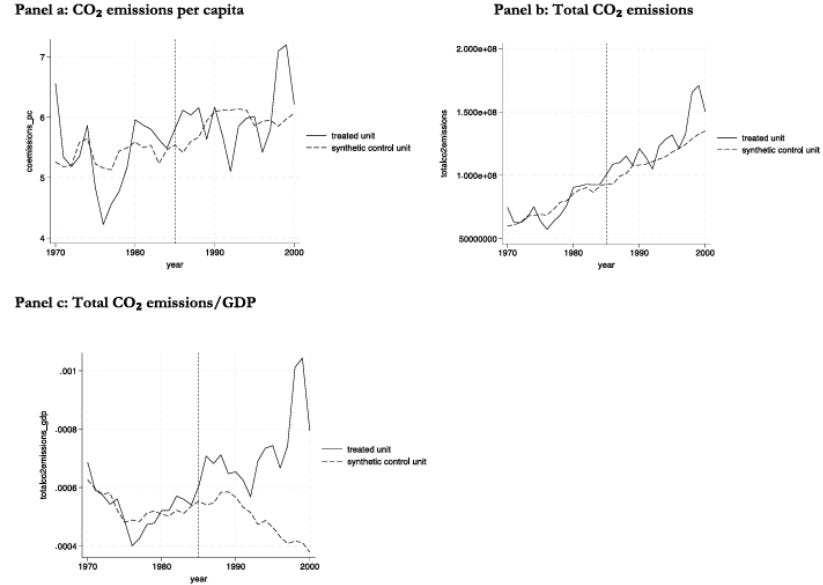
The authors went a step further and decided to review the experience of de-liberalizing regimes. Using the same methodology, observing the de-liberalization period in Venezuela, the authors found that as the country grew poorer during de-liberalization, emissions per dollar increased significantly compared to the counterfactual.
This is not a claim that markets solve all environmental problems. The authors are careful on this point: externalities exist and matter. But the empirical record from these 49 liberalization episodes suggests that the institutional environment in which growth occurs shapes environmental outcomes in meaningful ways, and that liberalization, on net, has not been the environmental disaster many assume.
The Bigger Picture
Read alongside the earlier Geloso et al. paper on the doughnut model, a consistent picture is emerging from the empirical literature. The degrowth framework predicts that capitalism and economic freedom systematically worsen social and ecological outcomes. Those predictions don’t hold. And now, when we look directly at episodes of major liberalization—the closest thing to a natural experiment we have—the environmental picture is considerably more optimistic than the standard narrative suggests.
This does not mean growth solves everything, or that environmental policy is unnecessary. But it does mean that the framing of a fundamental choice between prosperity and preservation is empirically unsupported. Countries can grow richer and achieve better environmental outcomes. The institutions that enable one tend to enable the other.
That is a finding worth sitting with, especially for those who have built policy frameworks on the assumption that the opposite is true.