








Good morning from the team at Press Gazette on Thursday, 19 March.
👍 Good news from the UK government yesterday as it reacted to overwhelming opposition from the creative industries to its position on copyright and AI.
It had favoured a presumption that AI companies could use whatever they want for training unless copyright holders opted out.
Team Starmer now appears to accept that their enthusiasm for AI as a way to boost sluggish UK productivity needs to be tempered with a copyright regime that does not destroy incentives for original work.
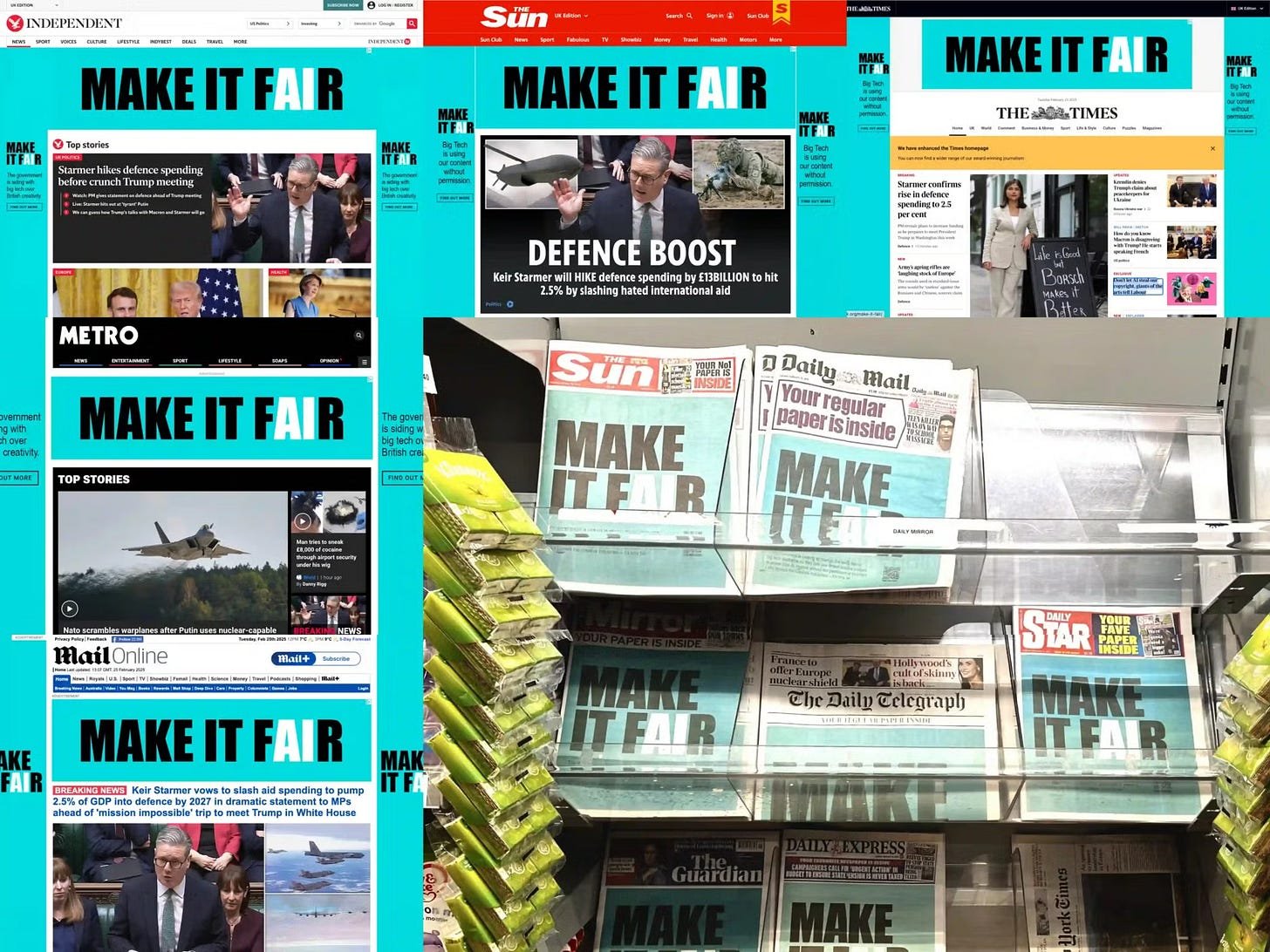
This follows a rare show of unanimity among every UK national newsbrand last year in the form of the Make It Fair campaign.
I wonder if it is also related to Sir Keir’s recent more robust stance towards Donald Trump, who will seek to protect the interests of US tech giants behind his America-first umbrella.
The next challenge is the upcoming regulation of Google by the Competition and Markets Authority under the 2024 Digital Markets, Competition and Consumers Act.
Given the direction of travel indicated by yesterday’s announcement I would be amazed if the CMA does not compel Google to separate its AI scraping from indexing for search (it has already asked it nicely to do so).
If so, this could open a handy new revenue stream as Google (like others) would be forced to pay for the news content needed to fuel its AI platforms.

🙌 Congratulations to The Times editor Tony Gallagher, who celebrated picking up a Fellowship award from the Society of Editors by revealing that digital subscriptions now more than cover the costs of the 700-strong Times and Sunday Times newsroom.
When other publishers were seeking reach and viral hits on social media in 2010, The Times went behind a paywall.
Its focus on quality and on producing a finishable daily digital edition and app has paid off, and The Times titles now have 659,000 digital subscribers.
Times Media Ltd has actually grown revenue in recent years, which is astonishing given the scale of structural decline for its print titles. Its latest profit (£61m on revenue of £383m) shows that the UK’s oldest national newspaper (launched when America was still a British colony) has a bright future.

😮 Culture Secretary Lisa Nandy asked on Tuesday whether press regulator IPSO needs to be tougher on publishers, adding press regulation “is the single greatest area in which I am urged by the public to act”.
She also acknowledged concerns about increasingly politicised broadcast news (without specifically name-checking GB News).
My hunch is that most organised campaigners against GB News and wanting press reform are motivated by concerns over bias rather than systematic misbehaviour.
Forthright campaigning by the UK’s market-leading newspapers at the time – the Telegraph, Mail and Sun – may well have helped swing Britain’s narrow vote in favour of Brexit, something which pro-Europeans find unforgivable.
But any form of media regulation that outlaws bias (the freedom to choose a particular point of view) would be a step down the road to state control of how we think.
As Karl Marx put it in an argument against censorship of the press: “You cannot pluck the rose without its thorns.”

🌞 And amid a general slump in Google referral traffic, which has been most strongly felt in the US, some cause for optimism.
This confirms anecdotal reports I heard last week at our New York conference.
A tech ecosystem that incentivises journalists to tell us something new about the world has to be encouraged (as opposed to the old world of SEO, which encouraged 100 mainly recycled articles about the same evergreen topic).
The Government is to increase BBC World Service funding by £33m over the next three years (£11m per year), an 8% increase on the previous year’s Government contribution as part of the Charter process. (BBC)
The Guardian has amended an article about a branch of Gail’s bakery in North London after concerns were raised by readers and Jewish members of staff. (The Times)
Dow Jones is targeting $1bn in EBITDA within five years, up 70% from 2025, and is launching a ‘super consumer’ bundle costing $7,499. (A Media Operator)
Charlotte Anderson, a freelance working for the Romford Recorder, has been named Young Journalist of the Year by the Chartered Institute of Journalists, which said: “Any freelance relying on local media fees has to work hard. Charlotte certainly did.” (CIoJ)
STV News staff have voted overwhelmingly for strike action in a pay dispute, as management has said they cannot offer a pay rise. Both National Union of Journalists and Bectu members voted in favour. (NUJ)
The core Los Angeles Times news business lost about $5m last year and is expected to break even in 2026. Owner Patrick Soon-Shiong said he has “turned it around” and isn’t planning to sell. (The Wall Street Journal)
PA Media has launched a real-time fact-checking service within its main feed called Quickcheck, which offers publishers evidence-backed context taken from its archive and reputable external sources.
New Policing and Media Charter for England and Wales launched.
Royal College of Policing head Sir Andy Marsh on new media charter.
Scarlet Howes says Channel 5 drama puts victims at heart of the story.
Investigation by Alan Rusbridger claims pattern of GB News breaching Ofcom rules.
Key insights and pictures from Press Gazette New York publishers conference.

Dominic Ponsford and Charlotte Tobitt talk about how journalists broke news of Andrew Mountbatten-Windsor’s arrest and why they named him despite the privacy risk.
They also discuss a plan by Mediahuis to cover “first-line” news with AI agents, and Dom gives his (somewhat premature) verdict on the Prince Harry and others versus Associated Newspapers privacy trial.