







Musk founded SpaceX in 2002, when rocket launches were almost entirely dominated by major governments. Since then, the company, along with others, including Rocket Lab and Jeff Bezos’ Blue Origin, have made major strides. NASA relies on SpaceX to get its astronauts and cargo to and from the space station, and the company is expected to play a key role in NASA’s return to the moon.
While SpaceX has historically made much of its money from launching spacecraft, cargo and other payloads for NASA, the U.S. military and commercial partners, the company has expanded in recent years into other businesses, most notably its Starlink satellite internet business. Musk has also made some aggressive — some might say outlandish — predictions about the future of the company’s artificial intelligence efforts, including its own xAI business, which Musk also co-founded and was acquired by SpaceX in February.
The stock debut comes at a time when AI-fueled euphoria on Wall Street has never been higher. Despite a war with Iran that has stretched into a fourth month, major stock indexes continue to notch record highs, thanks primarily to shares of AI-linked companies.
Goldman Sachs President John Waldron said the SpaceX IPO is a sign that there’s an appetite to fund the artificial intelligence boom.
“It shows you that the capital markets — led by the U.S. capital markets, but the global capital markets — are demonstrating a willingness to finance this AI infrastructure build and this build in space,” he told Bloomberg Television in a Friday morning interview.
Goldman Sachs is the lead underwriter of the SpaceX offering, along with Morgan Stanley, JPMorgan Chase, Bank of America and Citigroup. There are more than a dozen additional banks involved in the process.
Not everyone is convinced by the high valuation, though.
Analysts at Morningstar wrote this week that they believe the company is “overvalued” given its financials. The company has yet to generate a profit and produced roughly $19 billion in revenue last year. “We value SpaceX at $780 billion,” the analysts wrote.
One of SpaceX’s top leaders, Chief Operating Officer Gwynne Shotwell, dismissed skeptics in an interview on CNBC on Friday morning.
“Look at our track record, look at our history,” she said. “We do really difficult things.”
Shotwell also cautioned that SpaceX is operating more for the long term than for quarterly earnings reports.
02:16
What does SpaceX’s stock market debut mean for you?
00:0000:00
“I do not want to focus on quarterly earnings,” she said. “I’m not saying we’re not going to do right by our investors, but what folks who invest in SpaceX need to know is that what we’re doing is very futuristic.”
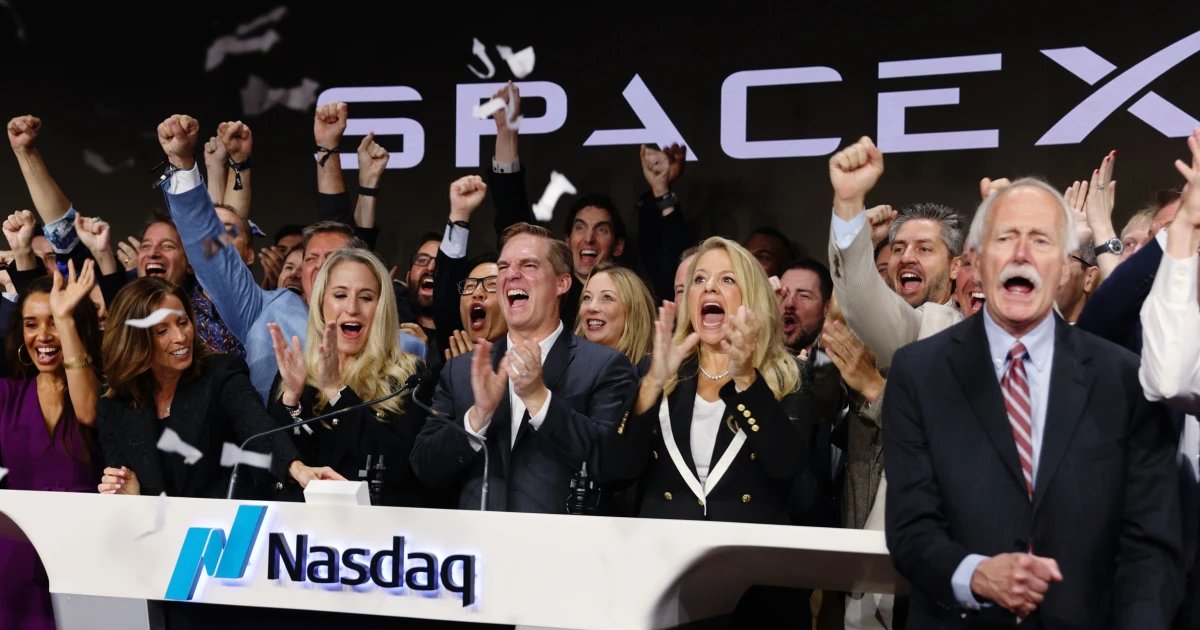
The IPO, which may also be viewed as a referendum on Musk himself, will be closely watched by those invested in the company — and those who are not. The offering could make Musk the world’s first trillionaire.
Musk is a politically and socially divisive figure who uses the social media platform X, a SpaceX subsidiary, to promote a nativist, far-right agenda around the world.
SpaceX, in its IPO filing, said it planned to offer 30% of the IPO to everyday investors through retail brokerages such as Fidelity, Morgan Stanley’s E-Trade, Charles Schwab and SoFi.
“There are plenty of options being put in place for retail” investors, Waldron said. “I think you’ll see plenty of opportunities for retail to invest.”
It will also be a test of the markets themselves.
Waldron said that “many of us have been preparing for this for a long time,” including the Nasdaq stock exchange and the banks themselves.
“A lot of preparation has been put in place,” he added.