








Morning light pours through the fan-vaulted ceiling of St Mary Aldermary, spilling between laptops and cups. The gentle hum of conversation rises beneath the carved-stone ribs of the building, one of Sir Christopher Wren’s lesser-known works. This is Host Café, EC4, an ethical, non-profit coffee shop run by the church itself — where City workers, freelancers and tourists alike sit in pews once reserved for prayer.
Londoners have long sought communion through conversation — and, for centuries, they have congregated in the caffeinated sanctuaries of the city: coffee houses. Long before St Mary Aldermary began serving single-origin espresso, another London pioneer, Pasqua Rosee, was pouring his first cups for a curious crowd in St Michael’s Alley in 1652, igniting a social revolution. By the late 17th century, London had become addicted, home to hundreds of so-called ‘penny universities’, each one a microcosm.
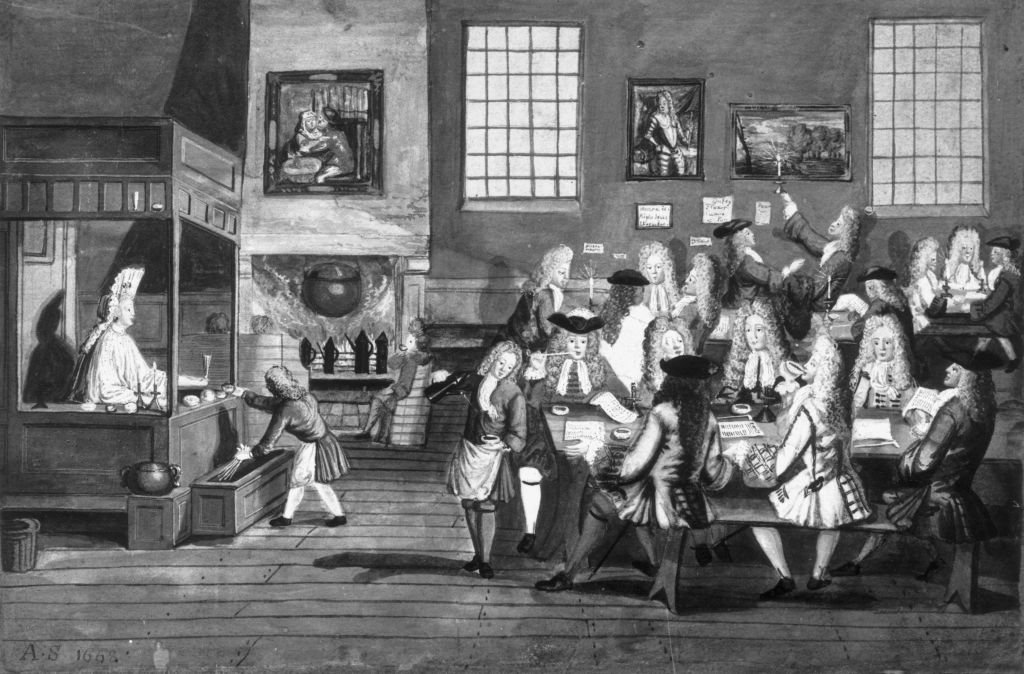
Step inside and you’d find sailors arguing with scientists, poets needling politicians and merchants huddled over ledgers by candlelight, akin to ‘rats in a ruinous cheese store… some going, some coming, some scribbling, some talking, some drinking, others jangling,’ wrote London Spy author Ned Ward in 1704. The air was thick with smoke, gossip and the smell of roasting beans. As Ward himself admitted: ‘When I had sat there for a while… I myself felt inclined for a cup of coffee.’ Early brews were tar-black, gritty, strong as hell and sobering. They woke people up, literally and figuratively, in an era when the safest drink was stupefying ale.

Step inside and you’d find sailors arguing with scientists, poets needling politicians and merchants huddled over ledgers by candlelight, akin to ‘rats in a ruinous cheese store.’
(Image credit: Rischgitz/Getty Images)
Each house had its speciality. The Grecian was a haven for duelling scholars and scientists — Isaac Newton once dissected a dolphin on the table. Jonathan’s echoed with stockjobbers bellowing prices; at Lloyd’s, the bustle of shipowners, merchants and sailors seeking reliable shipping news evolved, improbably, into a global insurance empire. Button’s on Russell Street was awash with pamphleteers and poets, housing first offices of Addison, Steele, Pope, Swift, Gay and The Spectator. Literary contributions were submitted through the mouth of a marble lion. What united these dens was convivial conversation. For a penny, one could buy entry into a new way of thinking: egalitarian, restless and caffeinated.
‘No man might refuse your company,’ stated one set of coffee-house rules. Equality was the order of the day — a radical idea in a city built on hierarchy — and ideas were prized more highly than titles. Anyone could enter and speak freely. Long communal tables, filled with manuscripts and printed papers, invited conversation between strangers and no seat could be reserved. As the historian Thomas Macaulay observed, you might have seen ‘earls in stars and garters, clergymen in cassocks, pert templars, sheepish lads from the Universities, translators and index-makers in ragged coats’, all blended together. Engaging with someone new was de rigueur and debate flowed as freely as the coffee itself.
Historians still argue whether women were seated at the table or written out of the scene, yet diaries and literature of the period place them inside these rooms — not only as patrons and participants, but often as proprietors and servers. They shaped the coffee-house world as much as any man.
A revolution in democratic discussion, the coffee house was equal parts newsroom, salon and free-school. A space where art and argument shared common ground. Their subversive chatter so alarmed authority that, in 1675, Charles II attempted to close them altogether, denouncing them as ‘places where the disaffected meet’. The ban lasted 11 days, overturned by public outcry and caffeine withdrawal.

(Image credit: Giulia Bernardelli)
Three centuries later, that same spirit survives. The tables are smaller now, the beans more expensive, but Londoners still gather around cups to exchange ideas, contend opinions and, occasionally, change the world. Button’s itself may now be a cheerless Starbucks, but, across the city, a handful of cafés, bars and salons still quietly uphold the noble art of conversation.
The Poetry Café in Betterton Street, WC2, sits in what Judith Palmer, director of the Poetry Society, calls ‘the Hogarthian heartlands of Covent Garden’: a fitting heir to London’s coffee-house past. ‘Poetry’s main hangout,’ she tells me, ‘is where poets come to launch books, try out new material or simply swap views.’ She notes the same collaborative energy now stretches far beyond the capital: 136 ‘Stanza groups’ gather across the country ‘meeting in village halls, above pubs and in each other’s kitchens… workshopping over a creative cuppa’.
A stroll away in Bloomsbury, the London Review Bookshop Café, WC1, has been given a new lease of life by St John, of nose-to-tail fame. It now serves up coffee alongside Proustian madeleines, literature and lively event nights. ‘When the good folk at The Review asked if we’d be interested in their former café space, we were intrigued,’ says Trevor Gulliver, St John’s co-founder and CEO. ‘A bookshop has its own calm and activity, a sense of purpose to its existence. The more time we spent there, the more it felt like a happy relationship — light-filled, full of ebb and flow between café and bookshelves, the many people who come through the doors, even the square behind.’
In Piccadilly, W1, the effortlessly elegant Maison Assouline hums with salon glamour for a new age. Recently named by 1000Libraries as the most beautiful book-café in the UK, this former bank hall is now a destination that invites ideas and human connection.
Then there are the new gatherings that widen the circle still further. The story-telling night RAW Talks seeks to champion ordinary people with extraordinary tales. As co-founder Christine Charitonos tells me: ‘There’s no shortage of events where one listens to experts or celebrities talk about their achievements. But do these types of nights satisfy the need for human connection? RAW platforms everyday people and their true-life stories in an environment where everyone is equal.’

The effortlessly elegant Maison Assouline hums with salon glamour for a new age
(Image credit: Alamy/Jeffrey Isaac Greenberg)
‘The coffee houses of the past were about ideas,’ she explains, ‘but they were also about finding belonging — a space where you could walk in, join the conversation and be accepted into the fold.’ The same might be said of Geist Talks, a cultural salon that began as a post-lockdown gathering of friends in a West End warehouse. ‘People were clearly longing for in-person conversation as an antidote to the screen-based isolation of those years,’ says co-founder Sara Sjölund. ‘Our first talk was on the science of the mind, with a Tibetan Buddhist monk and a Yale neuroscientist and, when we hosted our second, with the mycologist Merlin Sheldrake, people were practically fighting for tickets.’ Today, Geist hosts monthly events in striking venues, each followed by an informal dinner ‘where people can continue the conversation’.
Echoing their Hanoverian predecessors, these modern salons are an antidote to loneliness and remind us that culture thrives in communal settings. The fundamental desire remains the same: to gather, to converse and actively listen.
As evening falls, Host Café’s last patrons drift out into Bow Lane and the aroma of roasted beans lingers in the nave like incense. Centuries ago, the same invigorating smell would have percolated through the alleys of Cornhill and Covent Garden, beckoning Londoners in search of warmth, wit and wisdom. The decor changes, but London’s truest communion endures: a table, a cup and the shared pleasure of being together.