





Tucked away in Ahilyanagar (formerly Ahmednagar), Maharashtra’s largest district, is a self-sustainable rehabilitation commune, Mangav. The creation of two doctors, Dr Rajendra Bajirao Dhamane and his wife Dr Sucheta Dhamane, Mangav is an extension of their NGO, Mauli Seva Pratishthan (MSP), wherein the duo offers lifelong care to mentally and physically ill homeless women and their children. “For more than two decades, my life as a doctor has taken me beyond hospital walls: to highways, railway stations, marketplaces, and forgotten corners of our cities where mentally and physically ill women wander without shelter, treatment, or dignity,” says Dr Rajendra, “Many are victims of repeated sexual violence. Some are pregnant. Most are nameless, undocumented, and invisible to systems. What began as emergency medical help gradually became a lifelong commitment.”

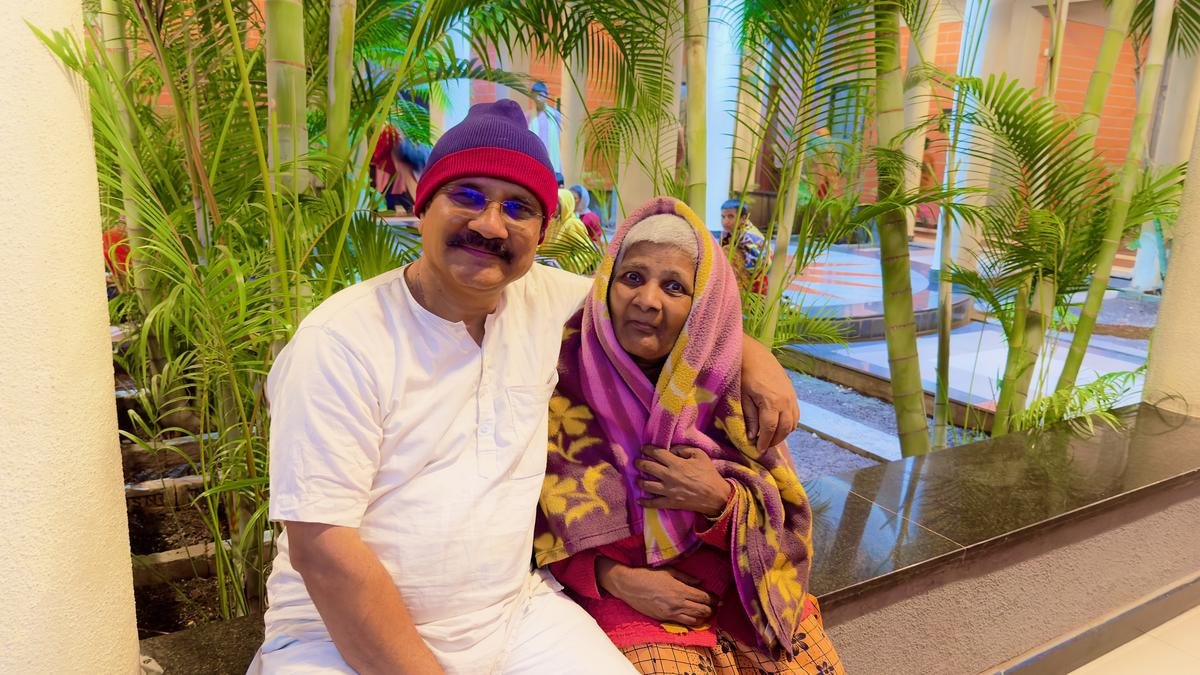
Dr Rajendra Bajirao Dhamane with a resident
| Photo Credit:
Special Arrangement
It takes a village
Today, 477 women and 43 children reside in Mangav as a community. “Most women were rescued from roads, public places, or hospital wards. Many children were born as a consequence of rape and exploitation of mentally ill women on highways. These children would otherwise have been born into homelessness and stigma,” he explains, adding that it was a conscious decision to not run Mauli (meaning mother, in Marathi) as a short-stay shelter. “In the early years, I realised that rescue alone does not solve the problem, nor does mental illness heal in a few weeks. Trauma does not disappear after shelter is provided. Many families refuse to accept these women back, and some women are so severely ill or cognitively impaired that independent living is impossible. Which is why we provide lifelong care, treatment, and rehabilitation,” says Dr Rajendra, recipient of the THE ONE International Humanitarian Award in 2016.

Today, 477 women and 43 children reside in Mangav as a community
| Photo Credit:
Special Arrangement
He stresses that Mangav is not an institution in the traditional sense, but a village model “built on rehabilitation through participation and dignity” that he grew with Dr Sucheta, who left her career as a teacher of Community Medicine in a medical college to work full-time with MSP. Here, she manages medical coordination, maternal care, children’s health, and rehabilitation programmes.

Mangav is an extension of their NGO, Mauli Seva Pratishthan (MSP)
| Photo Credit:
Special Arrangement
Baking as psychotherapy
Based on individual capacities, residents are involved in dairy and gaushala management, agriculture and fodder cultivation, tailoring and daily community services. The most recent intervention is their bakery and food processing unit where operations began a year ago. Here, 30 women who have recovered and/or are stable bake eight varieties of cookies, and whip up cakes and pastries on order. “They need to be engaged physically and mentally, and such initiatives also work as psychotherapy,” says Dr Sucheta. “We have trained them in baking for a year. We have also brought in high-grade machines and called in experts to train the women to use them,” she says. As for the offerings, she says the focus has been on creating healthier alternatives with organic produce. “We bake two varieties of nan khatai, jowar flaxseed jaggery cookies, blueberry oat cookies, ragi cookies, and more, that are stocked in local stores and we also take festive, corporate orders.”

Dr Sucheta Dhamane (left) with a resident at the baking unit
| Photo Credit:
Special Arrangement
Come July, and a cafeteria — an extension of their ongoing dairy project — will launch on the Ahilyanagar-Shirdi Highway. “Here, alongside the bakery products, we will retail milk and byproducts such as peda, lassi, and paneer that are made in-house,” she says, adding that cattle dung from the gaushala also powers their gobar gas plant. “Our entire system is run only on solar and gobar gas.”
These initiatives, she says, function as occupational therapy with purpose, that help women regain routine, confidence, and a sense of belonging. “Some women, once stabilised, recall their earlier lives. We have had women who were previously teachers, office workers, factory labourers, and even professionals. Mental illness does not discriminate. Society, unfortunately, does.”

Come July, and a cafeteria — an extension of their ongoing dairy project — will launch on the Ahilyanagar-Shirdi Highway
| Photo Credit:
Special Arrangement
Beyond medicine
Dr Rajendra explains how women reach them through police rescues, hospitals, NGOs, social workers, and compassionate citizens. “Most arrive without identity documents, medical history, or family contact.” The process begins with an emergency medical stabilisation, psychiatric assessment and medication, nutritional rehabilitation, legal documentation and FIRs where needed, and long-term therapy and social adaptation,” he says, adding that family tracing is attempted wherever feasible, but most families refuse to accept them. And when a resident passes away, funerals are conducted “with all legal procedures”. “In the few cases where there is no other critical illness, we do eye donations. We do not donate any other organ,” he says.

The gaushala at Mangav
| Photo Credit:
Special Arrangement
Their work is not limited to medical treatment, but daily living: feeding, counselling, handling crises, celebrating recoveries, and sometimes mourning losses. Addressing the former, Dr Rajendra says SBI Foundation and Rotary have been supporting MSP’s medical infrastructure needs. “Through the support of SBI Foundation, we established the MAULI–SBI Foundation ICU Unit, enabling us to manage critical medical emergencies within our campus. Rotary organisations have supported infrastructure development, medical equipment, training programmes, and community outreach,” he shares.
A home for all
The next chapter at MSP includes a 300-bed, 1 lakh square foot charity hospital (currently under construction) and research centre focussing on PAN-India access under the umbrella of the NNG Institute of Mental Health, Neurosciences, and Cardiology that the duo has launched. “This Institute will focus on mental health rehabilitation, neurological disorders, cardiac care for underprivileged populations across India, and clinical research in social medicine and psychiatry. The objective is to bridge the gap between tertiary healthcare and humanitarian access,” stresses Dr Rajendra, whose son Dr Kiran Rajendra Dhamane is currently pursuing his MD in Medicine at Cooper Hospital, Juhu, Mumbai, and is keen to integrate advanced cardiology services with charity healthcare.

Dr Kiran Rajendra Dhamane (fourth from left) with Dr Rajendra and a few residents
| Photo Credit:
Special Arrangement
Encapsulating his learnings from the last two decades, Dr Rajendra says that while mental illness needs medicine, abandonment needs lifelong human commitment. “Mangav aims to give back what the world took away from these women: home, routine, safety, and belonging. Our dream is simple: no woman suffering on the road is ever told that she is someone else’s problem. At Mauli, she becomes our responsibility for life,” he concludes.
Details on msp.org.in/