






There is a wonderful World Cup advert running on Argentine TV that sums up how people may be feeling across that country this morning, after Lionel Messi’s stunning hat-trick against Algeria.
Leading up to the tournament, there had been a sense that Argentina’s job had already been done. By winning the previous World Cup in 2022, the dream had been realised, the mission accomplished.
National broadcaster TyC Sport tapped into this feeling brilliantly; in a staged interview with a reporter on the street, a fan says, “To be honest, after two Copas America and one World Cup, I’m kind of done already.”
A passer-by hears this, interrupts and looks into the camera, giving a passionate rallying call to people in their homes, cafes and workplaces who might feel they are done, too. “They say that football owed Messi a World Cup,” he says. “Who knows how many it owes him — what if it owes him two?”
Messi, Mbappe and Haaland put on a show | World Cup Daily Briefing
Megan Feringa and Amitai Winehouse
Judging by the throngs of Argentina supporters that have descended on this World Cup, lighting up New York’s Times Square with their chanting and jumping, it would be hard to say they are lacking enthusiasm for this one, but Messi lit a fire under their campaign in Kansas City on Tuesday.
Much of the world woke up this morning to yet another seismic Messi moment and another piece of World Cup history, wondering if Argentina can become only the second team in history to win this tournament back-to-back.
Little has changed for them since 2022, in the sense that the first-choice side are stable in terms of selection and tick along very nicely, allowing Messi to be the difference maker. At 38 years old, though (he turns 39 next Wednesday), and after four seasons in MLS in the United States, there had been some doubts about exactly how effective he might be at the top level. While that may still prove to be an issue as the tournament progresses, he is, on this evidence, still the main man — and possibly still the best player on the planet.
It was especially noticeable early on during the 3-0 win against Algeria, even for him, that he was spending much of the game walking, waiting to pick his moments. By the time he was substituted after 80 minutes, the job done (for now), he had covered 6.81km, according to FIFA data. For comparison, Kylian Mbappe of France, another player known for attacking contribution over defensive effort, covered 9.7km in 90 minutes against Senegal earlier in the day. Erling Haaland, who can spend large parts of the game without the ball, covered 9.6km for Norway as they beat Iraq in Tuesday’s second match.
This has long been the case for Messi and Mbappe, and is a fairly routine part of the sport. Olivier Giroud, who won the World Cup with France in 2018, explained to the BBC before the 3-1 victory against Senegal that manager Didier Deschamps previously played Blaise Matuidi, a less technically gifted player but willing runner, as Giroud put it, to cover for Mbappe’s deficiencies. Former Manchester City midfielder Fernandinho recently explained how Pep Guardiola covered for Sergio Aguero in a similar way.
When Algeria had the ball at the back, Messi stayed high alongside striker Lautaro Martinez, strolling around and cutting off passing angles if nothing else.
Generally, Argentina have surrounded Messi with combative energy once again. While Alexis Mac Allister is a less dynamic presence than four years ago, he served as the team’s metronome at the base of midfield. Enzo Fernandez, meanwhile, has come on significantly since Qatar, while Rodrigo De Paul, who became a meme for acting almost as Messi’s bodyguard four years ago, is still there, doing the work of two men.
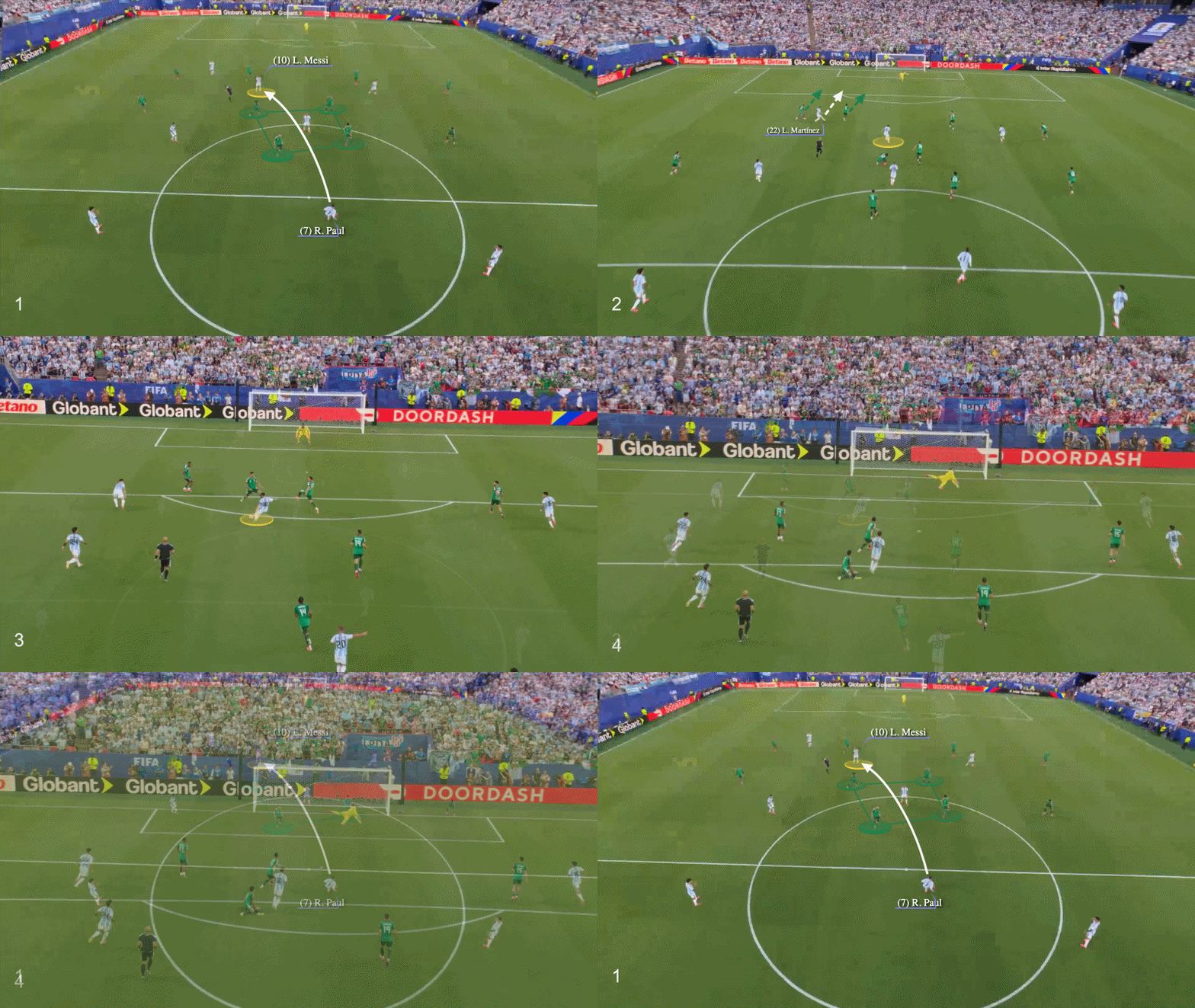
And while Messi’s first goal was a stunning finish, it was made possible by a magnificent De Paul pass. Algeria had packed their midfield to try to stop Argentina, and Messi dropped deep to attempt to open things up, but Mac Allister found himself surrounded by green shirts when trying to lay the ball back to him. De Paul, though, simply passed through the middle of four Algerians, straight to Messi’s feet, eliminating the midfield, and with Lautaro offering a run in behind, the defence were pulled away from the ball.

It left Messi in acres of space, with nobody closing him down. From an Algerian perspective, it could not have been drawn up any worse, and from there the Inter Miami man ‘simply’ stroked the ball into the top corner with the inside of his left boot. The goalkeeper, Luca Zidane (son of France legend Zinedine, to add another layer of World Cup magic), got two hands to the shot and probably should have done better.
Those are the moments that Messi saves his energy for, and it works. He showed this during a 90-second period shortly after his first goal, when he was initially walking back from an offside position, immediately offering a dart in behind when Cristian Romero had the ball, then coming short to get it instead, playing a one-two with Mac Allister, two one-twos with Thiago Almada, including a pass that was dinked over a defender, and then standing up a cross to the far post. If anything, beyond the goals, highlights his ability to burst into life, to be a threat in several different ways, it is something like that.

The goals, of course, are the standout, and his second looked simple at first glance but was another example of him always being available and alert. Initially, he is out on the left to control a long ball from goalkeeper Emiliano Martinez, which he immediately flicks in behind for Nicolas Gonzalez. His cross gets headed clear only to Mac Allister, who lines up a shot while Messi urges him to play the pass.

Mac Allister shoots but Messi stays alert, keeps moving and anticipates Zidane’s spill, allowing him to stroke the ball home calmly with his right foot.
He could have had the third before it did actually arrive — always anticipating and on the move when he needs to be, he begins his run in behind before the first pass reaches Mac Allister, allowing him to be through on goal once the Liverpool midfielder receives and moves it on. This time, Zidane was equal to it.

The hat-trick goal is classic Messi, one he has scored 100 times before (or maybe more).
Argentina break the press with some intricate play and create an opportunity to attack quickly. Messi receives the ball in the centre circle and, as always, drives forward. He passes left to Gonzalez and continues his run to the edge of the box, the area he knows so well.
Algeria’s Hicham Boudaoui was close to Messi when he played the pass out wide but instinctively retreated into the box as he and his team-mates tried to cover the danger, leaving more space outside the box.
Messi takes three touches in 1.2 seconds to set the ball exactly where he wants it, allowing him to open up his body and curl it into the bottom-left corner, as he has done so many times before.

“It was a difficult game, the scoreline is a bit exaggerated because we have the (No) 10,” De Paul told DSports afterwards.
There is some controversy around the performance, as some have highlighted an ugly challenge where Messi’s studs were planted on Algeria defender Aissa Mandi’s calf, although it was very clearly an accident after a tangle of legs.
Messi was tearful at full time, revealing he had had “some difficult days” away from football, while De Paul added that, generally speaking, his friend is playing without the pressure that has accompanied his previous World Cup campaigns, having got the job done at his fifth appearance in Qatar four years ago.
That victory was considered a consecration of his place as the world’s greatest ever player and, as a side dish, a true World Cup legend. The assumption was that it was his last World Cup, that his sparkling career was finally complete.
And yet, on Tuesday, he became the first man to play in six different editions (beating Cristiano Ronaldo by a day, assuming the Portuguese features when his team get underway on Wednesday), and moved level at the top of the competition’s all-time scoring charts, alongside Miroslav Klose of Germany with 16.
Clearly, there is a lot more to come.
Is anybody else done?