







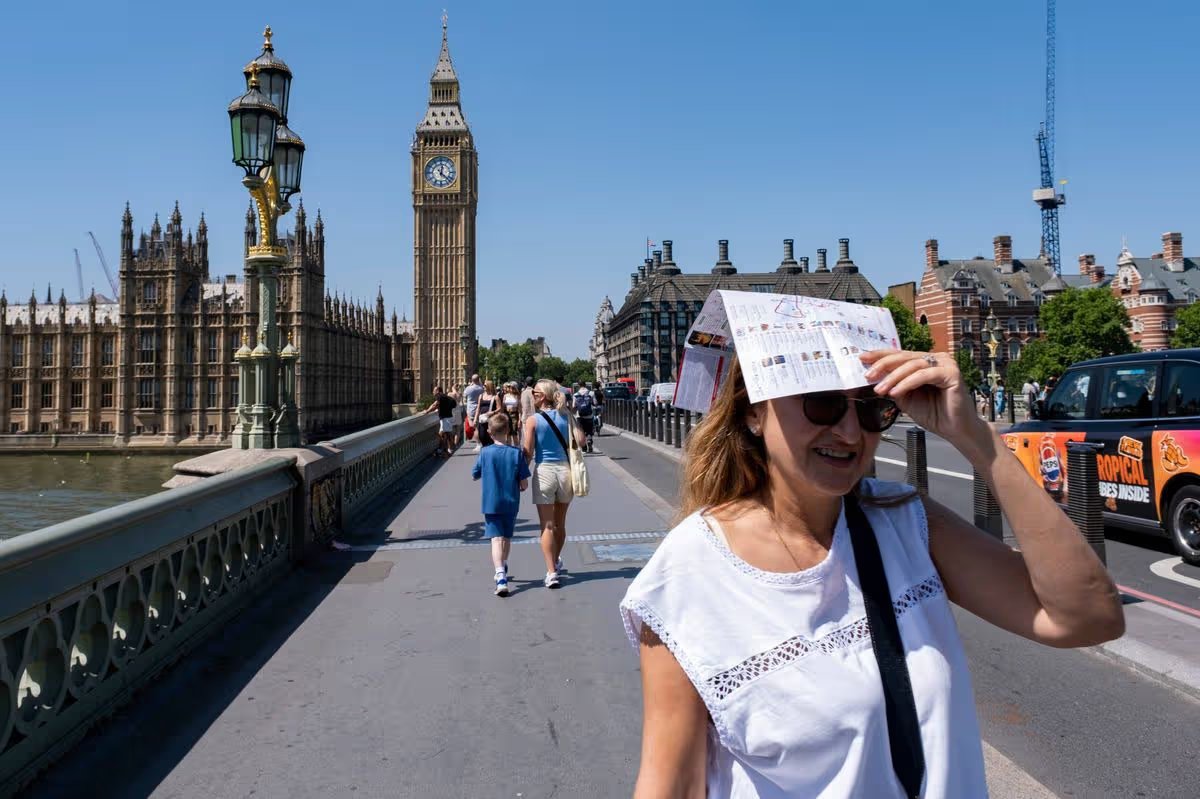
The Met Office has issued an extreme amber heat warning for parts of the UK as temperatures are set to soar to more than 38C, with the sweltering heatwave expected to last until at least Thursday
Britain is braced for record-smashing temperatures which could rocket beyond 38C as extreme heat warnings and health alerts have been issued.
The Met Office says the scorching conditions could persist until at least Thursday, triggering weather warnings and fears for vulnerable residents. Weather experts have said there is “growing confidence” this week could shatter the record for the hottest June temperature of 35.6C, which was established in 1976 in Southampton.
The UK Health Security Agency (UKHSA) cautioned people to expect significant impacts across health and social care services along with a rise in deaths, particularly among those aged 65 and over or with health conditions.
The blistering heat could also cause disruptions to rail, road and air travel, with the possibility of some tarmac melting, according to the Met Office. On Monday, National Rail advised travellers to check their journeys in advance, allow for extra time and to carry water.
Over the coming days, humid conditions are forecast alongside potentially tropical nights, when the overnight temperature does not fall below 20C, making it feel “muggier” than last month’s heatwave, the weather service said.
For Monday, central southern England could see highs of up to 34C with the temperature set to climb to 37C on Tuesday in southern England and south-east Wales, Met Office meteorologist Simon Partridge said. “Then Wednesday and Thursday, both 38C but there’s potential for it to go higher and then by Friday, coming down a little bit, so we’ll see 33C and then it should ease off into the weekend but still stay quite warm, even into next week, although it won’t be anywhere near as warm as this week,” he added.
The Met Office has issued an extreme amber heat warning from Monday until Thursday, highlighting potential health risks for those vulnerable to extreme heat and heat-related issues for the wider population, as well as a possible rise in water safety incidents.
The warning for Monday and Tuesday encompasses most of southern England, central and eastern Wales, and a large portion of the Midlands, while the alert for Wednesday and Thursday also includes parts of Greater Manchester, Yorkshire and Cheshire.
Those in the alert area are advised to stay hydrated and avoid the sun, and refrain from exercising between 11am and 3pm, according to the weather service.
Mr Partridge stated: “It’s a very unusual, very rare spell of very hot weather, so it’s one of those ones where people should take care, try to keep their houses as cool as possible, check in on those that are vulnerable, so the very young and very old, in particular, are more vulnerable to extreme heat.
“But everybody will feel this because it will be very hot and the overnight temperatures, in particular, will mean that people won’t be getting as much sleep, probably, as they would usually do, so it will affect everyone.
“There’s also potential for impacts to transport as well. We know that when things get very warm, there can sometimes be issues with railway lines, and even possibility that some roads might not be doing too well. If it gets too warm, you may even see a little bit of tarmac melting at times.”
The scorching temperatures are anticipated in regions between Bristol and London and south of the M4, with the majority of England and Wales set to reach above 30C this week, he explained.
Separate amber heat health alerts have been issued by the UKHSA which now cover most of England from Monday morning until Friday night. A UKHSA yellow heat alert is also in place for the North East of England during the same period.
The heat follows after at least 15 people perished after encountering difficulties in open water during a hot spell in May.
Mr Partridge said: “We’re also asking as well for everybody to just be very wary around bodies of water, because in the last heatwave, unfortunately, quite a few people lost their lives by going into cold water and getting cold water shock.
“That’s still very much an issue, so just be careful how you cool yourself down. If there’s the option between a hose pipe and jumping in the lake, probably go for the hose pipe and just keep yourself safer.”
Meanwhile, Europe is also sweltering under the heatwave, with temperatures forecast to hit 37C in Rome and 39C in Madrid on Monday. In France, temperatures soaring above 40C are forecast for Monday as emergency services and military personnel have been placed on wildfire alert. French authorities have imposed restrictions on public alcohol consumption and called off some outdoor sporting events.
Last summer broke records as the hottest ever recorded for the UK, with an average temperature of 16.1C from the beginning of June through to the end of August, according to the Met Office.
The previous record was set during summer 2018, followed by 2006, 2003, 2022 and 1976. When asked about climate change’s impact on current conditions, Mr Partridge explained that extremely hot periods are becoming more common.
“This is the second heatwave of this year already so it just shows that the warming climate means that these more extreme spells are becoming more frequent, and that’s unfortunately just the way things are going at the moment and it doesn’t seem to be slowing down,” he added.
For the latest breaking news and stories from across the globe from the Daily Star, sign up for our newsletters.