









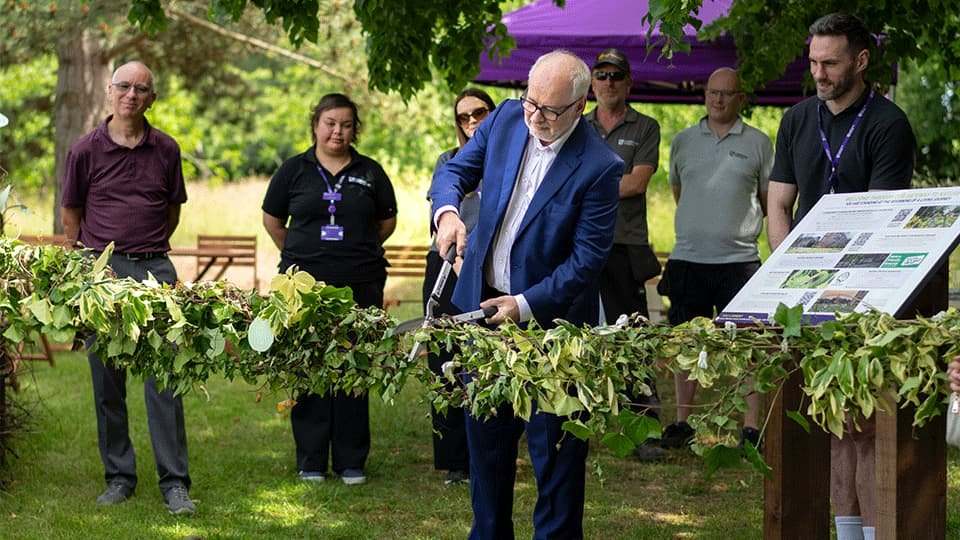
The University is continuing its commitment to creating a campus where people and nature thrive together through a new Nature Plan, to revitalise and reconnect vital habitats on campus, and create thriving ecosystems that support diverse wildlife.
On 22 June, the R.A.I.S.E. Nature Plan was launched at The Barefoot Orchard on Loughborough University Campus, with the aim of enhancing nature to improve biodiversity and support the learning, health, and wellbeing of students, staff and the wider community. This coincided with the opening of the “Gateway to Nature”, a physical entry point for our staff, students and local community to begin to explore the natural environment of Loughborough’s campus and practically experience the nature around us every day.
The event featured talks from Nik Hunt, the University’s Environmental Manager; Jack Matthews, Geoheritage Conservation and Interpretation Officer of Charnwood Forest; Elliot Brown, Loughborough University’s Sustainability Manager, and Vice-Chancellor, Nick Jennings. The talks were followed by an interactive walk led by Richard Fenn-Griffin, Assistant Gardens Manager, through campus and Burleigh Wood.
The Gateway to Nature and the engagement with nature through this will be developed as part of the R.A.I.S.E Nature Plan. The plan builds on the idea that creating a Nature Positive Campus at Loughborough University has always been shaped by place, its beautiful campus, its vibrant community, and the shared ambition to create a better future. Today, as biodiversity declines and natural systems face increasing pressure, the institution’s responsibility to act is clearer than ever.
The R.A.I.S.E. Nature Plan provides a structured approach to:
- Recover – Protecting and restoring existing wildlife habitats to aid recovery.
- Act – Identifying opportunities to take action that supports Loughborough’s strategies and meets its sustainability goals and environmental obligations and commitments.
- Improve – Increasing biodiversity by enhancing existing areas and creating new ones, linking these spaces with wildlife corridors as well as contributing to wider regional and national biodiversity targets.
- Sustain – Managing the grounds and buildings in ways that ensure ecosystems are sustained.
- Educate – Using the campus as a living laboratory to educate students, staff and wider community in biodiversity conservation.
Loughborough students, staff and wider local community can get involved in supporting this plan through the promoted nature activities or simply by being more aware of the nature around them and valuing it through appropriate use.
Access to green, accessible open spaces supports health and wellbeing, and the Loughborough University campus offers a wide range of such environments. Its woodlands, wetlands, conservation areas, wildflower zones, formal gardens, fruit route and sports areas provide places to walk, relax and work, while supporting diverse wildlife. This proactive approach to providing natural spaces and nurturing green environments is what makes Loughborough a Nature Positive University. In fact, Loughborough is a founding member of the Nature Positive Universities Alliance, a worldwide network of over 700 higher education institutions from more than 100 countries, founded by the University of Oxford and the UN Environment Programme (UNEP) in partnership with the UN Decade on Ecosystem Restoration. The initiative encourages universities to commit to assessing their biodiversity footprint, set measurable targets, implement actions, and report progress annually. The goal is to halt, prevent, and reverse nature loss while integrating biodiversity restoration into campus operations, supply chains, and local communities.
Biodiversity literacy training (Biodiversity Literacy Training July 2026 | Sustainability | Loughborough University) is another commitment made by the University to preserve ecosystems on campus. This engaging online session, the first of which will be held on 2 July, is designed to equip participants with a clear understanding of how human activity impacts biodiversity, while empowering them with the knowledge and practical tools needed to take positive action to restore and protect nature. It directly supports Loughborough’s R.A.I.S.E. Nature Plan, helping individuals build the awareness and capability required to contribute meaningfully to Loughborough’s biodiversity goals.
These initiatives are aiding Loughborough in achieving the United Nations’ Sustainable Development Goals (SDGs), of which the University has been a proud signatory since 2020. The SDGs provide a global framework for achieving a better and more sustainable future for all. There are 17 goals, each addressing global challenges such as climate action, life on land, life below water and responsible consumption and production, which are all connected. The SDGs drive Loughborough’s work on Sustainability.