










Tulane University is taking over the long-stalled effort to turn the former Charity Hospital in downtown New Orleans into a hub of education, medical research and apartments, university officials said Tuesday, a key milestone in an ambitious redevelopment project that has bedeviled city leaders for nearly two decades.
Under an agreement Tulane reached earlier this month with 1532 Tulane Holdco, the consortium selected in 2018 to oversee the $300 million project, Tulane will be responsible for restoring the 90-year-old former hospital and turning roughly two-thirds of it into the new home of the Tulane Celia Scott Weatherhead School of Public Health and Tropical Medicine and the Tulane Innovation Institute.

A rendering shows an aerial view of Tulane University’s plans for the former Charity Hospital building on Tulane Avenue.
1532 Tulane Holdco will convert one-third of the structure into apartments that will likely serve the Tulane and broader biomedical communities.
The deal still needs to clear several hurdles before it is finalized. And while it could fall through, it offers the best hope in years that the hulking former hospital on Tulane Avenue that never reopened after Hurricane Katrina may see life again.
Tulane University President Mike Fitts said in an interview earlier this month that the project can serve as a catalyst for the redevelopment of New Orleans’ medical corridor and, more broadly, the city’s downtown.
“I grew up in cities where there is a street life and activity in the downtown,” Fitts said. “That is what we envision downtown — a real concentration of literally thousands of employees, students, startups in a public space. That is a unique good that, in the long term, makes sense.”

A rendering shows Tulane University’s plans for the forecourt of the former Charity Hospital building on Tulane Avenue.
It is nevertheless a big bet for Tulane, which is putting its institutional muscle behind the project, assuming the risk and taking on most of the financial responsibility for transforming the landmark building into the centerpiece of its growing downtown campus.
Tulane officials say that once the redevelopment is completed, they expect to have space for 700 researchers, innovators and support staff in the building, creating one of the largest concentrations of health, biomedical and other research talent in the Gulf South.
“The whole point of this is integrating research across schools and creating the startups that come out of it,” Fitts said.
Joseph Stebbins, a partner with the Israeli El Ad Group in 1532 Tulane, said Tuesday that it’s too soon to discuss details of his group’s portion of the project but that the agreement between the two sides is a major step forward.
“It’s been very good working with the people at Tulane,” he said. “Everyone has been at the table.”

A cyclist passes Charity Hospital on Tulane Avenue in New Orleans, Tuesday, June 23, 2026.
The Charity deal is the latest of several major projects across New Orleans to see movement in recent months. Earlier this year, work began on turning the derelict Bywater Naval Station into a mixed-use development, and the owners of the former Lindy Boggs Medical Center in Mid-City announced that they planned to begin tearing down that structure later this year.
If the hospital redevelopment comes to pass, it would offer a boost to Mayor Helena Moreno, who has made cleaning up New Orleans’ large, blighted eyesores a priority of her administration. Though the project has been years in the making, it appears to have come together on her watch.
“The agreement to move forward with the transformation of Charity Hospital is another powerful sign that confidence in New Orleans is growing,” Moreno said in a statement Tuesday. “Institutions, developers, and investors are making long-term commitments to our city because they believe in our future.”
Tulane officials said they hope to begin construction before the end of the year and move into the building in the fall of 2029.
Long time coming
Tulane’s announcement comes more than a decade after plans to redevelop the hospital were first conceived by Mayor Mitch Landrieu’s administration and nearly eight years after the LSU Foundation selected 1532 Tulane to convert the former Charity Hospital into a mixed-use complex with medical offices, apartments and retail space.

The abandoned Charity Hospital building on Tulane Avenue in New Orleans is seen Oct. 20, 2023.
At the time, LSU and state officials said they selected 1532 Tulane over a competing proposal from New Orleans-based HRI because 1532 Tulane offered more cash up front and relied on fewer historic tax credits and public subsidies to make the deal work.
But the project was slow to get off the ground and hit by cost overruns due to the pandemic, supply chain disruptions, inflation and interest rate spikes. By 2024, the group had spent nearly $80 million with little to show for it and racked up liens and lawsuits totaling more than $6 million, court records show.
More than two years ago, Tulane, which had always agreed to lease space in the building as an anchor tenant, began exploring the possibility of playing a larger role, moving from a tenant that would occupy about a third of the building to an equity partner and, eventually the role of lead developer.
After months of negotiation with the lenders and equity partners that had backed 1532 Tulane Holdco, they finalized the current agreement earlier this month.

Tulane University signs surround Charity Hospital in New Orleans, Tuesday, June 23, 2026.
Greater New Orleans Foundation President and CEO Andy Kopplin, who was Landrieu’s Chief Administrative Officer when the Charity project was first envisioned, said Tulane is “the only entity with the strength and long-term vision to make the deal happen.”
“And it is an incredibly bold leap to make,” he said.
Unanswered questions
Under the terms of the deal, the LSU Foundation will amend its lease with 1532 Tulane to convert the former Charity building into a condominium with two “units” of unequal size — the large one, which will be under the control of Tulane University, and the smaller one, which will remain under the control of 1532 Tulane.
Tulane University will then acquire what’s known as a long-term leasehold condominium interest in the building.
It is unclear how much the project, which had an estimated price tag in 2018 of $300 million, will cost altogether. But Tulane’s portion alone will come to at least $500 million, a figure university officials say could well increase over time.
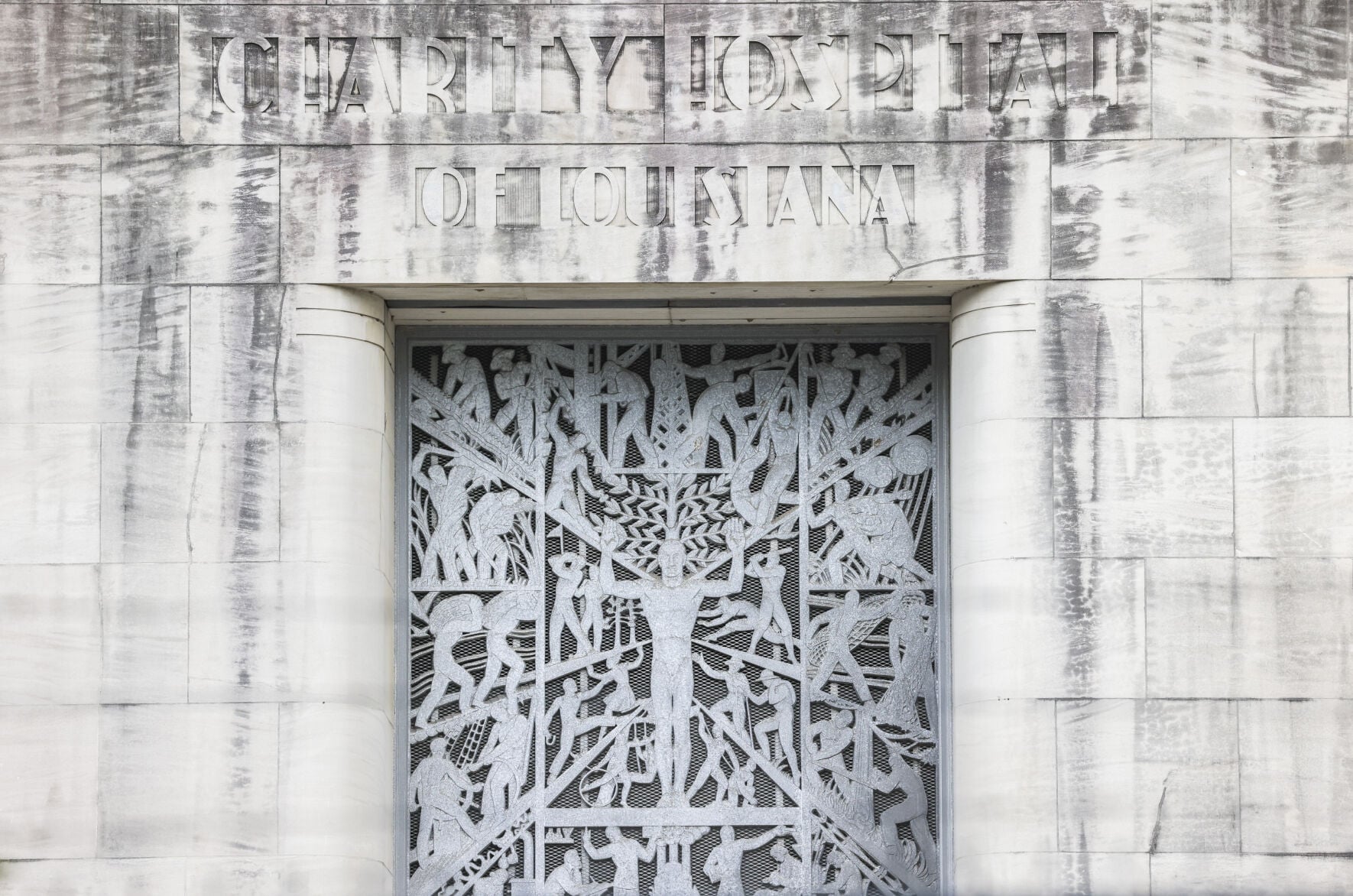
Charity Hospital sign and facade photographed in New Orleans, Tuesday, June 23, 2026.
“This is an old building that has been vacant for 20 years,” said Tulane Senior Vice President and Chief Operating Officer Patrick Norton. “Will it punch back? Of course it will. It’s a complicated project.”
1532 Tulane, meanwhile, will likely spend upwards of $100 million or more building out the residential portion of the building.
Tulane declined to provide specifics on how it plans to fund its portion of the project except to say it will come from university resources, private philanthropy, historic tax credit financing and public-sector support. In its announcement, the university said the Goldring Family Foundation provided the lead private gift for the project.
“We are continuing to work with public and private partners as the project advances toward financial closing and are not sharing a detailed funding breakdown at this time,” said Norton, Tulane’s executive lead on the project.

Renderings show designs for the interior of the former Charity Hospital, where Tulane University plans to house the Tulane Innovation Institute.
The city, under former Mayor LaToya Cantrell, put up $20 million toward the project to settle a lawsuit with the heirs of the Wisner Trust, including Tulane. The state, through a discretionary fund controlled by Louisiana Economic Development, has promised $30 million toward the project over three years. The first of those payments, $10 million, was approved by state lawmakers during the recent session.
It is not clear how much more public money will be required or in what form those subsidies could come.
“This project only works if public and private sources come together,” Fitts said.
Potential and pitfalls
According to renderings released Tuesday by Tulane, the reimagined Charity building will be a gleaming, light-filled version of its former self, with public spaces redesigned to bring together researchers, students, entrepreneurs and healthcare professionals.

A rendering shows plans for an internal courtyard as part of Tulane University’s plans to renovate Charity Hospital.
Visitors to the Tulane portion of the building will enter through a restored historic lobby and new entrance on LaSalle Street. Former waiting rooms will become a café and retail spaces. Common areas will also include a food hall and indoor-outdoor courtyards.
The building’s first floor will also feature a multi-purpose event and collaboration space, classrooms, and a 170-seat auditorium designed to support lectures, conferences, community programming and public events.

A rendering shows plans for the historic lobby of the former Charity Hospital building on Tulane Avenue.
Separate residential and academic entrances, along with dedicated loading and service facilities, will support the building’s mixed-use design.
While Tuesday’s development signals progress toward the building’s redevelopment, months of work remain before a financial closing.
University officials say their project team will continue to advance the design, refine the project scope, complete construction pricing and finalize financing and development agreements.
This story has been updated to include remarks from Mayor Helena Moreno, developer Joseph Stebbins and GNOF CEO Andy Kopplin.