








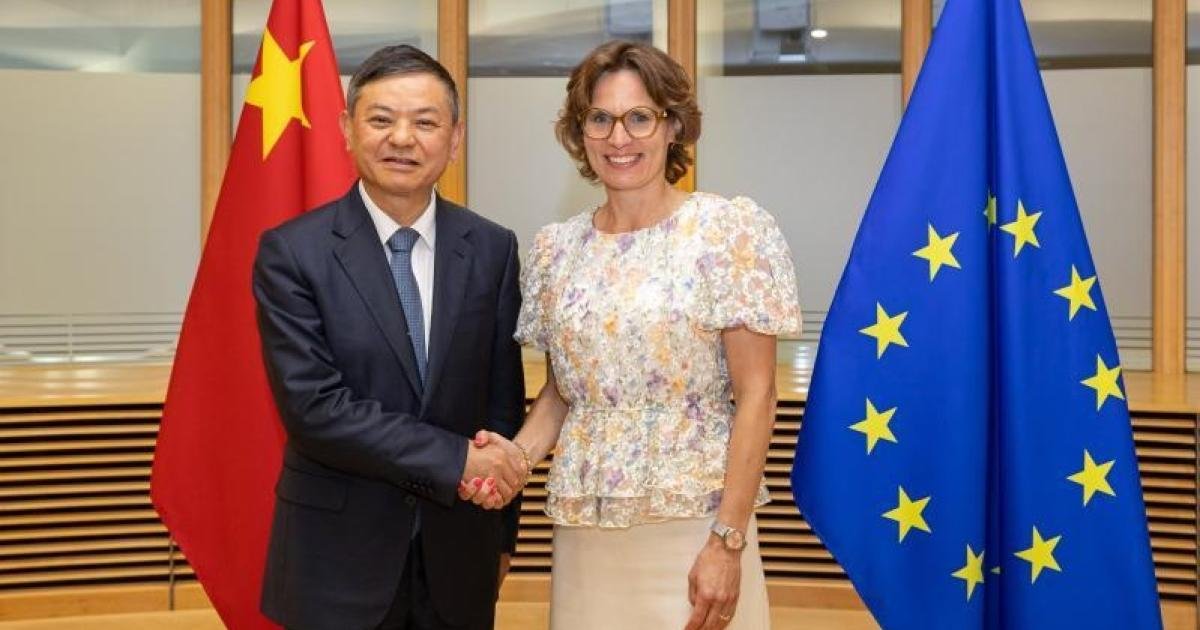
The EU and China reaffirmed their commitment to strengthening cooperation on key global environmental challenges on Tuesday (23 June), ahead of major international meetings later this year.
Discussions took place at the 11th EU-China Environment Policy Dialogue in Brussels, with the European Commissioner for Environment, Water Resilience and a Competitive Circular Economy, Jessika Roswall, and China’s Minister for Ecology and Environment, Huang Runqiu, co-chairing the meeting.
The high-level talks provided an opportunity to deepen EU-China environmental engagement and coordinate positions ahead of upcoming milestones, including CBD COP17 in Armenia, and the resumption of negotiations on a Global Plastics Treaty.
Both sides reiterated their shared responsibility to address the triple planetary crisis of climate change, biodiversity loss and pollution, and to work together on delivering concrete global outcomes.
“In the current geopolitical context, effective diplomacy is more important than ever. The EU and China must continue to work together to finalise the negotiations on a global treaty to end plastic pollution, to implement our shared commitments on biodiversity, and to strengthen environmental multilateralism.”
Jessika Roswall, European Commissioner for Environment, Water Resilience and a Competitive Circular Economy
Biodiversity and nature finance
Discussions focused on implementing the Kunming–Montreal Global Biodiversity Framework and preparations for the CBD COP17. The two sides discussed progress on nature protection and restoration in particular areas where implementation needs to be accelerated to meet the 2030 targets.
The EU presented its approach to scaling up biodiversity finance, including the EU Nature Credits Roadmap, and both sides exchanged views on mobilising private investment for nature protection and restoration.
They also spoke about ongoing work on nature credits and the importance of high-integrity approaches as a complement to public biodiversity funding.
The role of the Cali Fund for the fair sharing of benefits from Digital Sequence Information (DSI) was recognised as part of broader biodiversity finance discussions.
Plastic pollution and chemicals
The EU and China reaffirmed their joint commitment to advance negotiations on an ambitious, legally binding global instrument to end plastic pollution, requiring global action across the full lifecycle of plastics.
Both sides agreed on the urgency of accelerating global action, noting that plastic pollution is rising and cannot be addressed by any country alone.
The discussions also addressed chemical pollution prevention and control, including persistent and hazardous substances such as per- and polyfluoroalkyl substances (PFAS), often referred to as “forever chemicals,” as well as persistent organic pollutants.
Strengthening multilateral environmental cooperation
The two reiterated the importance of effective multilateral environmental governance and agreed to continue technical and political exchanges in support of ongoing international processes.
They discussed the importance of science-based policy-making and recognised the roles of intergovernmental science panels such as the IPCC on climate change and IPBES on biodiversity, as well as the International Resource Panel on natural resources.
Looking ahead, both sides confirmed continued cooperation in preparation for future high-level engagement, including the 7th High-Level Environment and Climate Dialogue in 2026, to be co-chaired by Teresa Ribera and China’s Vice Premier Ding Xuexiang.
The EU and China agreed to maintain close cooperation at both political and technical levels and to continue contributing positively to international environmental negotiations and governance frameworks.
More information
Nature credits | European Commission
Roadmap towards Nature Credits | European Commission