








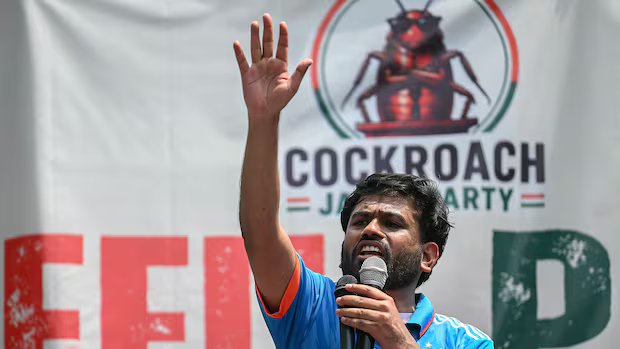
The “cockroaches” will not be squashed, according to Abhijeet Dipke, the founder of a new political movement aimed at Gen Z youth in India.
On Tuesday, the Cockroach Janta Party (CJP) extended their protest in central New Delhi to a fourth day, demanding the resignation of Dharmendra Pradhan, the country’s education minister.
A dead-of-night social media post by the CJP said, “Cockroaches are awake and fighting the system” and claimed that Delhi police was trying to “squeeze” the demonstrators out of their protest space near the Indian Parliament.
The 30-year-old Dipke has turned the lowly cockroach into a potent and viral symbol for young Indians, who are impatient over a lack of well-paying jobs and angry about a scandal over national exams.
“I don’t think we are here to topple the government. All we want is to change the political discourse of India,” Dipke told CBC News.

An online satirical jab at India’s government has exploded into a political movement on the streets. For The National, CBC’s Susan Ormiston breaks down the origins of the Cockroach Janta Party (CJP) and how Gen Z frustrations are fuelling its rise.
“The youth of this country is very frustrated, and this protest is a result of years of frustration, especially for the students,” said Aditi, who only goes by one name, at an earlier demonstration in Delhi.
On Sunday, two million students aspiring to get into medical school were forced to rewrite the National Eligibility cum Entrance Test (NEET), formerly known as the All India Pre-Medical Test, they’d sweated over last month, after it was revealed that test questions had been widely leaked. The education ministry cancelled the results.
It’s not the first examination controversy and the Indian government is under pressure to clean up national testing.
‘I’m so nervous’
In a country that puts a premium on academic excellence, the students are under high pressure to succeed in the tests, especially when working parents have sacrificed a lot to fund their education.
Indian media reported that at least 12 students have died from suicide since the first exams in May. One 18-year-old woman, the daughter of a cook, left a note to her parents that said, “Mom and Dad, you had faith that your daughter would become a doctor, but I no longer have the courage to take the NEET exam again.”
The CJP is demanding some families receive compensation from the government in the wake of those deaths.
“I’m so nervous,” said 19-year-old Shravani Sanjay Nivate at a test centre in Mumbai on Sunday, as anxious parents dropped off their daughters and sons and waited in the blazing sun for them to rewrite the three-hour exams.

Nivate, the daughter of a domestic worker, dreams of being a cardiologist. She scored high in the first round of NEET exams back in May, she told CBC, only for the government to void the results after the leaks.
She called CJP founder Dipke a populist fighter for Gen Z, “because there is no one else who understands our feelings.”
Pradhan, the national education minister, sees the CJP differently. As the “cockroaches” kept up their protest in central Delhi, he went on the attack.
“They are the B team of disruptive elements. Those who were rejected in the democracy have come in disguise and are now after the system,” Pradhan said on Monday. “They raise slogans for those who want to divide the country. They have been identified.”
Government has ‘misplaced priorities’
India has what’s called a demographic dividend: youth aged 15-29 make up 27 per cent of the population, translating into about 371 million people, the largest youth demographic in the world.
“We had a great opportunity to turn this young population into a workforce but the government has failed to do so because it has misplaced priorities,” Dipke said.
He said its priorities are more about grabbing power, trying to “break parties” and win elections by “hook and crook.”

He’s tapping into a vein of youth who are disenchanted with the political elite, and using the power of social media to recruit.
Dipke previously worked as a volunteer for three years on social media campaigns for the Aam Aadmi Party (AAP) in India, which emerged from an anti-corruption movement in 2011. He then went to the U.S. to get a master’s degree in public relations.
In May, while finishing his degree at Boston University, Dipke picked up on growing resentment over comments made by India’s Chief Justice Surya Kant in court about some unemployed youth.
“Have you seen there are youngsters who are like cockroaches: they don’t get employment, they don’t have any place in the profession … some of them become social media activists, some become RTI [right to Information] activists and they start attacking everyone,” Kant said.
The justice later defended himself by saying his remarks were explicitly aimed at people practising with fake or bogus degrees. But the damage was done.
Dipke seized on the cockroach as a satirical mascot for a youth party of the “lazy and unemployed.” Images he posted on X and then Instagram went viral, sparking memes, songs and masks.
“You find cockroaches where something is rotten,” Dipke told CBC, “so it means that the system of the country is so rotten that we have so many cockroaches coming out.”
Within days, the CJP had more followers than the Bharatiya Janata Party, India’s ruling party. Within weeks, the CJP boasted 22 million followers on Instagram.

Youth anger overstated, says expert
Some political watchers suggest that support for the CJP — which isn’t a registered party yet, and may never be — is small by Indian standards. The protests attract thousands, not tens of thousands, and the movement is in search of a clear focus.
“If you’re looking for the Cockcroach Party as a reflection of youth anger, it’s nowhere close to that,” said Mahesh Vyas, CEO of the Centre for Monitoring Indian Economy (CMIE). “I have seen India for a long time. [There’s been] a lot more stress in an earlier time.”
Vyas, who has tracked the Indian economy for more than 40 years, says polling research done by his company last month suggests the Cockroach Party is not tracking nationally.
“India is not going to burst with the youth getting angry, they’re not going to burn down buses and cause any havoc in the country.”

But he acknowledges there’s a wide gap between the bulge of educated youth and the job prospects available. Unemployment for people aged 15-29 is tracking at 29 per cent — five times the national rate.
“The economy can’t run fast enough, that is the core of the problem,” said Vyas.
India has “a fantastic opportunity in the youth” and the conditions for growth as a big country with a large domestic market. “But that opportunity is getting lost,” he said, in part because of a lack of private investment.
While the Cockroach Janta Party has yet to develop into a full-fledged political party, its followers are seizing the moment to tell the government of Prime Minister Narendra Modi that they want more attention.

“At least with these protests, something will go into the heads of the people who are in power,” said Rutam Pimplapure at CJP’s inaugural protest in Delhi on June 6.
Amanda Fernandes, who was also there, said that given the strength and size of her demographic in the largest democracy in the world, “I think it only makes sense to the youth if it forms into a political party.”