






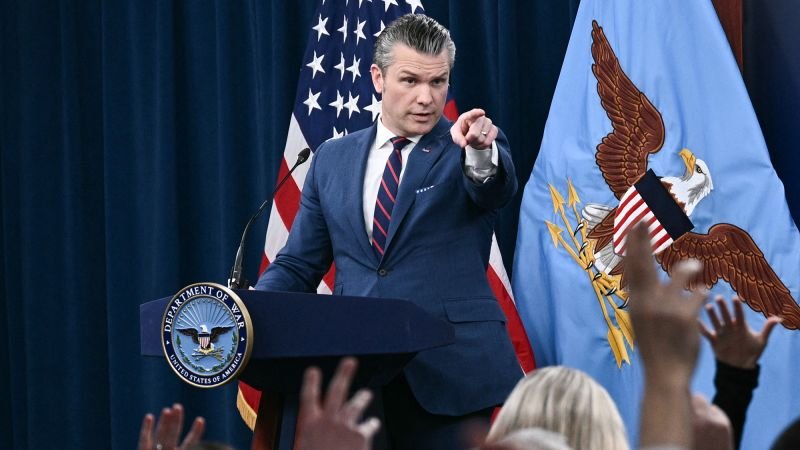
Defense Secretary Pete Hegseth has been taking steps to thwart news coverage of the Pentagon for more than a year. Now he has finally met some resistance.
Friday’s ruling by a federal judge striking down Pentagon press limits was cheered by the news organization that sued over the policy, The New York Times, and by a wide range of First Amendment advocates.
“This is a great day for freedom of the press in the United States,” the Pentagon Press Association, which represents scores of journalists who regularly cover the military, said. “It is also hopefully a learning opportunity for Pentagon leadership, which took extreme steps to limit press access to information in wartime.”
Some beat reporters who were pushed out of the Pentagon complex last fall are now discussing how to get their credentials reinstated.
But Hegseth’s press office says, “We disagree with the decision and are pursuing an immediate appeal,” signaling that he will continue to pick fights with the news media.
At recent press briefings about the war in Iran, Hegseth has mirrored President Trump’s hyperbolic language about the media and made plainly false claims about news coverage.
More alarmingly, from the perspective of Pentagon correspondents, he has also hindered the free flow of information about the US military, in part through the restrictive press pass rules that The Times challenged in court.
The rules had the effect of replacing major news outlets like The Times and CNN with a handpicked group of relatively small and explicitly right-wing outlets.
But the rules veered into unconstitutional territory, senior US District Judge Paul Friedman wrote in Friday’s ruling.
The policy is “viewpoint discrimination,” Friedman wrote, “not based on political viewpoint but rather based on editorial viewpoint — that is, whether the individual or organization is willing to publish only stories that are favorable to or spoon-fed by department leadership.”
Governments routinely try to encourage favorable coverage, but Hegseth has gone much further since leaving Fox News for the Defense Department, which he has rebranded as the Department of War.
One of his first moves was to boot some news outlets, including CNN, from long-established media workspaces inside the Pentagon complex.
It was billed as a temporary “media rotation program,” boosting pro-Trump media outlets that never had a presence at the Pentagon before. For one year, Breitbart was meant to replace NPR, One America News Network to replace NBC News, and so forth.
But any argument about media diversity was undermined by the department’s inaccessibility.
Hegseth’s spokespeople declined to hold regular press conferences, effectively closed the Pentagon press briefing room, and made key parts of the Pentagon complex off-limits to journalists without an official escort.
By May 2025, the Pentagon Press Association was calling the restrictions “a direct attack on the freedom of the press and America’s right to know what its military is doing.”
It was apparent to many beat reporters that Hegseth wanted to prop up propagandistic outlets while punishing traditional media outlets.
He promoted himself on Fox, for instance, and gave access to right-wing content creators, while bashing what he called the biased “hoax press.”
In September, his press office circulated a new policy controlling the press credentials that grant physical access to the Pentagon complex.
The policy challenged the ability of reporters to freely gather information, for instance, through leaks from sources inside the military, by enabling the Pentagon to suspend or revoke credentials due to reporting.
Media lawyers said the revised rules criminalized routine reporting. So, rather than abide by the new policy, journalists from virtually every major American news outlet turned in their press passes en masse last October.
The Pentagon gave credentials to what it called “the next generation of the Pentagon press corps,” made up of staples of the MAGA media diet that are barely known to the rest of America.
Those media outlets were welcomed into the building’s workspaces, though the cubicles and offices are said to be largely empty nowadays. Before long, some of those outlets also began to complain about a lack of transparency from the Pentagon.
A handpicked ‘press corps’
When the US and Israel began strikes in Iran, and the Pentagon resumed somewhat regular press briefings, Hegseth called almost exclusively on MAGA-aligned outlets that were given front-row seats in the briefing room.
Representatives of bigger news outlets with decades of experience covering the US military — who were granted temporary access to the building — were seated in the back and generally ignored.
Furthermore, The Washington Post reported that the Pentagon “barred press photographers” from some briefings after the photographers published photos of Hegseth “that his staff deemed ‘unflattering.’”
Those photographers were allowed back inside for the most recent briefing on March 19.
But Hegseth added a new anti-media talking point to his repertoire that day, claiming that the “dishonest and anti-Trump press will stop at nothing — we know this, at this point — to downplay progress, amplify every cost, and call into question every step.”
He diagnosed them with “TDS,” short for Trump Derangement Syndrome, a favorite insult of MAGA loyalists.
Hegseth also said Iran wants “to put out fake AI-generated images, which, by the way, sometimes our press happens to fall for, like the Abraham Lincoln on fire.”
His assertion that the American press has fallen for the fake imagery is itself fake. As CNN’s Daniel Dale reported, “There is no evidence that mainstream US media outlets promoted fake videos of the Lincoln on fire.” In fact, several US outlets, including The Times, debunked the videos.
When it filed suit against the Defense Department last December, The Times said the press pass restrictions were “an attempt to exert control over reporting the government dislikes.”
When Friedman ruled in agreement on Friday, The Times treated it as front-page news, and a spokesperson said the ruling “enforces the constitutionally protected rights for the free press in this country.”
“Americans deserve visibility into how their government is being run, and the actions the military is taking in their name and with their tax dollars,” The Times said.
Julian Barnes, the Times reporter named as a plaintiff in the lawsuit, wrote on X, “This is a big win for the press, the public and the United States military, which fights better when observed by a robust press corps.”
Journalists at other news outlets are also monitoring the case closely. A CNN spokesperson said of the ruling, “This is an encouraging development and we are evaluating next steps and what this means for CNN.”
All the while, most original journalism about military matters has still been produced by the traditional outlets that lost access to the Pentagon complex last fall.
While Hegseth and his deputies have adopted a hostile approach toward the press corps, rank-and-file military officials have not.
When the ruling was handed down, beat reporters who had previously worked inside the Pentagon received messages from military personnel saying things like: “Does this mean we’ll see you Monday?”