








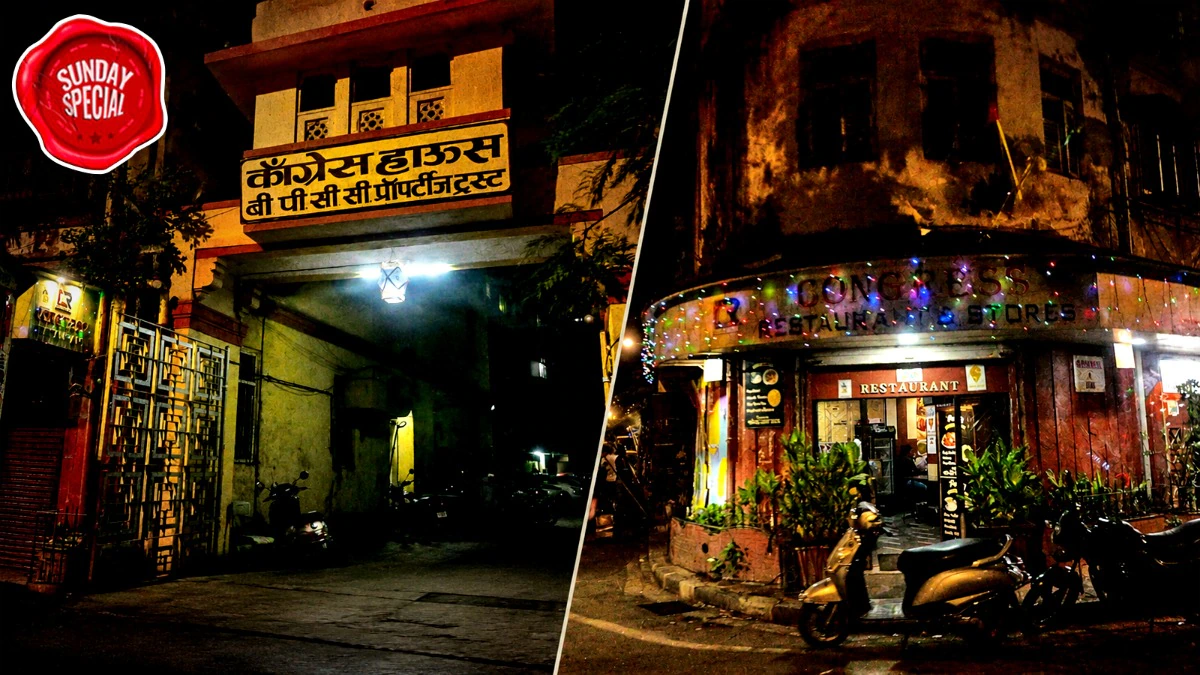
The first person I met at the former Mumbai headquarters of the Indian National Congress wanted to make one thing clear. “This is not the brothel,” he said. The man, a watchman who has worked at the complex near Grant Road for years, has probably repeated the sentence hundreds of times.
For residents of the building, known as Congress House, that clarification has become muscle memory. It was once among the most important political landmarks in India, once frequented by Mahatma Gandhi, Jawaharlal Nehru, Vallabhbhai Patel, Muhammad Ali Jinnah, Sarojini Naidu, and many other stalwarts of the Independence movement. Today, men often enter its compound, looking for sex.
Some men, who get past the watchman’s strict vigil, even end up knocking on the residents’ doors after mistaking the historic political landmark for the century-old mujra house and a brothel that lies just 20 feet across the road from Congress House. But it would be inaccurate to say that Congress House is entirely untouched by the sex trade.
Sex work does not take place inside Congress House, claim its residents. But the Congress Bar and Permit Room, which is a part of the now-dilapidated art-deco compound, is where pimps and middlemen are often seen hanging out, negotiating the hafta they earn from the sex workers next door. “The Congress Bar and Permit Room started out as an Irani cafe,” explained Nayan B Yagnik, one of the trustees of the Bombay Pradesh Congress Committee (BPCC) trust, which now owns the building.
Today, the former Irani cafe in Congress House has turned into a seedy bar, where patrons often stop by for a drink before going across the road to have sex at the brothel.
For generations of Mumbaikars, the name Congress House is a shorthand for prostitution. But how did it become a synonym for a brothel?
Before getting to the euphemism’s clarification, let’s look at the geography of Congress House.
Congress House is not a single building, but a cluster of seven ageing structures spread just off the Lamington Road in South Mumbai. Each building is named after leaders of the freedom movement and the Congress party. Sarojini Sadan, People’s Jinnah Hall, Kasturba Kutir, Dadabhai Nowroji Manzil, Tilak Mandir, Vitthal Sadan, and Congress House itself. Just across the road is the NB Compound, one of Mumbai’s oldest surviving mujra districts, named after Noor Mohammed Beg, a landlord who purchased the property in 1936.
NB Compound and Congress House are barely 20 feet apart, and face each other. Over the decades, the identities of the two buildings have become so intertwined that one has nearly swallowed the other. The brothel’s presence spills across the road into Congress House, particularly at its bar, where pimps and patrons are frequently seen. The name of one of India’s biggest political parties has spilled over into NB Compound.
However, this wasn’t always the case.
Congress House was established in the 1920s as the headquarters of the Bombay Pradesh Congress Committee and soon became a nerve centre of the freedom movement, hosting meetings, protests and planning sessions linked to the nationalist struggle. Historical accounts and research on the area note that even some tawaifs from the neighbouring mujra district contributed to nationalist fundraising efforts, including the Tilak Swaraj Fund.
Decades later, after the Congress split into Congress (O) and Congress (I), both factions laid claim to the landmark property. The dispute was eventually settled in favour of a trust that continues to own the complex today.
In 1972, Prime Minister Indira Gandhi helped establish a music academy here for performers of the Agra Gharana.
Such was Congress House’s prominence during the freedom movement that its name eventually came to describe the entire neighbourhood. Even today, the locality is known as Congress House despite being home to several other historic compounds, including Nikko House and NB Compound itself.
“Nobody really knows precisely how the kotha came to be known as Congress House,” Yagnik said. “These places are over a century old, and much of their history is anecdotal. One possibility is that sex workers began using ‘Congress House’ as the destination when they asked to be dropped here by the cabbies. The Congress office was the area’s biggest landmark, and one of India’s most important offices till the 1960s. Over time, the name spread to the entire neighbourhood,” the trustee of BPCC told India Today Digital.
This misunderstanding frustrates many residents today. A wrong name on Truecaller can be annoying. Imagine then, living at an address that generations of Mumbaikars associate with a brothel. A schoolgirl I spoke to said the address often becomes fodder for bullying at school, and she has never told her classmates the exact area where she lives in Grant Road.
But this story goes beyond the residents’ frustration. In this tiny neighbourhood, both Congress House and the women across the road have been stripped of their histories and reduced to labels.
I had been to this part of Lamington Road before for reporting assignments, but generally after sunset, when the area starts bustling. This time, when I arrived at Congress House around noon, I expected the kind of atmosphere one associates with a red-light district, as Kamathipura is just next door. Instead, I found families carrying groceries, children returning from school, and residents chatting outside their homes. The building, which I saw in daylight for the first time, looked worn but lived-in. Small businesses, offices and shops that had remained hidden during my earlier evening visits were open this time. A remarkably ordinary scene in a not-so-ordinary locality.
The paint is peeling off the walls in long strips. Signboards have faded. In places, peepal are sprouting from cracks in the concrete, roots snaking through the art deco masonry. But it is still inhabited, like thousands of crumbling structures across Mumbai, long after decay has set in.
The residents India Today Digital spoke to were either frustrated or indifferent.
Baljinder Singh (name changed), a permanent resident, is one of those residents who is fed up with men who come to the area seeking sex. “Drunk men have shown up at odd hours at least thrice at my door in the last three-four months,” he said. Singh has now installed a peephole camera at his door.
But the watchman acts as the first line of defence at Congress House. Unlike the relaxed chowkidars of other old Mumbai societies, this one questions visitors strictly. “People think this is a brothel and just walk in. I stop them,” he told India Today Digital, refusing to share his name.
Santosh Modi runs a kirana shop in Congress House. His shop overlooks the brothel, and the Queen Mary School right opposite to it. Raised in the area, Modi is quite indifferent about the setting. Right in front of his shop, schoolchildren boarded the bus on the same road where pimps, mostly in white shirts, sit, always on a vigil. “Look at the school,” Modi said, adding, “No problem here.”
Another resident, a Sikh man, requesting anonymity, offered an even more detached perspective. The presence of a brothel in the vicinity of his house is seemingly neither unusual nor disruptive to him. “It [the brothel] has always been here. They dance, have sex, and earn money. Outside the NB Compound and the Congress House stretch, nothing about their appearance reveals who is a sex worker and who is not,” he said, adding that the sex workers in the lane maintain a certain discipline. “They don’t interfere with others. They are money-minded. Who isn’t in Mumbai?” he said.
But this view is not shared by all. A young resident, who spoke to India Today Digital right outside the building with her mother, expressed frustration at the stigma attached to their address. “We don’t like stepping out in the evening sometimes because of how men who come to the area look at us,” she said. “Why should we be judged for something happening next door?” she added, expressing frustration over how most people think of Congress House as a brothel.
Today, over 80 families are living in Congress House, and at least a dozen commercial properties on its ground floor. While men in the neighbourhood spoke of normalcy, women appeared more burdened by the association of a heritage building and their address being linked to prostitution.
THE LOOK AND FEEL OF THE CONGRESS HOUSE LOCALITY
The lane in which Congress House sits is quite symbolic of Mumbai’s cosmopolitanism.
At the entrance stands the Young Men’s Christian Association (YMCA). Further inside is Saidham Wadi with its Sai temple. In a by-lane sits an Irani Fire Temple in Shapoorji Broacha Baug. And, improbably, in the same building as NB Compound, a BJP Kisan Morcha office operates below rooms linked to sex work, directly opposite Congress House.
Different worlds coexist next to each other in this lane, much as they do across Mumbai.
Shops in the lane, mostly selling auto parts, run by the Sikh community members, shut by 6-7 pm. Those closing hours are unusual for Mumbai. But that is also when another Mumbai awakens, the one seen in Madhur Bhandarkar’s Chandni Bar (2001), or Mira Nair’s Salaam Bombay! (1988).
Mannat Singh, a shop owner, complained of daily solicitations. “Andar aa jaao mere raja,” is what I hear when I visit the warehouse on Paper Mill Lane during evenings (a by-lane in Congress House area),” complained Singh.
Another shopkeeper, who requested anonymity, told India Today Digital, “Why don’t they [the sex workers and the pimps] go somewhere else? They have swallowed the entire area.”
But despite the discomfort it causes for the residents, and the uneasy, sexual tension that lingers in the lane as the sun sets, the area seems largely safe today because of the presence of police.
As evening falls, DB Marg police station, about 500 metres from the brothel, deploys personnel here. A sub-inspector here noted sex work in NB Compound operates within legal bounds, meaning it is in private space and consensual. A battery of cops patrols from dusk to dawn, covering both Kamathipura, and Congress House areas, with a permanent vehicle stationed between Congress House, NB Compound, and Queen Mary School. “We are there for the safety of patrons and the women,” a woman constable told India Today Digital.
However, despite the police bandobast, women residents rarely step out onto the streets in the evening unless absolutely necessary.
Geeta Thatra, a researcher who lived in the area and documented it in detail in her 2016 paper “Contentious (Socio-spatial) Relations: Tawaifs and Congress House in Contemporary Bombay/Mumbai,” captured Congress House intimately.
Speaking to India Today Digital, she said, “The entire area is called Congress House, and this confusion has persisted over the years. But the residents of the Congress House are turning against the women [sex workers] and want them to be removed from the area despite the fact that women themselves do not bother anyone. They are largely confined within their premises or step out to work in bars or other places.”
“But they [the sex workers] are often subjected to complaints by the Congress House residents, who are also upset that their property is not yielding a good price in the market,” she said.
PARALLEL HISTORIES IN THE CONGRESS HOUSE LANE
The Congress House emerged as a hub of the nationalist struggle. Jinnah Hall was established in 1918, and the Bombay Pradesh Congress Committee (BPCC) office opened in 1925 by Mahatma Gandhi. It hosted Satyagraha meetings, boycotts, and Quit India activities in the 1930s and 1940s. Funding from the Tilak Swaraj Fund helped acquire the property.
Meanwhile, just next door, NB Compound, purchased around 1936 by a landlord, Noor Mohammed Beg Mohammed, developed almost simultaneously as a centre for mujra performances. However, Beg did not belong to any performing community.
Geeta Thatra’s research paper explains that tawaifs from communities like Kanchan, Deredar, Bedia, and others — many migrants from Uttar Pradesh, Madhya Pradesh, and Rajasthan — performed here.
Since Congress House and NB Compound exist in such proximity and evolved simultaneously, courtesans also contributed to the Tilak Swaraj Fund, according to Thatra’s research paper. However, they were not allowed to hold office in the Provincial Congress Committees. Gandhi is said to have told the courtesans that “no one could officiate at the altar of Swaraj [self-rule] who did not approach it with pure hands and a pure heart.”
These very kothas in NB Compound once hosted jumme ki baithaks, where legendary musicians like Ustad Ahmed Jan Thirakwa, Ustad Amir Hussain Khan, and vocalists such as Ustad Bade Ghulam Ali Khan found patronage, training, and competition. The space played an important role in Hindustani classical music, carrying forward gharana traditions even as the anti-nautch movement — a late 19th and early 20th century campaign by reformers and missionaries that stigmatised tawaifs and their art as immoral and “corrupt” — pushed many performers to the margins.
The two sites coexisted harmoniously for decades.
Thatra noted in her paper that no official complaints or condemnations were made by BPCC or Sarvodaya Movement figures about the mujra performances nearby.
Mumbai-based senior journalist and author Jane Borges has reported that in 1972, Indira Gandhi, the then Prime Minister, had set up a Sangeet Academy at Congress House. In her WordPress column, Borges wrote, “In 1972, Mrs Indira Gandhi, the then Prime Minister, set up a Sangeet Academy at Congress House. The Academy was home to members of the Agra community of singers and dancers who organised dance shows for the royals over 300 years ago. I am sure she did not realise what it was going to be like today…”
Congress House’s trustee, Nayan B Yagnik, who spoke to India Today Digital in an office once used by Jawaharlal Nehru, recalled how two Congress factions, Congress (I) and Congress (O), once laid claim to the property after internal splits, before it ultimately went to a trust.
Today, the name “Congress House” is a notorious moniker that has swallowed many of these identities.
GROUND REALITIES OF NB COMPOUND TODAY
Inside NB Compound, conditions are grim. Sewage drips onto the footpaths from broken pipes. Rats, garbage heaps, and the stench of open drains fill the space.
At night, the dim lights hide what daylight cannot. Sexual desire edits the scene. The women wait for a reaction. The men come looking for women. The pimps keep vigil on both.
Ravi Ji, a key figure and seen by pimps as the person in charge (karta-dharta) of the brothels in NB Compound, whom I met through a pimp named Sajid, acknowledges that pimps take about a 50% cut from the women. “It might seem like dirty work today, but it was very cultural. Back in the day, many people associated with the Congress party also came to NB Compound to watch mujra,” Ravi Ji told India Today Digital, refusing to disclose his full name, except to say he is from Rajasthan.
Even today, the main gate of NB Compound still bears the sign: Mumbai Sangeet Kalakar Mandal, registered in 1977.
Tawaifs who lived here transitioned to dance bars, which are now banned, but operate rampantly across Mumbai and its suburbs.
The same neighbourhood that houses one of Mumbai’s oldest red-light districts also has schools, temples, businesses and homes, and towers that house business tycoons. The same road that separates Congress House from NB Compound also connects them. Not far away stands Firdaus Hindu Hotel, where Saadat Hasan Manto is said to have found inspiration in the lives of Kamathipura’s sex workers.
The story of Congress House is ironic. It is remembered for something it never was. Meanwhile, the women of NB Compound are remembered only for one aspect of what they once were — mujra performers, often in a negative light.
As I left the lane, some men headed towards the brothel. Patrol vehicles made their rounds. The residents disappeared into the entrances of Congress House.
– Ends