




‘They thought they could pressurise India. They talked bad about our leaders. They said India was a dead economy. They were not sensitive to the Indian psyche.’

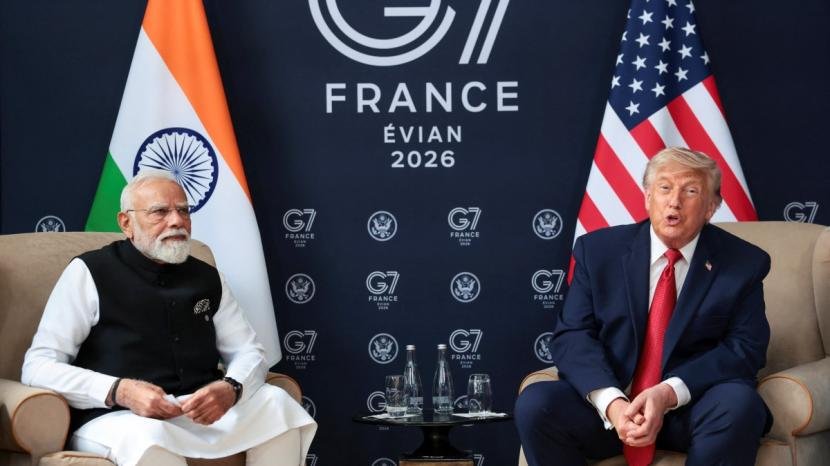
IMAGE: Prime Minister Narendra Modi meets with US President Donald Trump during the G7 summit in Evian-les-Bains, France, June 17, 2026. Photograph: Evelyn Hockstein/Reuters
Key Points
- ‘India should not have agreed to so many terms. In the past, India had never agreed to such one-sided terms.’
- ‘There was nothing from the US side to offer to India.’
- ‘India had agreed to the joint statement which was one-sided. That gave them the confidence that India would agree to any pressure from the US side.’
He came. He went back. He didn’t conquer.
That is the story of US Trade Representative Jamieson Greer’s visit to India on the 23rd and 24th of June 2026.
The 2026 story goes like this.
Under the February 7, 2026 framework, Washington offered to reduce reciprocal tariffs on Indian exports from 25% to 18%.
In return, they wanted access to Indian markets; agriculture, energy, defence, aircraft, digital services and advanced technologies.
But the US supreme court’s February 20 ruling invalidated the reciprocal tariff regime.
After that, the business trade agreement proposed by America was like a one-way market access agreement rather than a balanced trade pact. Only America benefitted from it.
Sense prevailed on India, and it did not sign the agreement.
And off he went back empty handed.
“Gradually there came a realisation that the deal was one-sided,” Ajay Srivastava, Founder, Global Trade Research Initiative, tells Rediff‘s Shobha Warrier in the first part of a two-part must-read interview.

IMAGE: Finance Minister Nirmala Sitharaman meets United States Trade Representative Jamieson Greer in New Delhi, June 23, 2026. Photograph: @FinMinIndia X/ANI Photo
Why The Deal Collapsed
The US ambassador to India said in May that a trade deal with India was 99% ready, but the US trade representative came and went back without actually achieving anything. What do you think happened?
The sentiment that the trade deal was 99% complete was echoed by not just the US side, but also by the Indian official side.
Gradually there came a realisation to the Indian side that the deal was one sided.
They were negotiating a deal that was agreed on the 7th of February in a joint statement issued by the US and India.
The joint statement said that US offered to reduce reciprocal tariffs on Indian exports from 25% to 18% in exchange for far-reaching Indian concessions on agriculture, energy, defence, aircraft, digital services and advanced technologies.
India agreed to cut its agriculture tariffs, industrial goods tariffs, etc.
India agreed to align its security and economic policies with the US.
India agreed to dilute its digital policy.
India agreed to buy US goods worth 500 billion dollars in the next five years.
Yes, India committed to all these things.
As against all these, the US side gave only one concession; that they will be reducing their reciprocal tariff from 25% to 18%.
US Supreme Court Changed Negotiations
Why did India agree to such a one-sided agreement in February?
If you ask me personally, yes, it was one-sided. India should not have agreed to so many terms.
In fact, in the past, India had never agreed to such one-sided terms.
Even the one thing which the US was offering, that is cutting reciprocal tariffs from 25% to 18%, was gone when on February 20th, the US supreme court passed an order holding reciprocal tariff as violating the law.
The court said the US president exceeded his authority, and he could not use reciprocal tariffs on countries based on trade deficit alone.
With that foundation gone, the only thing the US was offering to India, that was reducing these reciprocal tariffs, did not exist.
It means there was nothing from the US side to offer to India.
Then, why did the US ambassador say the agreement was 99% done?
They thought they could pressurise India.
They talked bad about our leaders. They said, India was a dead economy. They were not sensitive to the Indian psyche.
They were openly insulting India and thought they could pressurise India that way.
They must have been emboldened to do so because no reaction was coming from Indian side.
Had India responded to those insults, they would not have said all these things.
They thought they could get away with whatever they wanted.
India had agreed to the joint statement which was one-sided.
That gave them the confidence that India would agree to any pressure from the US side.

IMAGE: Nirmala Sitharaman meets Jamieson Greer and his delegation in New Delhi, June 23, 2026. Photograph: @FinMinIndia X/ANI Photo
Do you think India should have reacted at that time itself to the one-sided agreement they were planning?
In my opinion, more than the agreement, if somebody is saying that India is a dead economy, that Indian software professionals are terrorists with the laptops, and calling our leadership bad names, India should have responded.
Had they done any such thing to China, China would have responded immediately.
Other countries also would respond.
But India didn’t respond.
This silence emboldened them. They thought they could pull this trade deal also.
But suddenly, there was a realisation on the Indian side.
It was like, how can you justify this one-sided deal to even a 10 year old, forget about the grown-ups, economists and other experts?
How will you explain that you are giving so many concessions to the US but not getting anything in return?
When the US smelt this, they launched the Section 301 investigations.
India Protects Strategic Interests
Investigate under the name of excess industrial capacity and forced labour…?
Yes, one investigation focused on alleged excess industrial capacity, while the other examined forced labour concerns in global supply chains.
And India was included in both the investigations.
They said India was not prohibiting imports from those countries that used forced labour. Obviously, they were referring to China.
The second was excess capacity; that India had excess capacity in solar panels, pharmaceuticals, garments, etc, and that was why India was able to export to the US.
India was not the only country that was investigated; there were 60 other countries too in the list.
It was on June 3 that the US released the findings of the forced labour investigation and proposed additional tariffs of 12.5% on imports from India and the other economies.
It meant they would impose higher tariffs.
The interesting point is that they had already done trade deals with the European Union, Japan, South Korea, the Philippines, and Malaysia. But they started investigations against them also.
Malaysia walked out of the deal then…
Yes, when the US supreme court judgment came, Malaysia could see that it was one-sided. So, they walked out.
Now the other countries will have a tough time explaining to their people how they are going to withstand the one-sided deal.
India must have seen all these things.
The second point is earlier the US considered India as the central point in Asia-Pacific.
But when they saw that China has become too big, and it cannot be contained through its Asia-Pacific strategy, they evolved the concept of G2.
G2 means America and China are equal, and the other countries are subordinates to them.
With that, the strategic value of India vanished. And they saw India purely as a market for the US goods and services.
They believed India would absorb even the maximum of US tariffs. That was how they were dealing with India.
Along with that, India did not respond to all those insults. It emboldened them furher.

IMAGE: Union Commerce Minister Piyush Goyal meets Jamieson Greer on the sidelines of the World Trade Organisation’s 14th ministerial conference in Yaounde, Cameroon, March 27, 2026. Photograph: @PiyushGoyal X/ANI Photo
Do you think India will only delay this agreement or will it abandon this one-sided agreement totally?
One thing is that you can delay it under some pretext.
One argument from the US side could be we would impose lower tariffs through Section 301 investigations.
But then the counter argument can be you can start new investigations as per the trade deal as you have done with the European Union, Japan, South Korea.
It is a fact that right now they have nothing to offer to India or any country through trade deals.
So, India can ask them, what are you giving us?
Then, India can delay the deal for 6 to 7 months. Then they can walk out of the deal.
Exports Stayed Surprisingly Strong
Even in the beginning itself, should India have agreed to give access to sensitive markets like agriculture, energy, defence, etc to America?
We don’t have full details right now. All we have is a half-page joint statement which mentions some agriculture products.

IMAGE: Ajay Srivastava.
Only when the detailed list comes, we will come to know.
Yes, there was a lot of pressure to open agriculture, almost all the industrial goods by $500 billion and so many other things.
India should not have agreed even what was very liberal.
After the US supreme court judgment, even that is gone.
But because of the judgment, India is empowered to walk away from the deal.
Feature Presentation: Rajesh Alva/Rediff