






Fans of the Disney+ TV series “The Mandalorian,” which debuted in 2019, appreciate its family-friendly take on the space Western genre.
Film production nerds hail the show for an entirely different reason: its groundbreaking “virtual production” process.
Most scenes for shows and movies are either filmed in real-life locations or in climate-controlled soundstages, where crews construct elaborate physical sets to replicate the real world. Filmmakers also shoot in front of giant painted or fabric “green screens” that can be replaced with other images during the post-production process.

But “The Mandalorian” producers tried something new, shooting the majority of the show’s scenes inside a giant, wraparound LED screen that can display everything from the exterior of an exotic planet to the inside of a spaceship, allowing actors to inhabit virtual worlds during their performance and saving producers time and money by not having to create digital backgrounds during postproduction.
Seven years ago, that process was revolutionary. Today, it has become another money-saving tool for producers of movies, TV shows, commercials and all forms of filmed media.
In Louisiana, a state once dubbed “Hollywood South” because of generous tax incentives that spawned a bustling film and TV industry, at least two companies and one university have invested in high-definition LED screens, special camera-tracking hardware, powerful computers and software to support “Mandalorian”-style virtual production on a smaller scale.
They’re hoping that the new technology will help rekindle interest in the state’s digital entertainment sector, which has dwindled due to increased competition worldwide and a slowdown in TV and movie production overall.

The LSU gymnastics team filmed a leotard reveal video in March 2024 at the LSU XR Studio on the school’s Baton Rouge campus.
LSU’s XR Studio (the XR is short for “extended reality”) functions as a classroom while also serving paying clients. A facility in New Orleans operated by a startup called LucyXR helps make TV shows, commercials, music videos, movies and other content. And FoxDog Studios, a year-old Baton Rouge venture, just assembled its own XR system and is putting it to use this summer.
Jason Jamerson, an associate professor who runs LSU’s facility, said the high-tech screens give producers another reason to work in the state.
“In the past, you would come to Louisiana to film bayous or live oaks,” he said. “But when we come out of the global slowdown, we will be more well-rounded and attractive because we’ll be able to reproduce any location through virtual production.”
Building digital sets
It was a busy scene on a Wednesday in mid-June at the WYES TV headquarters as New Orleans-based visual effects expert Kenny Morrison and several crew members were building sets for an indie feature film called “Exalted.”
But there were no saws, hammers, two-by-fours or paint cans in sight.
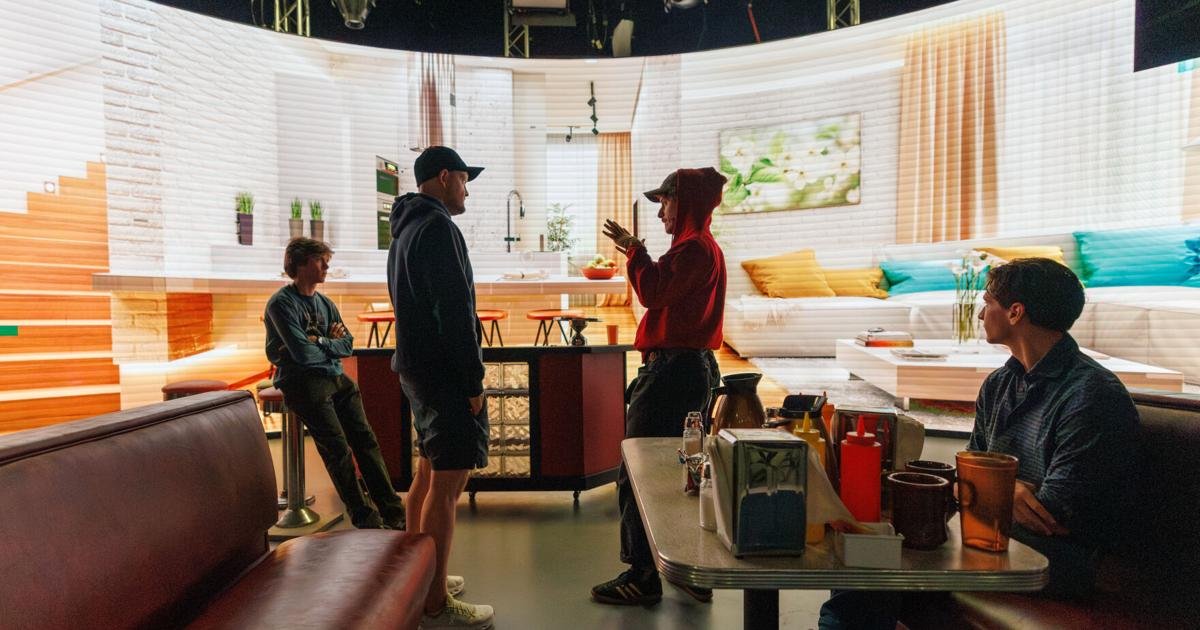
Instead, Morrison and his team tapped on computer keyboards, set up lights, and calibrated a billboard-sized curved LED wall that, at 13 feet high and 38 feet wide, dominated the room. The sets they were building were virtual, existing only on screen but capable of mimicking real places when combined with actors, props and furniture and then filmed using special equipment.

Asia Gagnon and Kenny Morrison work behind the an ‘extended reality’ screen in the studio at WYES in New Orleans, Wednesday, June 17, 2026.
Crew members arranged booths, tables and other props on the soundstage’s concrete floor in front of the screen, which displayed a photorealistic image of a diner interior.
Morrison was overseeing the work on behalf of his clients, the producers of a $5 million psychological thriller targeting a 2027 release. The movie started filming last fall in St. Francisville and came to New Orleans to finish up.
For Morrison, a New Orleans-based director and cinematographer who has made more than 2,000 commercials over a multidecade career, the “Exalted” gig is a chance to show off the power of the extended-reality production technology he has assembled in the three years since he formed his tech-focused company.
LucyXR closed a $500,000 fundraising round last year, and Morrison spent about twice that on the modular LED wall and related equipment, which now stays in use at WYES, a public television station that rents Morrison space and uses his gear for several of its shows.
Before the indie movie, the XR studio hosted three other projects over the last two months.

Left to right: Director Sergey Torchilin, Visual Effects Supervisor Kenny Morrison and Director of Photography A. Hennen Payne have an impromptu meeting in front of Morrison’s extended reality screen in a studio at WYES in New Orleans, Wednesday, June 17, 2026.
In May, New Orleans musician Jon Batiste shot a music video in the space, and New Orleans Saints quarterback Tyler Shough appeared in TV commercials for a Louisiana law firm. Morrison himself filmed several commercials for a credit union in one day by using the extended reality screen to simulate multiple locations.
“That kind of efficiency would have been impossible five years ago,” he said.
More high-tech studios
Louisiana’s first virtual production studio debuted in 2021 in the College of Art + Design building on LSU’s Baton Rouge campus.
The school secured a $1.25 million state grant to build the facility, which has been used for hundreds of projects, including music videos, interviews, classes and sports marketing videos. Clients include NBC News and Fender, the musical instrument manufacturer.
Jamerson, the associate professor who runs the space, said the key to making the virtual sets seem real to viewers is software and hardware — originally developed by video game makers — that work together to change the image on the screen to reflect different points of view.

Students have filmed several short films at the LSU XR Studio on the school’s Baton Rouge campus.
“The camera is a window into a fake world that might have nearby trees and distant mountains, so if the camera moves across the room, those background elements should move at different speeds,” he said. “It’s called parallax.”
Jamerson estimates that more than half of all TV shows use some form virtual production now — and, starting this summer, content creators will have another option in Baton Rouge, where the year-old startup FoxDog Studios is applying finishing touches to its own setup.
“We received the delivery on Mardi Gras Day and have been poking everything with a stick ever since, getting things calibrated and ready to go,” said Doug Dominguez, a Lafayette native and one of the studio’s three co-owners.
The business opened last fall in a retail space near the Mall of Louisiana to provide production services for small- to medium-sized projects that don’t necessarily need a huge soundstage like Celtic Studios, the nearly 30-acre facility in Baton Rouge that recently hosted a $50 million Amazon feature film. “Branded content,” a form of marketing common in the era of social media, is one of the studio’s areas of focus.
Dominguez and his partners converted their 10,000-square-foot space into three separate production studios for use by clients like Taryn Kloth and Kristen Nuss, the Louisiana-based beach volleyball superstars. The athletes will soon break in the new video wall, shooting a promotional video set on a California beach.

Actor Sam Claitor poses for a camera test on March 26, 2026 at FoxDog Studios in Baton Rouge. Studio technicians built a camping scene using a combination of real props and a digital background displayed on an LED screen.
“The technology gives us access to places we couldn’t normally be,” said Dominguez, who emphasized the best way to use the screens is to make them invisible.
“If you notice it, it’s bad VFX and somebody messed up,” he said.
Dominguez said the price of the extended reality screens and other hardware has dropped dramatically over the past four years, so more people will likely invest.
Louisiana film industry waiting for ‘action’
Investments in virtual production from LSU, Lucy XR and FoxDog come as the Louisiana film industry has slowed down after a post-pandemic boom in 2021 and 2022, when at one point there were 28 TV shows or features shooting simultaneously, according to Simonette Berry, business agent for the IATSE Local 478, a union representing 1,400 film industry workers in the region.
A decade earlier, Louisiana’s film production activity briefly topped California’s, but times have changed.
A generous two-decade-old film production tax credit still offers producers rebates up to 40% on qualified expenses, but competing incentives from other states have leveled the playing field while the entire country has ceded ground to global locations.
“We’re not just competing with Georgia or California anymore,” Berry said. “We’re competing with the UK, Ireland, Saudi Arabia and, of course, Canada. The U.S. used to have 60% roughly of production globally and now we have more like 40%.”
Another factor leading to the nationwide slowdown is Hollywood is simply making less content.

Samuel Macaluso, left, tests the way a tracking device interacts with the extended reality screen at WYES in New Orleans, Wednesday, June 17, 2026. The trackers are part of a system that changes the screen image based on a camera’s location.
Evidence of the slump can be seen at the state’s big soundstages, where an encouraging start to the year was followed by quieter months headlined by “Ally Clark,” the Amazon movie that shot at Celtic in Baton Rouge and other locations.
Investments in XR technology from LSU, LucyXR and FoxDog represent a fraction of that one film’s budget, but Berry said infrastructure improvements at any scale could help bring more work to the state, where experienced crews are hungry for work.
“As the industry changes, people will continue to need stage space, skilled workers and vendors whether they’re filming for Netflix or YouTube,” she said.