








John Hoey and Professor Mary Cannon explore how environment and identity contribute to psychosis risk in adolescents
Nearly one in three adolescents reports experiences such as hearing voices or seeing things that other people cannot. These are often seen as rare or severe symptoms, yet they are far more common than many assume. While they do not necessarily indicate a clinical disorder, they are important early warning signs linked to later mental health difficulties. (Healy et al., 2018; I. Kelleher, P. Corcoran, et al., 2013).
This raises an important question for policymakers and practitioners. Are we focusing too narrowly on diagnosis, and not enough on the environments that influence young people’s mental health?
Psychotic experiences are linked to everyday life
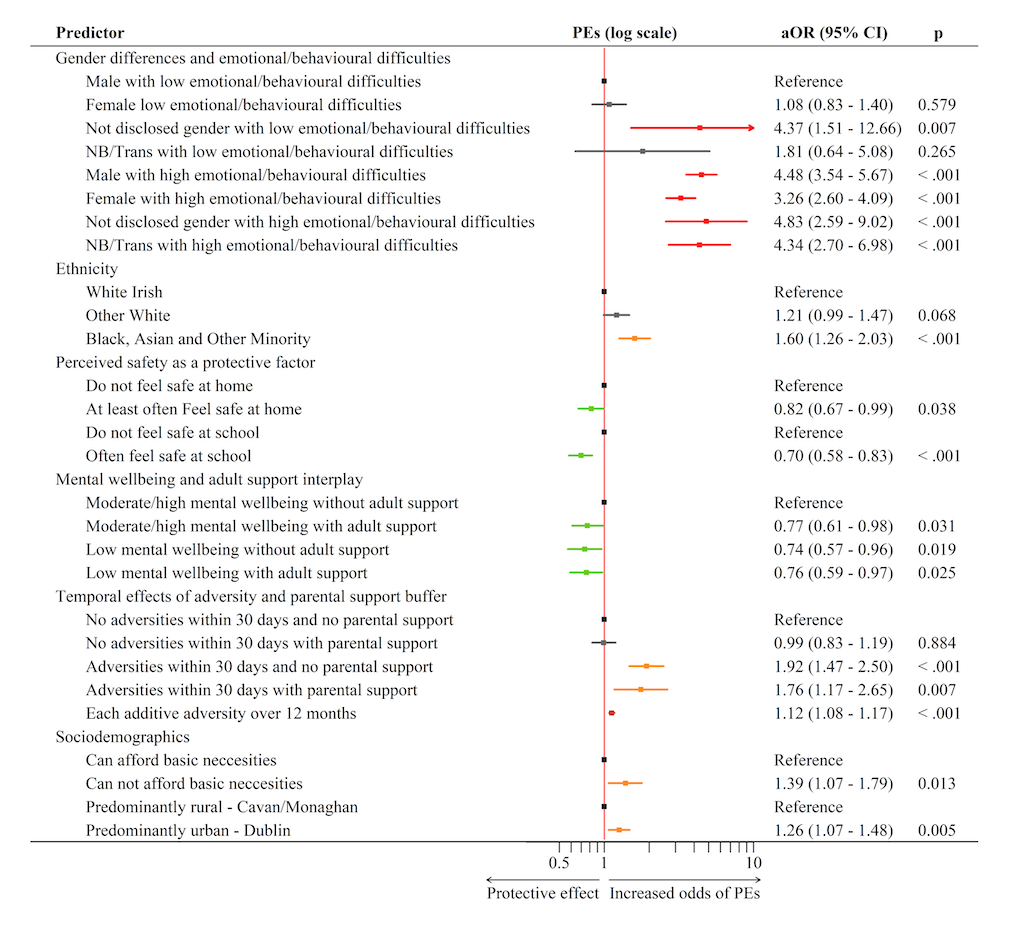
New research based on over four thousand adolescents across the Irish counties of Dublin, Cavan, and Monaghan shows that these experiences are closely tied to day-to- day circumstances (Figure 1). Adolescents experiencing emotional and behavioural difficulties were significantly more likely to report psychotic experiences. Exposure to adverse life events such as family conflict, bereavement, or social rejection further increased risk. Each additional stressor added to the likelihood of experiencing these symptoms, consistent with previous longitudinal research in this area (I. Kelleher, H. Keeley, et al., 2013).
These findings reinforce what is becoming increasingly clear: adolescent mental health cannot be understood in isolation from social and environmental context.
Inequality and stigma are central to risk
Psychosis risk is not evenly distributed. Young people from minority ethnic backgrounds and those who identify as non-binary or transgender were significantly more likely to report psychotic experiences. This pattern reflects the impact of stigma, discrimination, and social exclusion, as described in Minority Stress Theory and supported by population-based research (Ian Kelleher et al., 2013; Staines et al., 2022). Financial hardship also played a role, highlighting how broader structural inequalities influence mental health outcomes from an early age.
These are not isolated findings. They point towards a wider reality that mental health disparities are socially produced and persist across different contexts.
Safety and support can make a measurable difference
Alongside risk, the study highlights clear protective factors. Young people who felt safe at home and school were significantly less likely to report psychotic experiences. Supportive relationships also mattered. Adolescents who felt supported by adults in school showed reduced risk, even when their overall mental wellbeing was low.
Parental support was particularly important in buffering the effects of recent adversity. While it did not remove risk entirely, it reduced its impact in meaningful ways. This aligns with wider evidence highlighting the protective role of supportive environments and relationships in adolescent mental health (Healy et al., 2018). This evidence shows that these experiences are not inevitable; they can be reduced through supportive environments and relationships.
Shifting from reaction to prevention
Mental health systems often respond once difficulties have already escalated. This research suggests that earlier intervention could have a significant impact on reducing psychosis risk. Improving school environments, strengthening relationships with trusted adults, and supporting families are practical steps that can reduce risk at a population level. These are not peripheral measures but central components of effective mental health strategy.
Addressing stigma and discrimination is equally important. Without tackling the underlying social conditions that affect marginalised groups, progress will remain limited.
Towards a more inclusive approach to adolescent mental health
Psychotic experiences in adolescence provide a valuable insight into broader mental health inequalities. Recognising the role of the environment, identity, and lived experience enables more targeted and effective responses. This includes investing in school-based supports, community initiatives, understanding and compassion towards minoritised groups, and approaches that reflect the lived realities of diverse young people.
Improving adolescent mental health is not only about expanding services. It is about creating conditions in which young people feel safe, supported and able to thrive.
Acknowledgements
This research was funded by the Health Research Board (Ireland).
References
- Healy, C., Campbell, D., Coughlan, H., Clarke, M., Kelleher, I., & Cannon, M. (2018). Childhood psychotic experiences are associated with poorer global functioning throughout adolescence and into early adulthood. Acta Psychiatr Scand, 138(1), 26-34. https://doi.org/10.1111/acps.12907
- Kelleher, I., Corcoran, P., Keeley, H., Wigman, J. T., Devlin, N., Ramsay, H., Wasserman, C., Carli, V., Sarchiapone, M., Hoven, C., Wasserman, D., & Cannon, M. (2013). Psychotic symptoms and population risk for suicide attempt: a prospective cohort study. JAMA Psychiatry, 70(9), 940-948. https://doi.org/10.1001/jamapsychiatry.2013.140
- Kelleher, I., Keeley, H., Corcoran, P., Ramsay, H., Wasserman, C., Carli, V., Sarchiapone, M., Hoven, C., Wasserman, D., & Cannon, M. (2013). Childhood trauma and psychosis in a prospective cohort study: cause, effect, and directionality. Am J Psychiatry, 170(7), 734-741. https://doi.org/10.1176/appi.ajp.2012.12091169
- Kelleher, I., Keeley, H., Corcoran, P., Ramsay, H., Wasserman, C., Carli, V., Sarchiapone, M., Hoven, C., Wasserman, D., & Cannon, M. (2013). Childhood Trauma and Psychosis in a Prospective Cohort Study: Cause, Effect, and Directionality. American Journal of Psychiatry, 170(7), 734-741. https://doi.org/10.1176/appi. ajp.2012.12091169 %M 23599019 5. Staines, L., Healy, C., Coughlan, H., Clarke, M., Kelleher, I., Cotter, D., & Cannon, M. (2022). Psychotic experiences in the general population: a review; definition, risk factors, outcomes and interventions. Psychological Medicine, 52(15), 3297-3308. https://doi.org/10.1017/S0033291722002550