









image:
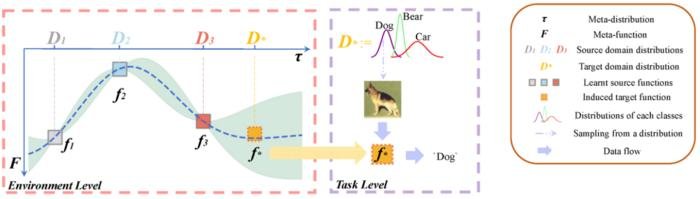
An illustration of the inference procedure in the Generalization Process, consisting of environment-level and task-level inference.
Credit: HIGHER EDUCATION PRESS
In recent years, domain generalization (DG) has garnered significant attention for its goal of learning models from multiple source domains to mitigate domain shift and enable generalization to unseen target domains. Most existing methods e.g., domain-invariant representation, focus on learning a universal sample-to-label mapping (function) across domains, overlooking semantically intrinsic domain-specific information and failing to maintain invariance across diverse unseen target domains.
To solve the problems, a research team led by Songcan CHEN published their new research on 15 June 2026 in Frontiers of Computer Science co-published by Higher Education Press and Springer Nature.
The team provides a novel standpoint for DG, i.e., domains are connected by a meta-distribution, namely environment distribution, which can sample various functions. In this way, they establish a meta-function function based on Gaussian Process, mapping from the environment to functions, to induce specific functions for unseen domains from observed function set. Compared with existing methods, the proposed method demonstrates superiority both theoretically and empirically.
In this research, they critically examine the limitations of existing domain-invariant representation (DIR) methods, highlighting their dependence on observed domains and their difficulty in maintaining invariance across diverse unseen target domains. To address these shortcomings, they propose a novel perspective: instead of learning a single universal function, they advocate for learning a function over functions.
Within this framework, each domain is treated as a meta-sample drawn from the environment distribution, and each domain-specific function is regarded as a sample from this meta-distribution. This abstraction enables the learning of a meta-function that can generate domain-specific functions capable of adapting to previously unseen domains.
To realize this idea, the team introduces GPDG, a Gaussian Process-based learning paradigm. GPDG captures both intra-domain information and inter-domain correlations using domain distributions and a kernel-based architecture. A Dirichlet Mixup-based domain augmentation strategy is also employed to enhance diversity and smoothness in the functional space. Extensive experiments are constructed to demonstrate the effectiveness of proposed GPDG.
Future work can focus on exploring simpler strategies for modeling the meta-function as alternatives to the relatively complex Gaussian Process.
Journal
Frontiers of Computer Science
Method of Research
Experimental study
Subject of Research
Not applicable
Article Title
Environment is a nexus: generalization process for domain generalization
Article Publication Date
15-Jun-2026
Disclaimer: AAAS and EurekAlert! are not responsible for the accuracy of news releases posted to EurekAlert! by contributing institutions or for the use of any information through the EurekAlert system.