








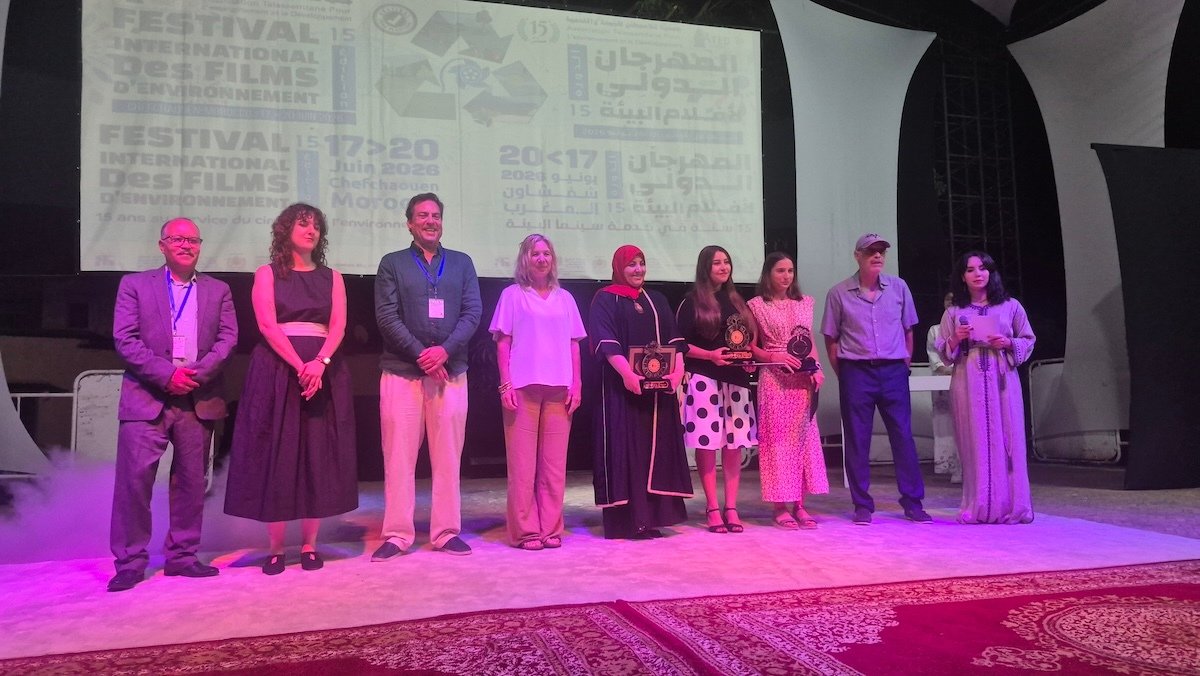
This edition confirmed, once again, that environmental cinema has become a tool for collective reflection, anticipating the future, and raising new questions about the relationship between humans and their natural environment.
From Chaouen to the World: The Environment Through the Language of Images
The fifteenth edition stood out for its broad openness to international cinematic experiences from France, Spain, Germany, Tunisia, the Sultanate of Oman, and other countries across different continents, offering the public the opportunity to discover diverse perspectives on contemporary environmental challenges, ranging from climate change and biodiversity loss to the sustainable management of natural resources and the protection of ecosystems.
In his opening remarks, Abdelilah Tazi, president of the Talassemtane Association for the Environment and Development, emphasized that the festival is grounded in the conviction that natural, cultural, and artistic resources can serve as a true catalyst for sustainable development, and that investing in film and visual media is an investment in raising awareness and driving change.
For his part, the festival director, Mohamed Sattar, noted that this cultural and environmental gathering has evolved from a simple film event to become, over the course of its successive editions, an international platform for reflection on the major environmental challenges facing the world today. He noted that the discussions hosted by the festival addressed urgent issues such as the decline in forest cover, growing pressure on water resources, the degradation of biodiversity, and the plastic waste crisis—one of the most pressing environmental problems of our time.

Sattar added that the Talassemtane Association believes in the power of images and sound as effective tools for raising awareness and transforming behavior, reaffirming its ambition to establish Chaouen as the capital of green cinema and as an international hub where culture and the environment converge.
He also welcomed guests from various countries, emphasizing that culture and cinema can contribute to building a collective environmental consciousness and that investment in creativity and visual arts is one of the fundamental pillars for achieving sustainable development that harmonizes human needs with the preservation of nature.
Awards That Convey Messages About Nature
The results of the official competition clearly reflected the festival’s overall focus, which recognizes works capable of combining artistic excellence with environmental commitment.

The Ethiopian Wolf: A Story of Survival on the Roof of Africa
In the feature-length documentary category, the award went to the French production “The Secret of the Ethiopian Wolf,” directed by Baptiste Deturche and Adrien Louis-Sauveur.
The film transports viewers to the highlands of Ethiopia, at an altitude of more than 3,600 meters, where the Ethiopian wolf—the world’s rarest canid species—lives. Through a meticulous examination of conservation efforts, the film reveals fascinating aspects of the life of this exceptional animal, which has developed unique behaviors within an isolated ecosystem, including a surprising diet based on flowers. The documentary serves as a powerful visual lesson on the fragility of endangered species and the need to protect their natural habitats.

“The Roots of Silence”: When Drought Speaks Through the Villages
In the professional short film category, the award went to “Les Racines du Silence” (The Roots of Silence), by the young Moroccan director Dounia Barouri.
The film delves into daily life in an isolated village near Marrakech, where drought is a daily reality. Through moving testimonies and intimate imagery, the film gives a voice to families suffering the effects of climate change and water scarcity, transforming silent suffering into a profound reflection on climate justice and the relationship between communities and the land.

“TAZN AKHT”: When a Rug Becomes an Environmental Document
The jury awarded a special mention to “TAZN AKHT,” a film dedicated to the Ouzguita rug as cultural and environmental heritage.
The film revives the memories of the women who have preserved the secrets of traditional weaving generation after generation, highlighting this craft’s connection to local natural materials and a sustainable, environmentally friendly production system. Beyond documenting a cultural legacy, the film explores the deep relationship between culture and nature, as well as between heritage protection and the conservation of local resources.
“The Call”: A Tree’s Voice Reaches New Generations
In the category of productions by educational institutions, the award went to the film “The Call,” which tells the story of a young man who prefers solitude until a tree chooses him to convey its suffering in the face of pollution and the damage caused by human activity. Through a symbolic and accessible narrative, the film conveys a powerful message about environmental education and the fundamental role of children and young people in protecting nature.
Can cinema anticipate smart cities?
One of the highlights of this edition was the international conference titled “Environmental Cinema as a Prospective Laboratory for Smart Cities,” which brought together experts, researchers, and professionals from Morocco and other countries.
Participants discussed cinema’s ability to anticipate environmental and urban transformations, as well as its role in shaping new visions of sustainable cities where technology serves both people and the environment. They also analyzed the influence of imagery on public policy and on building collective awareness of emerging ecological challenges.
From the Mediterranean to Chaouen: The Marine Environment at the Center of the Debate
The festival also hosted a session dedicated to marine mammals and artisanal fishing in the Mediterranean, addressing the complex relationship between marine biodiversity and the socioeconomic reality of northern Morocco’s coastline.
The screening of a short documentary film on the damage caused to fishing nets by dolphin predation sparked a scientific and practical debate on the need to reconcile the protection of marine mammals with the interests of artisanal fishermen, within a balanced approach based on the sustainability of marine resources.
“Echos del Mar”: A Master Class on Environmental Film
The event also featured a group master class in the town of Stehat, focused on the short film “Échos de la Mer” (Ecos del Mar) by director Frédérique Gilbert. Participants learned about the different stages of creating an environmental film, from the initial idea and screenplay to filming and editing, gaining an understanding of how imagery can serve as a tool for defending marine ecosystems.
The activity concluded with a beach cleanup at Stehat, reflecting the festival’s practical dimension and strengthening the link between environmental culture and ecological citizenship.

Environmental Ambassadors: Art in the Service of the Planet
True to its tradition, the festival continued to recognize prominent figures from the worlds of art and film through the “Environmental Ambassador” award, an initiative aimed at promoting the integration of environmental considerations into artistic works and audiovisual production.
In this edition, the festival expanded the scope of this initiative by creating the title of International Environmental Ambassador, previously reserved for Moroccan figures. The first person to receive this distinction was Frédérique Gilbert, director of Spain’s International Environmental and Marine Mammal Film Festival, in recognition of her work through the CETASEA festival and its educational and scientific programs dedicated to raising awareness about ocean protection and the conservation of marine ecosystems, especially among children and young people.
Green Cinema: A Cultural and Development Project
Throughout the festival’s activities, the green cinema project established itself as a vision that transcends the framework of an annual event to contribute to the building of a lasting environmental culture based on art, knowledge, and communication.
The issues addressed—forest degradation, water scarcity, biodiversity loss, plastic waste, and renewable energy—represent real challenges for Morocco and the world, requiring collective action and a language capable of reaching all audiences.
It is worth noting that the festival remained committed to the “Zero Plastic” initiative, avoiding the use of single-use plastics throughout the event thanks to the involvement of participants and service providers. Additionally, an awareness-raising workshop was organized for students from the areas surrounding Chaouen, in collaboration with the Heroes of Fnideq Association for Spearfishing and Environmental Protection.
Chaouen: Capital of the Image That Defends Life
The fifteenth edition concluded by reaffirming Chaouen’s status as one of the leading Arab and African platforms dedicated to environmental cinema. Through films inspired by mountains, forests, and oceans, and discussions that brought together scientists, artists, and decision-makers, it became clear that the commitment undertaken years ago by the Talassemtane Association is bearing fruit.
In a city where nature and culture intertwine, cinema has become a voice that champions the environment, a memory that preserves it, and a window onto a future of greater balance between humanity and its planet.