










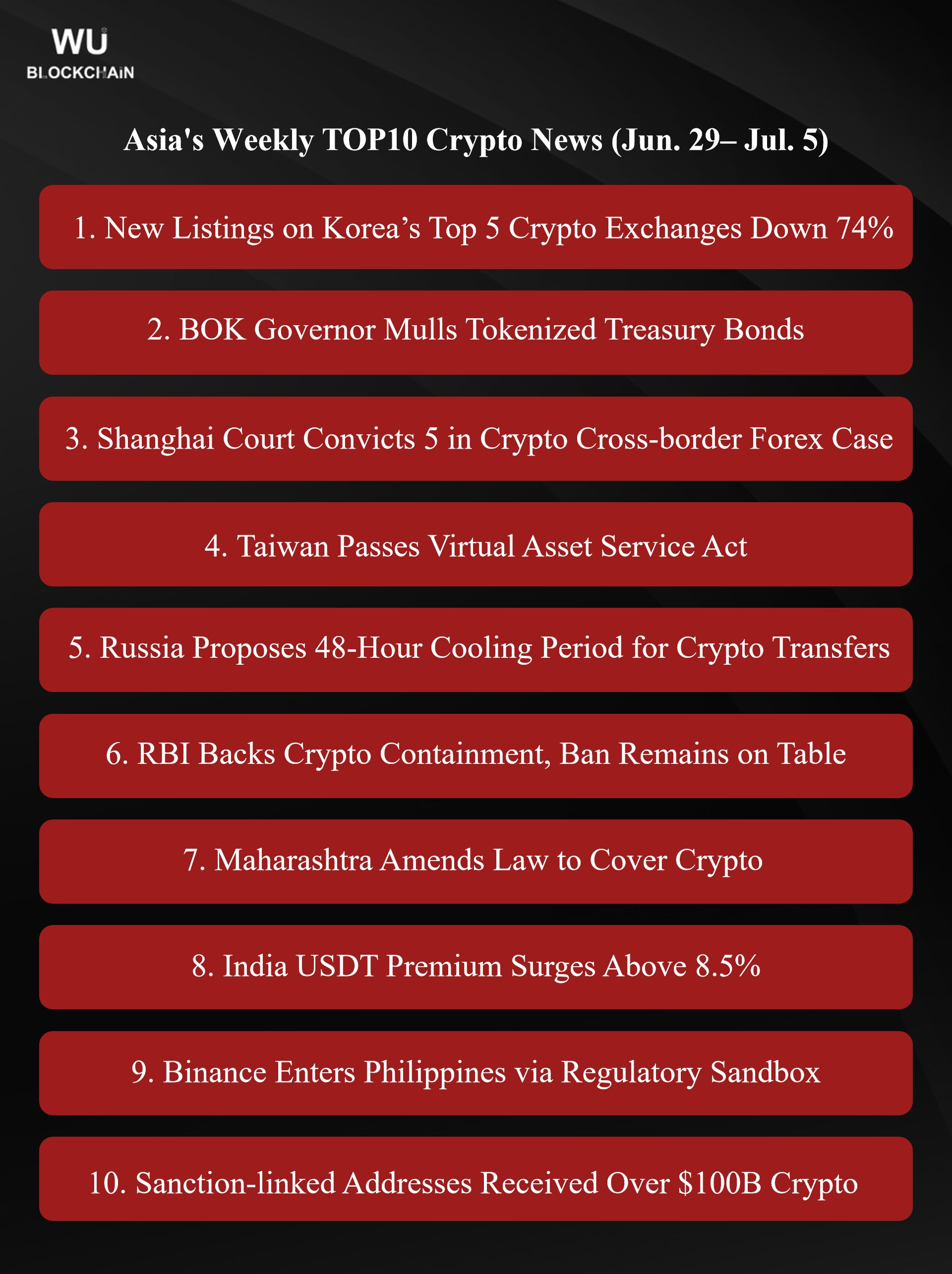
1. Net New Token Listings on Korea’s Five Major Crypto Exchanges Plunge Around 74% Year-on-Year link
The pace of new token listings on South Korea’s domestic crypto exchanges slowed markedly in the first half of the year, accompanied by a rise in delistings of illiquid and problematic tokens. EToday compiled data from South Korea’s five major exchanges — Upbit, Bithumb, Coinone, Korbit and Gopax — showing the net increase of newly supported trading pairs after accounting for terminated listings stood at 49 in the first half of this year, a roughly 74% drop from 191 in the same period last year. The number of newly listed assets fell 44% year-on-year, while terminated listings surged 258% compared to last year. Reports state that amid slumping trading volumes and squeezed fee revenue, South Korean crypto exchanges have shifted their competitive focus from expanding token listings to liquidity management, stricter token vetting and compliance with institutionalized regulations.
Separately, Korea Exchange (KRX) announced revisions to KOSDAQ listing rules and implementation guidelines. Technology special-listed companies that change their core business within five years post-listing will face substantive delisting reviews. The move is widely viewed as closing loopholes that allowed some firms to list via technology special provisions before pivoting into virtual asset treasury operations. KRX noted that companies amending articles of incorporation to add or switch core businesses outside the scope of their original similar or affiliated operations may trigger such reviews.
2. BOK Governor: Tokenization of Treasury Bonds & Other Assets Deserves Policy Consideration link
Shin Hyun-song, Governor of the Bank of Korea, presented a paper at the European Central Bank’s Central Banking Forum on July 1, arguing that tokenization of assets such as government bonds should be considered and proposing a central bank-led “unified ledger” framework that hosts CBDCs, tokenized bank deposits and tokenized government bonds on a single programmable platform. Shin Hyun-song stated that a central bank-governed unified ledger delivers greater stability compared with decentralized blockchains. If government bonds are issued and circulated within this unified ledger, bond ownership transfers and fund settlements can be executed simultaneously, collateral management can be automated, and the framework will facilitate monetary policy implementation and financial stability.
3. Shanghai Court Hands Down Verdict in RMB 200M Cross-Border Crypto FX Swap Case; Five Convicted of Illegal Business Operations link
The People’s Procuratorate of Jing’an District, Shanghai, recently initiated public prosecution over a cross-border illegal virtual currency foreign exchange case involving over 200 million yuan. Five defendants led by the principal criminal Li received criminal sentences, while four others obtained non-prosecution with conditional non-litigation. Investigations revealed that starting in 2019, Company Z operated under the guise of a “private bank”. Its domestic and overseas teams conducted cross-border matching foreign exchange transactions using virtual currencies as a medium. The group attracted clients through overseas study and immigration agencies, providing services to high-net-worth individuals with offshore asset demands. Exploiting the anonymity and on-chain circulation features of virtual currencies, gang members artificially erased capital transaction trails, charged a 3% service fee, and converted virtual currencies into foreign currencies overseas before depositing the funds into clients’ accounts.
4. Taiwan Legislature Passes Virtual Asset Services Act on Third Reading, Establishing Formal Crypto Regulatory Framework link
Taiwan’s Legislative Yuan passed the third reading of the Virtual Asset Services Act, formally establishing a regulatory framework for cryptocurrency trading platforms and stablecoin issuers. The bill mandates that Virtual Asset Service Providers (VASPs) must obtain licenses from the Financial Supervisory Commission (FSC) prior to operation, with stricter requirements imposed on cybersecurity, client asset segregation and internal controls. Platforms that previously completed Anti-Money Laundering (AML) registration are granted a 12-month transition period to file license applications and a 21-month timeline to secure approval. Stablecoin issuers are required to secure dual licenses from the central bank and the FSC and maintain full reserve backing. Additionally, the law stipulates that illegal operation of VASP or stablecoin businesses carries a maximum penalty of seven years in prison plus a fine of NT$100 million (approximately US$3.14 million). Cryptocurrency fraud or market manipulation may result in up to ten years of imprisonment and a fine of NT$200 million (roughly US$6.28 million).
5. Russia Proposes Mandatory 48-Hour Cooling-Off Period for Regulated Crypto Transfers link
Vladimir Chistyukhin, First Deputy Governor of the Central Bank of Russia, stated that Russia plans to introduce a 48-hour cooling-off period for legal cryptocurrency transfers. This measure applies solely to fund transfers between accounts and excludes crypto brokerage and trading activities, designed to curb fraud. Relevant provisions have been incorporated into the national regulatory bill for the crypto market, which is expected to take effect on September 1. Chistyukhin also noted that Russian citizens may only hold crypto assets independently via non-custodial wallets outside Russian territory, while crypto storage within Russia’s jurisdiction is restricted to custodial wallets.

Sponsored by FinTax
6. RBI Backs Containment Stance Toward Crypto; Full Ban Remains Under Review link
Senior officials of the Reserve Bank of India (RBI) submitted observations to the Standing Committee on Finance of India’s Parliament, backing a restrictive containment strategy leaning toward prohibition for crypto assets and recommending banks and other regulated financial institutions to isolate themselves from crypto assets and privately issued stablecoins. The RBI stated that prohibition remains one of the policy options recognized under international standard-setting frameworks. Applying conventional regulatory frameworks to crypto assets risks legitimizing speculative products and creating a false sense of security among users. The RBI further warned that widespread stablecoin adoption could erode India’s monetary sovereignty and financial stability. Meanwhile, the RBI advised policymakers to draw a distinction between speculative crypto assets and the tokenization of regulated financial instruments such as government and corporate bonds to avoid stifling tokenization innovation.
7. Maharashtra Revises MPID Act, Bringing Crypto Assets Under Deposit Protection Coverage link
According to The Times of India, the Maharashtra Legislative Assembly of India passed amendments to the Maharashtra Protection of Interests of Depositors (in Financial Establishments) Act, 1999 (MPID Act), officially bringing Virtual Digital Assets (VDAs), including cryptocurrencies and other blockchain-based digital instruments, under the scope of this law. The amendments mandate that financial institutions must deposit 50 percent of their total outstanding debt as security before filing appeals against recovery orders. The provision aims to stop financial entities from dragging out repayment to investors through prolonged appeal proceedings.
8. USDT Supply Tightens in India, Stablecoin Premium Surges Above 8.5% link
USDT supply has tightened abruptly in India, with the stablecoin premium surging from the usual 3% to 4% to over 8.5%. Last Saturday, USDT traded at 102.88 Indian rupees in local markets, while the closing USD-INR exchange rate on India’s forex market the previous Friday stood at 94.65. Reports state that following the Directorate of Enforcement (ED)’s crackdown on VDA-facilitated fund transfers worth 2500 billion rupees, reduced USDT inflows and fears of further supply slowdowns have pushed up local stablecoin premiums. Purushottam Anand, founder of Crypto Legal, noted that most VDAs have long traded at a premium above global prices on Indian exchanges, and the recent jump partially reflects a risk premium stemming from regulatory ambiguity. Separately, the Standing Committee on Finance of India’s Parliament will hold a meeting with the Reserve Bank of India (RBI) and the Institute of Chartered Accountants of India (ICAI) on July 2 to discuss future policy directions.
9. Binance Secures Operations Approval via Philippine Regulatory Sandbox, Officially Enters Local Market link
Yi He, co-founder of Binance, announced in a post that Binance has officially entered the Philippine market. Documents shared by her show that the Securities and Exchange Commission (SEC) of the Philippines has approved Blockshoals Technologies Inc. to test financial products and services under its regulatory sandbox framework. As part of this program, Blockshoals will complete system integration with Binance, its global Crypto Asset Service Provider (CASP) partner. After finishing a 90-day testing and compliance integration phase, relevant products and services will be offered to Philippine users via Binance’s global infrastructure under rigorous oversight and compliance frameworks set by Philippine regulators.
10. Addresses Linked to Sanctioned Entities Received Over $100B Worth of Crypto Assets in 2025 link
Data from Chainalysis and other blockchain analytics firms shows that sanctioned jurisdictions including Iran, Russia and North Korea are accelerating their adoption of cryptocurrency to bypass U.S. and Western sanctions. Crypto addresses linked to sanctioned entities received more than $100 billion worth of crypto assets in 2025, nearly eight times the volume recorded in 2024.
Reports indicate these parties process funds via self-developed digital tokens, proprietary crypto exchanges and layered transaction architectures. Western officials and analytical firms allege Iran and Russia have used crypto assets to procure drones and weapons components, while North Korea is accused of stealing crypto via hacking and cybercrimes to purchase fuel and military hardware.
Follow us
Twitter: https://twitter.com/WuBlockchain
Telegram: https://t.me/wublockchainenglish