







For the last two years, the half-million attendees of the Lollapalooza summer music festival in Chicago’s Grant Park have been treated to a new feature: a bright red Coca-Cola-branded pop-up roller skating rink, complete with a DJ booth, cubbies full of skates and plenty of frosty soda cans.
The marketing ploy was the brainchild of Coke and Live Nation Experiential, an in-house division of the global company that owns the festival. But the rink itself was built about a thousand miles south — in New Orleans’ Bywater neighborhood — by Raven PMG, an under-the-radar Louisiana business that’s found success in the $130 billion and growing experiential marketing industry.

Operating out of a warehouse on Montegut Street, not far from where the train tracks cross St. Claude Avenue, Raven is a specialty fabrication company that designs, builds, ships and installs elaborate temporary structures used to promote products and brands at festivals, sporting events and conventions while giving attendees a shady place to sip a drink, use the bathroom or get a great view of whatever action is going on outside.
The private company, which was founded more than a decade ago but grew dramatically after the pandemic, oversees nearly 200 installations — or “experiences,” in industry parlance — annually for major events like Lollapalooza, the World Cup, Bonnaroo and Essence Festival of Culture. It works for roughly 100 brands or agencies, including Live Nation’s in-house team. It has about 70 full-time employees, and contractors swell that number to well over 100 during busy seasons.
Depending on the scale and complexity of the work involved, Raven will charge as little as $10,000 to more than $1 million for a project. The company declined to provide its annual revenues but says the number quadrupled over a three-year period after the pandemic.

Workers build a structure made out of shipping containers, steel and other materials at Raven in New Orleans, Thursday, June 25, 2026.
It’s an impressive trajectory for a venture that began by providing sound systems for concerts at New Orleans bars. Raven co-founder Chris Berends said that success owes much to the company’s Louisiana roots, which have informed its ability to make massive events more fun.
“At the end of the day, we want to build something that when someone attends an event, they want more of it, whether it’s a tequila drink or a ticket to the next festival,” he said during an interview last week.
From shoestring budgets to the big time
Larose, Louisiana native James Dufrene founded Raven in 2009 primarily to provide audio production at New Orleans events. Three years later, he forged a professional bond with future business partners Berends and Mélinda Cohen while designing stages, lighting and sound systems on a shoestring budget for the fledgling BUKU Music + Art Project, an electronic music event that was active from 2012 to 2022.
In 2015, Berends and Cohen joined Raven full-time as the company pivoted to focus on fabrication. Early New Orleans successes for the trio included a project to promote a Disney video game at the Voodoo music festival and another marketing Mountain Dew during the 2017 NBA All-Star weekend.
The company continued to grow through the end of the decade, moving its headquarters several times along the way, graduating from what was essentially a storage space underneath the Eiffel Tower building on St. Charles Avenue to a series of warehouses in town before moving to its current location in 2019.
During the pandemic, which brought events-based marketing to a halt, Raven pivoted to using its fleet of 18-wheelers to haul loads for customers outside of the entertainment industry. Then, after the lockdown — when attendance at festivals, concerts, sports events and other gatherings skyrocketed — Raven grew as well.
“People were clamoring for real experiences,” Berends said. “Audiences wanted to touch grass again and build relationships with brands in a more realistic way and not just get hammered by digital trash.”
Creating memorable experiences to promote brands
Experiential marketing is nothing new. Think of the world’s fairs from the 19th century, when companies assembled pavilions to unveil innovations like electric lights and washing machines.
But the industry is operating at a different gear this decade, as marketers and brands look to build consumer trust by connecting with audiences at big events like Formula 1 races, the Super Bowl, the World Cup and scores of big music festivals. At those gatherings, companies compete to create memorable experiences, hoping for exposure at the event plus coverage on traditional media and social media during and after.
The Wall Street Journal reported last year that advertisers’ interest in experiential and live marketing surged after the pandemic, with spending in 2024 increasing 10.5% year-over-year to $128.35 billion globally, surpassing 2019’s pre-pandemic spending of $121.87 billion.
This marketing arms race has led to increasingly elaborate “activations,” to use the industry jargon.

Frank the cat lies on a desk as employees work at Raven in New Orleans, Thursday, June 25, 2026.
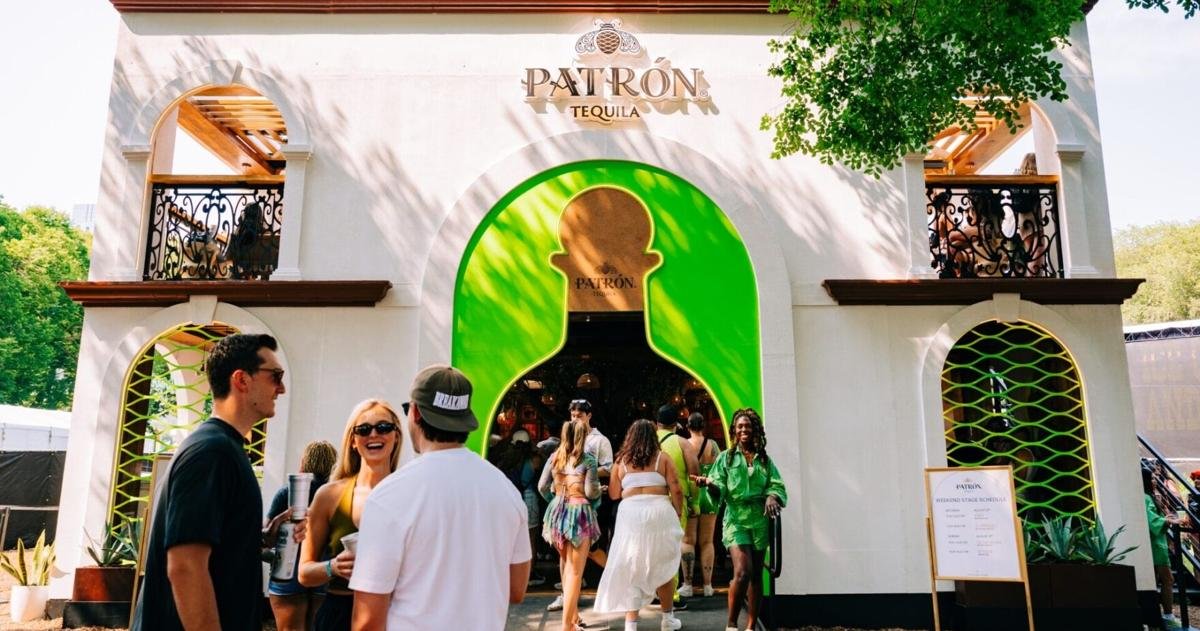
In addition to the temporary roller-skating rink, Raven has created a pop-up laundromat promoting the South Korean electronics company LG. The activation debuted in 2018 at Bonnaroo, the Tennessee music festival. Last year, the company built a movable mansion for Live Nation Experiential to promote the Mexican tequila brand Patron. The structure, recently named “best festival activation” by an industry publication, debuted at Lollapalooza and has since made the rounds.
This summer, Raven workers are putting the finishing touches on a free airbrush station to promote a T-shirt brand. The company’s list of creative builds also includes a 35-foot-tall steel middle finger that shoots fire, dragons that spray water and a temporary tattoo parlor.
“The space has become more and more competitive and impressive,” Berends said.
Busy workspace
Raven PMG’s Bywater manufacturing facility was bustling with activity recently as metal workers, carpenters and scenic artists finished building several structures using repurposed shipping containers and other materials. Employees assemble all projects completely at the factory before taking them apart and shipping them to events using a flat-packing system that’s like IKEA on steroids.
In an open area outside the factory, workers applied finishes to a two-story VIP lounge, second-floor viewing platform and garden promoting a national bank that will be installed at the Minnesota Yacht Club music festival this July in St. Paul. Elsewhere, team members worked on projects for other clients, including a liquor company, several clothing manufacturers, a doughnut and coffee chain, and a mouthwash maker.

Josh Beck, COO of Raven, holds a 3D printed hippo head at Raven in New Orleans, Thursday, June 25, 2026.
The scene looked like a combination of what you’d see at one of Louisiana’s Mardi Gras float-building studios and its many industrial manufacturing facilities. Berends said that’s because Raven’s strength is pulling talent from many of the state’s industries, including artists from Bywater, carpenters and electricians with backgrounds in film production, construction pros, transportation industry vets, and a healthy contingent from “down the bayou.”
“There’s a heavy Cajun component to our business,” Berends said. “The build methodology for our steel structures really reflects that identity, because all of these guys are coming from the shipping industry or the oil field.”
Berends said those skillsets help Raven provide turnkey service and keep up with competitors as the experiential marketing industry continues to chase innovation.
“We want to continue to push the boundary of what’s possible in the time that you’re given to build something,” he said. “In 2005, you would have a tent with a folding table and someone giving out shots. Over the last 20 years, we’ve seen some amazing advances in technology, and I want Raven to be the leader.”