








Simona Bianchi and Mauro Overend from Delft University of Technology explain why multi-disciplinary approaches are key to creating safer, eco-friendly, and resilient buildings that protect urban communities and ensure long-term sustainability
The built environment is ill-prepared for more frequent and increasingly intense climate-related extremes, resulting in severe economic losses and public health risks. Recent scientific and technological advances provide solutions to improve building resilience to specific risks, but they are often costly, rarely eco-friendly, and almost never address the multiple hazards present in many locations. This is hardly surprising because there is neither a clearly defined framework for quantifying the climate resilience of buildings nor tools to support the selection of optimal solutions for real-world multi-hazard scenarios.
How resilient is a building?
A holistic measure of building resilience requires multi-criteria indicators and calculation methods for both individual hazards (e.g., floods or heatwaves) and multi-hazard scenarios (e.g., fire following an earthquake). In our ongoing projects, we have developed a comprehensive set of indicators covering structural safety, energy efficiency, carbon emissions, occupant wellbeing, and cost, which together form the basis for Resilience Readiness Levels for buildings. These levels assess how effectively buildings can respond to and recover from diverse extreme events. Applications to real-world buildings have shown that this approach is adaptable across different environmental conditions and contexts. Its flexibility enables the incorporation of multi-hazard scenarios and evaluation of resilience across scales, from individual building components to entire neighborhoods.
Beyond practical resilience scores, assessing probable losses (costs, emissions, fatalities) from multiple hazards is essential for disaster risk management. By accounting for uncertainties in hazard intensity, building response, and other factors, a probabilistic approach provides reliable, evidence-based guidance for designing resilient built environments. To ensure consistency, practitioners should apply a harmonized methodology across all hazards. While catastrophe modeling offers frameworks for hazards causing physical damage, equivalent methods for hazards affecting wellbeing and human health, such as heatwaves and cold spells, are currently lacking. Our ongoing work is developing human-centered risk assessment methods to quantify losses from these hazards, complementing traditional physical-impact analyses.
Can resilience be achieved with low-carbon sustainable building technologies?
Delivering future-proof buildings requires multi-functional high- performance technologies designed to enhance resilience, safety, energy efficiency, occupant wellbeing, circularity, and scalability, making them adaptable to diverse natural hazards and end-user needs. Our approach applies plug-and-play modular systems to both new and existing structures.
For new buildings, the focus is on low-carbon resilient packages for the building envelope (façades). A multi- criteria design method, supported by a comprehensive toolbox and library of pre-evaluated materials, connections, and systems, guides the process. The toolbox provides structured guidance on multi-hazard-resilient components while accounting for construction type, materials, window-to-wall ratio, cost, energy, daylight performance, structural stability, indoor comfort, disassembly procedures, and end-of-life strategies. This enables early-stage design teams to select optimal combinations of components and systems (Fig. 1) to deliver integrated and locally adapted solutions.
For existing buildings, we are developing low-invasive double-skin exoskeleton solutions that have been validated in real-world applications. These modules are tailored to structural typologies such as masonry or reinforced concrete and are designed to achieve enhanced integrated performance, including seismic safety and energy efficiency. The interventions combine ventilated façade systems with load-bearing timber structures in a modular form, providing holistic architectural renovation that can be rapidly assembled from the exterior while minimizing disruption to building occupants.
What digital tools are needed to support the transition to a resilient built environment?
This requires multidisciplinary digital tools and services to perform multi- hazard resilience assessment, design and management. In particular, to support the selection of optimal solutions across scales.
At the component-to-building scale, we are developing parametric workflows to guide both retrofit and new design selection. These workflows allow testing of different climate change and hazard scenarios on buildings, evaluating their multi-criteria performance. Each system is analyzed through a database-driven parametric model and assessed against both a resilience score and an adaptivity score, reflecting circularity, reusability and flexibility. The resulting technology packages enables the identification of optimal combinations of measures to address multiple hazards while aligning with user objectives.
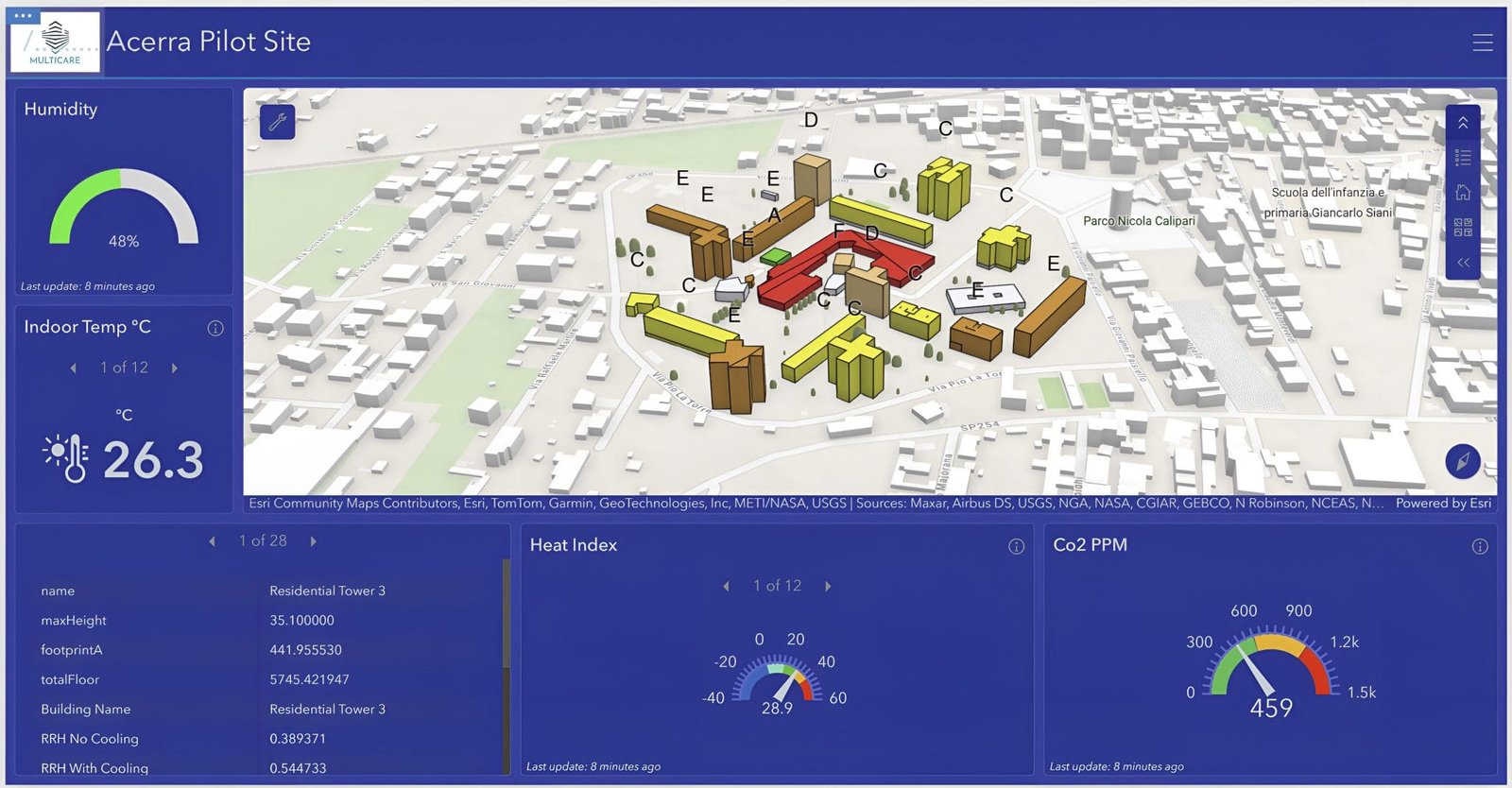
At the urban scale, we are developing a spatial decision support system (Fig. 2) to generate and visualize holistic urban community models, integrating buildings, energy grids, transport, environmental data and CO2 emissions, along with resilience and socio-demographic indicators. The system ensures efficient management of massive geospatial data, standardized interoperability, communication between heterogeneous datasets and simulation models, and spatial analyses required for multi-criteria decision support.
On the monitoring and operational side, we are implementing technical infrastructures for multi-hazard early warning and rapid response. The framework integrates heterogeneous sensor data from multiple providers and locations using open geospatial standards, supporting predictive modeling, evacuation planning and energy and comfort optimization in buildings.

Image authors: Niall Buckley, Koldo Urrutia-Azcona (IES)
Who is involved in these research efforts?
A strong European consortium is developing these multi-disciplinary multi-scale design methods, technological physical and digital solutions. These efforts will strengthen the built environment’s capacity to prepare for and respond to disruptive events, positioning multi-hazard resilience as a central priority for all stakeholders.