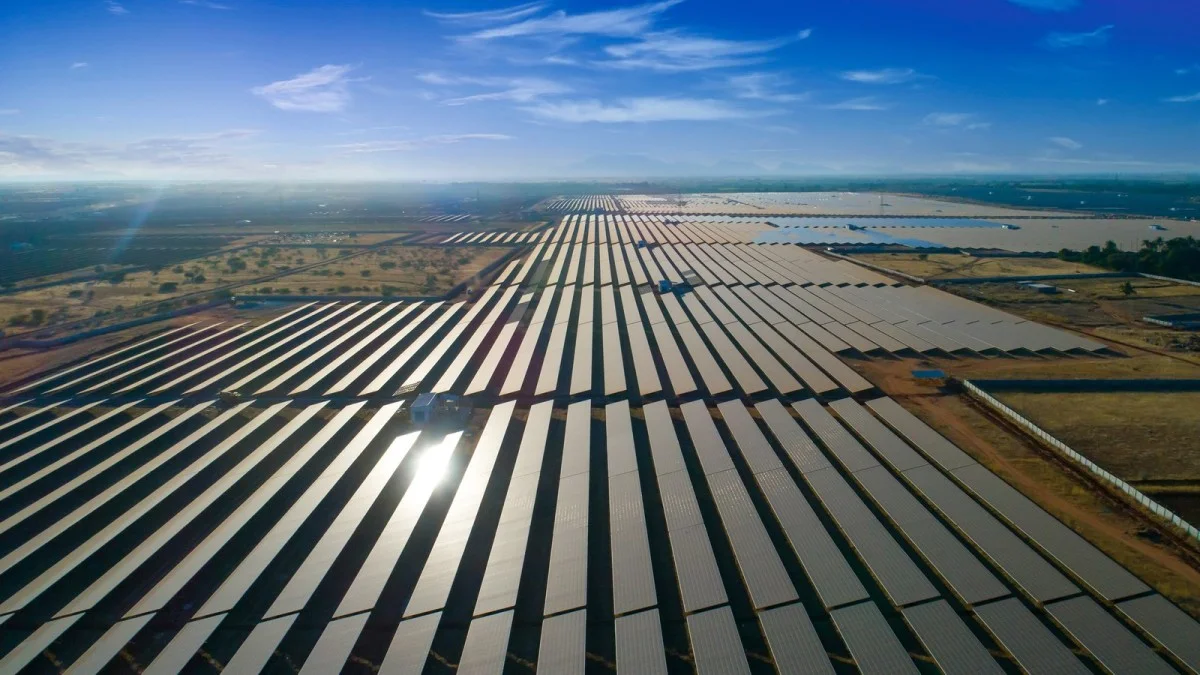
Just a decade ago, the Indian government seemed hell-bent on using coal to power its industrialization drive, with large-scale solar energy virtually unheard of in the country apart from a few microgrids serving remote rural villages and rooftop installations. In early 2015, the Modi administration set a goal to double domestic coal output to roughly 1.5 billion tonnes by 2030. However, the country’s energy landscape has since undergone a massive transformation in a short space of time.
While the majority of the world’s industrial heavyweights built their modern economies on coal and oil, India is now looking to bypass this high-emissions pathway by rapidly scaling up remarkably cheap domestic solar installations. Indeed, India is on track to become the first major country in history to power its primary economic industrialization predominantly through solar energy rather than fossil fuels.
India is currently going through a massive solar boom, and recently leapfrogged the United States to become the world’s second-largest market for solar capacity additions behind only China.
Driven by massive utility-scale projects and aggressive government subsidies, India added a record-breaking 44 GW of solar power in the 2025/2026 financial year alone, taking its installed solar capacity to 154 gigawatts (GW), third globally behind China and the U.S. India’s solar sector is growing at a scorching clip with annual capacity additions clocking in at 40% CAGR, and installed capacity set to double again by 2030.
Related: Why the AI Boom Is About to Break the U.S. Power Grid
While coal still accounts for ~70% of India’s electricity production, its share is projected to drop below 50% by 2035 as new coal plant planning winds down with cheap solar alternatives taking over. The International Energy Agency (IEA) now projects that solar will meet roughly half of India’s massive electricity demand growth through 2030.
India’s rapid solar expansion is being driven by a mix of falling solar costs, favorable geographic factors, generous government subsidies, and protective domestic manufacturing policies.
The monstrous Khavda solar park is situated in the remote, barren salt desert of the Rann of Kutch, spanning over 726 square kilometers near the India-Pakistan border. The facility is set to become the world’s largest solar farm with a generating capacity of 30 gigawatts–enough to power ~25 million U.S. homes.
In addition to policies that promote rooftop solar for residential use, the Indian government has adopted several incentives to fast-track utility-scale solar development, including the Production Linked Incentive (PLI) to boost domestic manufacturing of high-efficiency solar PV modules, and Green Energy Open Access Rules that allow large consumers with a sanctioned load of 100 kW and above to easily purchase green power directly from solar developers.
Meanwhile, India has evolved from an import-dependent market into a domestic manufacturing powerhouse that now actively exports solar panels.
To insulate itself from geopolitics and lower reliance on Chinese imports, the country has implemented the Approved Models and Manufacturers (ALMM) policy, a major regulatory framework introduced by India’s Ministry of New and Renewable Energy (MNRE) to verify the quality, authenticity, and country-of-origin for solar energy components. Only solar products and manufacturers on this government white list are legally permitted for use in government-subsidized, government-funded, net-metered, and open-access renewable projects across the country.
India’s solar manufacturing capacity has been surging, with total cell capacity standing at 30 GW annually, driven by a Production Linked Incentive (PLI) scheme and ALMM mandates.
That said, India has to contend with a multitude of challenges in its ambitious solar odyssey. To wit, the country’s transmission grid has struggled to keep pace with surging solar generation: last year, nearly 40% of solar energy produced in western desert regions failed to reach major industrial and population centers, mainly due to inadequate transmission lines. Areas like Phalodi and Jaisalmer face daytime curtailments, leaving nearly 4.3 GW of capacity stranded. Consequently, developers like Adani, NTPC, and JSW have been forced to dial down peak-hour production to protect grid security.
Thankfully, New Delhi is executing a $100-billion program to rapidly expand the national grid by ~30% by 2032 through several initiatives.
New transmission lines, including the Green Energy Corridors, are being built to move electricity from solar-rich states such as Rajasthan and Gujarat to major industrial and population centers. The grid is also becoming more flexible through digital scheduling systems that better match electricity supply with demand, while coal and gas plants are being upgraded to reduce output when solar generation peaks during the day and ramp up quickly after sunset.
The government is also investing heavily in energy storage to shift surplus daytime solar into the evening. Rajasthan is building a 5,000-megawatt Battery Energy Storage System (BESS) to ease grid congestion and meet peak demand, while India aims to develop more than 100 GW of Pumped Hydro Storage (PHS) by 2047. Projects such as the 500-megawatt Kundah pumped storage facility in Tamil Nadu, along with new developments in Madhya Pradesh and by Tata Power, are expected to play a central role in balancing the country’s rapidly growing solar fleet.
By Alex Kimani for Oilprice.com
More Top Reads From Oilprice.com
Oilprice Intelligence brings you the signals before they become front-page news. This is the same expert analysis read by veteran traders and political advisors. Get it free, twice a week, and you’ll always know why the market is moving before everyone else.
You get the geopolitical intelligence, the hidden inventory data, and the market whispers that move billions – and we’ll send you $389 in premium energy intelligence, on us, just for subscribing. Join 400,000+ readers today. Get access immediately by clicking here.