








Governments, insurers and communities can respond to rising disaster risks, increasing insurance costs and growing protection gaps by developing sustainable and inclusive support for household wellbeing, community resilience and economic stability, according to a new report by Australian Reinsurance Pool Corporation (ARPC) and The University of Queensland (UQ).
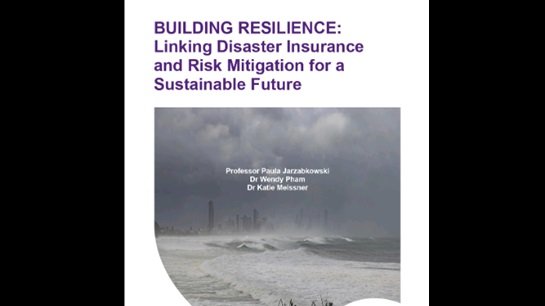
The 39-page report “BUILDING RESILIENCE: Linking Disaster Insurance and Risk Mitigation for a Sustainable Future” developed through a collaboration between ARPC and UQ, focusses on the challenges facing disaster insurance and the trade-offs involved in sustaining a more resilient and inclusive insurance system.
The report brings together research from Professor Paula Jarzabkowski, Dr Wendy Pham and Dr Katie Meissner and examines increasing pressures on disaster insurance systems in Australia and globally, including rising disaster losses, affordability challenges and growing protection gaps.
The study reveals the importance of maintaining access to sustainable and inclusive insurance to support household wellbeing, community resilience and economic stability.
Drawing on Australian and international experience, the research identifies four interconnected areas that will influence the long-term viability of disaster insurance:
- The balance of risk sharing between the public and private sectors.
- Approaches to insurance pricing, including risk-reflective and solidarity-based models.
- Opportunities to better connect insurance with physical risk reduction and mitigation measures.
- Mechanisms that support continuity of insurance coverage over time.
The report provides a framework for considering the trade-offs involved in these areas and highlights the importance of collaboration between industry, government and consumers in addressing increasingly complex disaster risks and supporting stronger community resilience.
It terms disaster insurance as a societal good, articulates the trade-offs involved in sustaining a viable and inclusive property insurance sector, and provides a framework for insurance industry, government, and consumer collaboration in a sustainable disaster insurance system.