







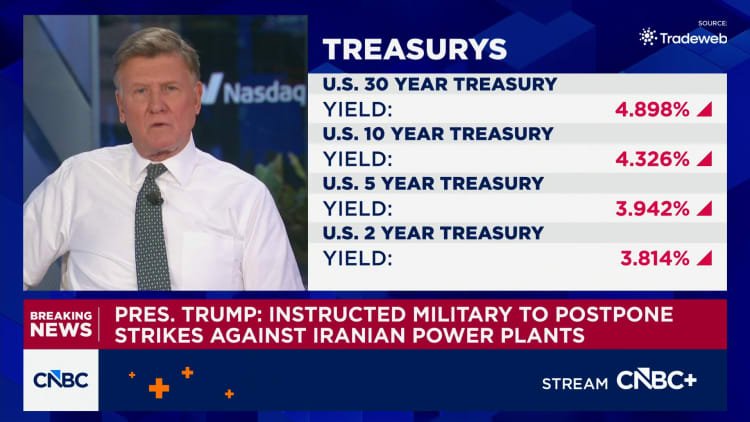

The 10-year Treasury note yield fell on Monday after President Donald Trump said further military strikes against Iran had been postponed after “productive” negotiations between the warring sides.
The benchmark yield was down more than 4 basis points at 4.348%. Earlier in the session, the benchmark security hit its highest level since July as traders had feared the Federal Reserve wouldn’t be lowering interest rates this year and actually could hike as their next move. It then fell sharply, but then turned back to flat before moving lower once again as traders processed the news.
The yield on the policy-sensitive 2-year note dropped more than 4 basis points to 3.848%. The 30-year bond yield was off 4 basis points at 4.92%.
One basis point is equal to 0.01%, and yields and prices move in opposite directions.
In a Truth Social post, Trump said that the U.S. and Iran had been in “VERY GOOD AND PRODUCTIVE CONVERSATIONS” about the conflict that began in late February.
“BASED ON THE TENOR AND TONE OF THESE IN DEPTH, DETAILED, AND CONSTRUCTIVE CONVERSATIONS, WHICH WILL CONTINUE THROUGHOUT THE WEEK, I HAVE INSTRUCTED THE DEPARTMENT OF WAR TO POSTPONE ANY AND ALL MILITARY STRIKES AGAINST IRANIAN POWER PLANTS AND ENERGY INFRASTRUCTURE FOR A FIVE DAY PERIOD, SUBJECT TO THE SUCCESS OF THE ONGOING MEETINGS AND DISCUSSIONS,” Trump added.
To be sure, Iranian state media reported shortly thereafter that the regime has denied any direct or indirect talks between the U.S. and Iran as having taken place.
“In order for equities to stabilize, beyond oil price considerations, bond yields need to stabilize too,” said JPMorgan equity strategist Mislav Matejka in a Monday note.
The economic data docket is mostly bare this week. The S&P Global Flash U.S. PMI report is due Tuesday morning, which measures the economic health of American manufacturing and services sectors.
February’s PMI report indicated a slowdown of business growth for services firms and employment expansion, and economists expect further softening. A reading above 50 tends to indicate growth, and forecasts predict the latest report to come in at 50.5, down from 51.9 in February.
The University of Michigan will release its consumer sentiment index for March on Friday.
Traders have been worried over the hostilities in the Middle East. Trump had said Saturday that he would “obliterate” Iran’s power plants if Tehran failed to fully reopen the Strait within 48 hours.
Iran responded by escalating threats to target energy infrastructure and desalination facilities in the Gulf. Iranian Parliament speaker Mohammad Bagher Ghalibaf also said Saturday that entities that purchase American government bonds and “finance the U.S. military budget” would be considered legitimate targets, alongside military bases.
— CNBC’s Holly Ellyatt and Fred Imbert also contributed to this report.