






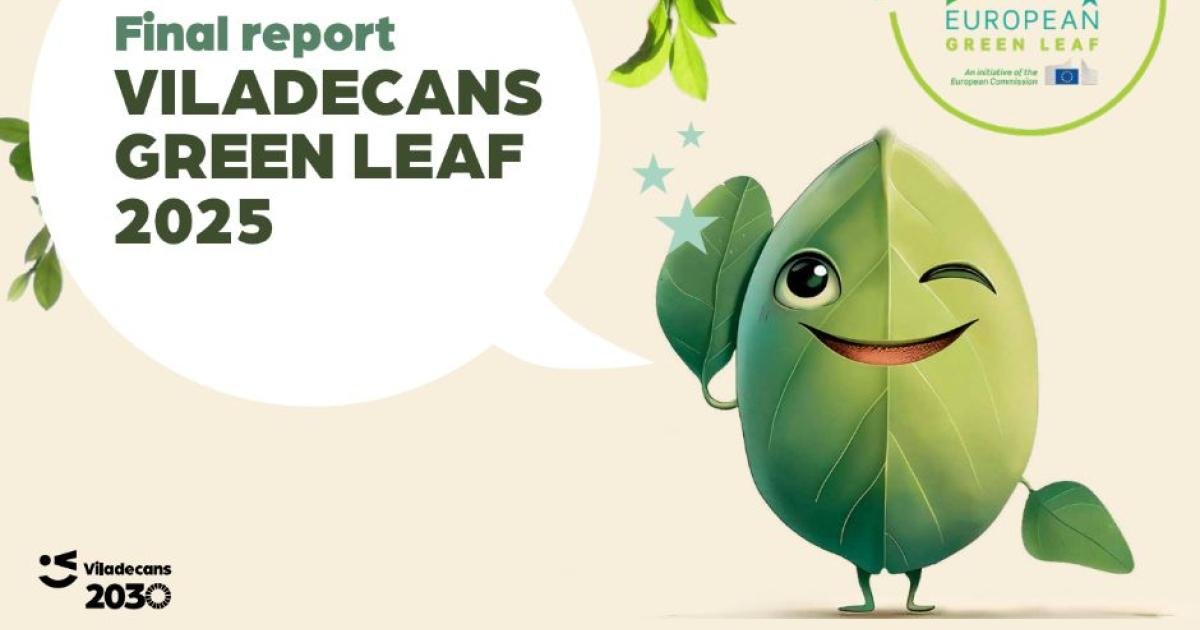
In 2025, Viladecans celebrated its year as a European Green Leaf city, turning the award into a city-wide opportunity to accelerate its sustainability journey and bring local climate action closer to residents.
On the 18th of January 2025, the Green Leaf opening event brought together more than 600 residents at Atrium Viladecans. It featured Olga Morales, Mayor of Viladecans, Jordi Sargatal, Catalan Ecological Transition Secretary of the Generalitat de Catalunya, and Manuel Szapiro, Head of Representation of the European Commission in Barcelona. Awarded the title alongside Treviso (Italy), Viladecans used the recognition to showcase more than two decades of environmental commitment. The award also reinforced the city’s ambition to become climate-neutral by 2030 and achieve negative emissions by 2050.
The final report on the Viladecans’ European Green Leaf 2025 highlights how the city placed participation, local pride and shared responsibility at the heart of its Green Leaf year. Throughout the year, Viladecans embedded the European Green Leaf message into cultural events, local festivals, workshops and community actions.
A central part of the campaign was La Remoleta, the Green Leaf mascot inspired by the carob leaf and named by the local community after the Remolar-Filipines nature reserve. The mascot helped make the city’s sustainability message more accessible, especially for children and families, appearing across educational materials, activities and public events. Through the Green Leaf Fans Programme, Viladecans invited residents, schools, businesses, shops and associations to become active ambassadors of change. Guided by the motto ‘Cada fulla suma!‘ (every leaf counts), the programme helped bring the award into everyday city life.
Education was another central pillar. Schools took part in activities such as ‘Let’s Visit the City Hall’, Green Leaf storytelling sessions, the Green Leaf Kahoot, the ‘Edunauta Passport’ closing event and the ‘Co-Carbon Tree Measurement Project’. Promoted by the Polytechnic University of Catalonia (UPC) and Viladecans City Council, the Co-Carbon Tree Measurement Project involved more than 400 students and teachers from eight schools, who measured 836 trees to understand how urban nature supports CO₂ absorption and climate resilience.
Major local events also played a key role in reaching wider audiences. The Fira de Sant Isidre welcomed over 50,000 visitors and featured a dedicated European Green Leaf stand, a ‘Fan Zone’, sustainability workshops and the Radio Remoleta initiative. During European Sustainable Mobility Week, more than 500 people joined a community bike ride, while the city’s first car-free day demonstrated how collective action can turn sustainable habits into lasting change.
Additionally, Viladecans shared its experience at European events, including the URBACT City Festival, the Cities Mission Conference, the Smart City Expo World Congress, the Energy Cities Annual Forum and a financing masterclass with the Smart Cities Marketplace.
The report also highlights various urban greening, biodiversity and circular economy initiatives. The Viu Verd programme supports Viladecans’ goal of reaching 30,000 trees by 2030. Meanwhile, the second urban bitter orange harvest saw more than 70 participants collect 720 kilogrammes of bitter oranges, later transformed into 144 jars of marmalade. Other actions included the Climate Pact of Viladecans, the spring flea market, the ‘Take a Step: Bring Your Own Container!‘ campaign, upcycling activities, as well as repair initiatives at Viladecans Repara.
The report shows how Viladecans used its Green Leaf year to build lasting momentum, bringing together citizens, schools, businesses, associations and European partners around a shared vision for a greener future and a more resilient city.