








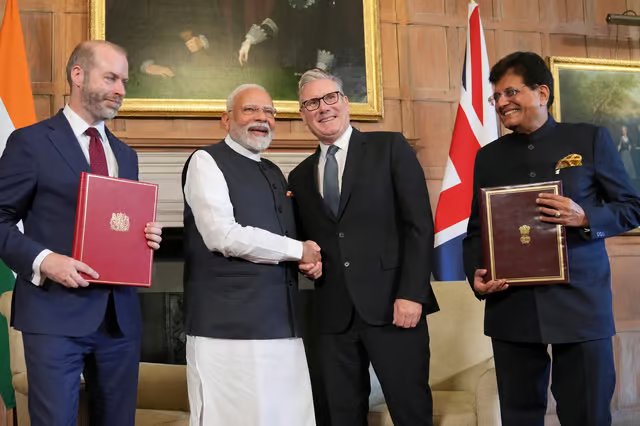


As Consul General of India in Edinburgh, it is a privilege to witness at close quarters the strength, warmth and growing ambition of the relationship between India and Scotland. From my base in the heart of Scotland, I see daily how this partnership is expanding through trade and investment, education and research, culture and community, innovation and sustainability, with shared aspirations for the future.
India and Scotland have already worked together across all of these fields, and that’s precisely why today’s implementation of the India-UK Comprehensive Economic and Trade Agreement (CETA) is more than the coming into force of an important trade deal.
It is a moment that gives fresh economic shape to a partnership that has been gathering strength for years. It’s a moment of celebration in the story of India and Scotland’s partnership. Hon’ble Prime Minister Narendra Modi has described it as a “historic milestone” that will boost bilateral trade and investment.
This is, of course, an agreement between India and the UK. But its significance will be felt especially strongly in Scotland. Scotland brings distinctive strengths to this partnership, and India today is a country of extraordinary scale, confidence and opportunity, with a target of becoming the third largest economy by 2030. When these strengths come together, the possibilities are immense.
A stronger India-Scotland economic partnership
CETA is projected to deliver a £190 million boost to the Scottish economy, supported in particular by gains for the food and drinks industry and financial services. Indian and Scottish firms are not starting from scratch, with annual bilateral trade in goods of around £1 billion. Thus, CETA will act as an accelerator for commercial links that already exist and are ready to deepen.
By reducing tariffs and improving customs facilitation, CETA has the potential to open new opportunities for premium Scottish produce in one of the world’s most dynamic markets. Similarly, it will open up significant opportunities for India’s exports by securing immediate duty-free access on 99 per cent of tariff lines.
Take that most iconic of Scottish exports, whisky. India is already the world’s largest whisky market, importing 220 million bottles in 2025 alone. Yet Scotch accounts for just 3 per cent of the Indian whisky market. The Scotch Whisky Association, calling this a “once-in-a-generation deal”, projects that it could increase Scotch exports to India by £1bn over the next five years, creating 1,200 jobs in Scotland and supporting long-term investments. That speaks to the scale of the commercial opportunity available in India.
But whisky is only one part of the story. The agreement also opens new possibilities for salmon and other premium produce, like soft drinks and confectionery that underline the breadth of Scotland’s export offer. Its industrial base, including specialist components, advanced manufacturing and high-value technical services, is well placed to contribute to India’s industrial expansion and infrastructure ambitions.
For Scottish engineering, advisory and professional-services firms, there is another opening: UK companies will have access to the large procurement market in India. Scottish companies can benefit from India’s investor-friendly schemes, such as Production Linked Incentive scheme.
Innovation, industry and supply chains
Scotland’s strengths align especially well with the sectors CETA is designed to unlock. Scotland has built an impressive fintech ecosystem, underpinned by strengths in financial services. India, meanwhile, has established itself as a global leader in digital payments and large-scale financial inclusion. The fit is obvious. More digital and cross-border delivery can help businesses move from conversation to collaboration – from promising contacts to meaningful commercial partnerships.
Just as important, this agreement has practical value for smaller firms. One of CETA’s strengths is its focus on making trade easier. Customs provisions commit both sides to faster processes, with a target of releasing goods in a time-bound manner where requirements have been met and no physical examination is needed.
The agreement also encourages the use of electronic documentation, requires more information to be available online, and includes a dedicated SME chapter intended to reduce the barriers that too often keep smaller firms out of major markets. For India and Scotland’s ambitious smaller exporters, that may prove every bit as important as any headline tariff cut.
There’s clear potential for Indian exporters in engineering goods, textiles, garments, leather and processed foods. With improved access, India’s highly competitive sector can offer Scottish retailers, manufacturers and consumers a broader range of quality products at more competitive prices, while strengthening the supply-chain connections that bind our economies more closely together. The agreement also provides predictable mobility pathways for skilled Indian workers.
Powering the future together
Few sectors better illustrate the scale of the opportunity created by CETA than clean energy and life sciences. As India pursues one of the world’s most ambitious renewable energy transitions – targeting 500GW of capacity by 2030 – Scotland has a real opportunity to bring its expertise in offshore wind and green hydrogen to a partnership of long-term strategic value.
The same is true in life sciences, where deeper collaboration can deliver real benefits. By strengthening links with India’s fast-growing scientific and healthcare sectors, which have a target of becoming a $300bn industry under the new BioE3 Policy, Scotland’s internationally recognised life sciences cluster can accelerate advances in clinical research, medical technology and health innovation. At the same time, Indian pharmaceutical companies will benefit from faster and more efficient market access, helping to lower costs, improve efficiency and support the NHS.
The opening of an Aberdeen University campus in India this year and talks for direct flights between India and Scotland will further enhance people-to-people ties.
The sheer breadth of these opportunities shows why the implementation of CETA is a moment of celebration. But this is the beginning, not the end. Its significance goes far beyond that. Today marks the start of a new chapter for the people of both countries – a chapter defined by stronger economic ties, deeper innovation and a strong people-to-people partnership, with benefits that will be felt for generations to come.
Siddharth Malik is Consul General of India in Edinburgh