





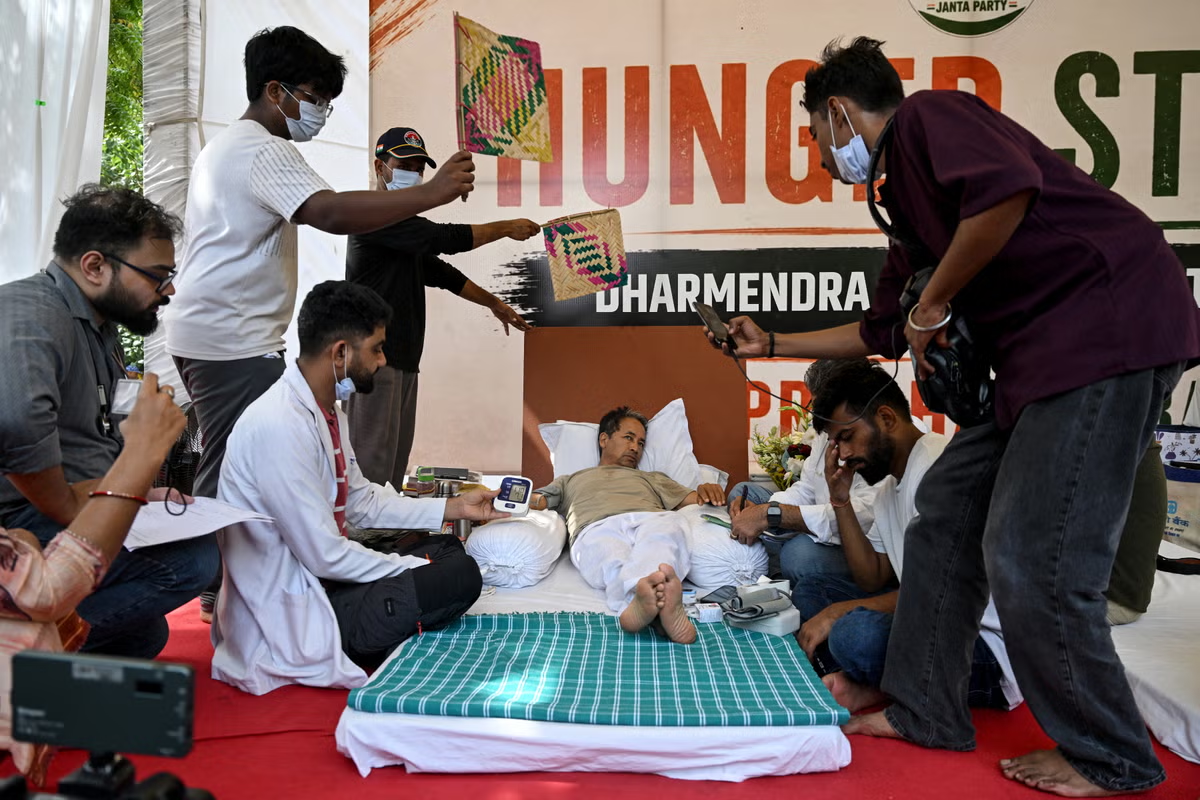
Prominent social activist Sonam Wangchuk has been on an indefinite hunger strike in the Indian capital of Delhi for more than two weeks amid growing concern over his deteriorating health.
Although the 59-year-old Mr Wangchuk is internationally known for his work on climate adaptation in the Himalayas and for inspiring a major Bollywood film, his current protest is not related to climate change.
Instead, he has joined a wider national movement demanding accountability after a series of irregularities shook India’s higher education system and affected one of its most important competitive examinations.
Here’s what we know:
Why is Wangchuk fasting?
The hunger strike centres on demands made by the Cockroach Janta Party (CJP), a satirical citizens’ movement founded by activist Abhijeet Dipke. The CJP, founded by 30-year-old Mr Dipke, has caught the imagination of young Indians on Instagram, gaining 22 million followers within a few days of being set up in May.
The group launched protests at Delhi’s Jantar Mantar on 20 June, following allegations of widespread irregularities in competitive examinations, including the cancellation of India’s national medical entrance examination after a paper leak.
Mr Wangchuk joined the protest on 28 June and began an indefinite fast in solidarity with students.
The protesters are demanding the resignation of federal education minister, Dharmendra Pradhan, arguing that he should accept political responsibility for the examination controversies.
They are also demanding greater accountability and reforms in India’s examination system and $116,000 in compensation for families of students who allegedly died by suicide following examination-related distress, according to the CJP. Young people have also been angered by paper leaks, which led to the cancellation of a medical college examination taken by 2.3 million candidates. It was eventually held last month.
Only 5 per cent to 6 per cent of students taking the exam, known as the National Eligibility cum Entrance Test, secure seats at medical schools.
The Independent has reached out to Mr Pradhan’s office for comment. Mr Pradhan had said authorities will ensure a “fair and transparent” re-test.
“As you know, 20 students have committed suicide. It should not happen that next year the number rises to 40 or 80. We are sitting here to prevent such situations,” Mr Wangchuk was quoted as saying by The Telegraph online newspaper earlier.
Why has this protest attracted so much attention?
Mr Wangchuk is one of India’s best-known public figures outside mainstream politics.
A mechanical engineer from the Himalayan region of Ladakh, he has spent decades working on education reform and sustainable technologies designed for mountain communities.
His best-known innovation is the “ice stupa” – an artificial glacier that stores winter water for use during the spring farming season.
He received the Ramon Magsaysay Award in 2018, often described as Asia’s equivalent of the Nobel Prize, and became widely recognised after inspiring the character played by Aamir Khan in the 2009 Bollywood blockbuster 3 Idiots.
However, Mr Wangchuk has often distanced himself from the film.
His involvement has transformed what began as a student-led protest into a national issue, attracting politicians, academics, activists and public figures from across India.
How is his health?
Doctors monitoring Mr Wangchuk say his condition has steadily worsened during the fast.
According to health updates released by the protest organisers, he has lost more than 8.4kg since beginning the hunger strike.
His blood pressure and blood sugar levels have also fallen, prompting repeated warnings from doctors.
Organisers say he now experiences dizziness when standing, struggles to walk without assistance and has become physically weak.
Despite concerns, Wangchuk has said he intends to continue fasting until the protest reaches what he describes as its logical conclusion.
Earlier in the protest, he said his body had adjusted to the fast and that although he had lost muscle mass, he remained mentally strong.
Who else is on hunger strike?
Mr Wangchuk is not fasting alone.
Several students and activists, including members of student organisations such as the All India Students’ Association (AISA), are also observing indefinite hunger strikes at the protest site. At least one participant has reportedly been hospitalised after their health deteriorated.
The protest has also drawn support from opposition politicians, economists, academics and civil society groups, many of whom have visited Jantar Mantar in recent days.
What are protesters planning next?
Organisers say they have received no formal response from the federal government of prime minister Narendra Modi despite weeks of demonstrations.
The CJP has announced a peaceful march to India’s parliament on 20 July, the opening day of the monsoon session, when lawmakers reconvene.
The organisers say students, parents and citizens from across the country will be invited to participate if their demands continue to go unanswered.
Wangchuk’s previous protests:
In recent years, Wangchuk has become one of the leading voices on issues affecting Ladakh, India’s high-altitude Himalayan region.
He has campaigned for stronger constitutional safeguards, environmental protection, and greater political representation for Ladakh after it was separated from the former state of Jammu and Kashmir and made a federally administered territory in 2019.
Last year, he was arrested while leading a protest march linked to those demands. Authorities accused him of inciting unrest, allegations he denied. He spent about 170 days in prison before the charges were dropped and he was released.
What happens next?
Right now the attention is focused on whether the government opens talks with the protesters, and whether Mr Wangchuk’s health forces an end to his fast.
Mr Wangchuk has insisted he will continue fasting despite mounting medical concerns, while organisers hope growing public pressure will push the government into negotiations before parliament reconvenes.
Meanwhile, Mr Dipke told BBC: “I don’t know why the government is so dismissive of the citizens of this country. We have been simply asking for accountability. We are not saying make us or Sonam Wangchuk the education minister. All we are asking for is to fix accountability and to change the person who has failed to conduct exams properly as an education minister.”
How have politicians responded to Wangchuk’s fast?
Congress MP Shashi Tharoor appealed to Mr Wangchuk on Wednesday to end his fast and, in an open letter, said: “You have awakened the conscience of the nation; that is what a fast is meant to do. India needs your voice for the long road ahead.”
CJP has called for a one-day mass hunger strike on 16 July. In a post on X, CJP said: “Tomorrow, July 16th, join us for 1-day mass hunger strike in solidarity with Sonam Wangchuk and the students of this country.”
As Mr Wangchuk’s health continues to deteriorate, support for the activist has grown across India’s political and cultural spectrum. Leaders including Mamata Banerjee, Arvind Kejriwal, Akhilesh Yadav, and Uddhav Thackeray have voiced solidarity with his campaign, while actors Shabana Azmi, Zeenat Aman, Naseeruddin Shah, Prakash Raj and Ratna Pathak Shah, among others, have also backed him.
Many supporters have urged Mr Wangchuk to end his indefinite hunger strike, expressing concern over his worsening condition even as they endorse his call for accountability over alleged examination irregularities.
Petition seeks to force-feed Wangchuk:
A public interest litigation has been filed in the Delhi High Court seeking urgent medical intervention for Mr Wangchuk as his indefinite hunger strike entered its 18th day on Wednesday, the Times of India reported.
Filed by advocate Rakesh Kumar Saini, the petition asks the government to shift Mr Wangchuk to a hospital, provide medical treatment and, if necessary, administer a liquid diet through force-feeding to protect his life.
If you are experiencing feelings of distress and isolation, or are struggling to cope, The Samaritans offers support; you can speak to someone for free over the phone, in confidence, on 116 123 (UK and ROI), email jo@samaritans.org, or visit the Samaritans website to find details of your nearest branch.If you are based in the USA, and you or someone you know needs mental health assistance right now, call National Suicide Prevention Helpline on 1-800-273-TALK (8255). The Helpline is a free, confidential crisis hotline that is available to everyone 24 hours a day, seven days a week.If you are in another country, you can go to www.befrienders.org to find a helpline near you.