








India has barred its seafarers from working aboard ships travelling through the Strait of Hormuz amid growing safety concerns owing to the US-Iran conflict.
The Indian government ordered shipowners, ship managers and recruitment workers not to place its citizens on voyages through the critical waterway until further notice.
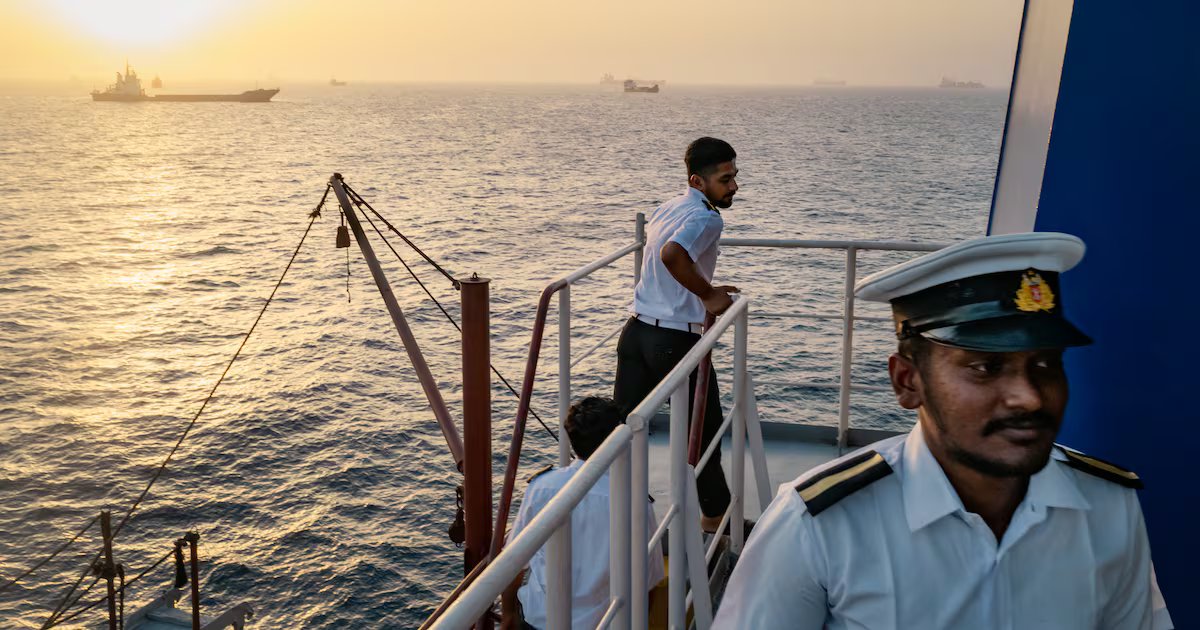
India is the world’s third-largest supplier of seafarers, with more than 300,000 sailors working across global shipping fleets, according to government data.
“No deployment of Indian seafarers on vessels undertaking voyages involving passage through the Strait of Hormuz until further orders,” the Directorate General of Shipping said in an order issued late on Wednesday.
Two Indian seafarers have been killed in attacks on vessels in the region over the last three days.
Recent attacks on vessels have increased the risks faced by seafarers and commercial ships operating in the conflict-affected area “significantly”, the shipping regulator said.
Sailors count cost of conflict
Nine Indian sailors injured on two UAE tankers hit in Iranian missile strikes in the strait are receiving treatment in the Emirates, Indian officials have said.
Three of them are in a critical condition and six are being treated for minor to moderate injuries in hospitals in the Northern Emirates, an Indian consular official told The National on Thursday.
The injured are receiving treatment for injuries in three hospitals in Dibba, Khorfakkan and Fujairah.
One Indian sailor was killed and a total of 45 seafarers – Indians and Ukrainians – were rescued from UAE tankers Al Bahyah and Mombasa after fires broke out on board following the Iranian strikes on July 14.
Officials from the Indian consulate in Dubai visited the rescued sailors to check on them and offer support after they were evacuated from the crude carriers and brought to the Northern Emirates.
The Indian consulate said it was in contact with the hospitals, shipping companies, UAE authorities and families of those injured.
One of the 12 Indian nationals on board the Bahyah crude vessel was killed when Iran hit the two UAE supertankers on July 14 with cruise missiles in the south of the strait. There were 18 Indian sailors aboard the Mombasa tanker.
Abhijeet Sangle, working president of the All India Seafarer and General Worker Union, welcomed the government’s decision.
“The decision of the Directorate General of Shipping to suspend the deployment of Indian seafarers to the Strait of Hormuz is a precautionary measure taken in the interest of safeguarding the lives and security of Indian seafarers,” he said.
“The safety of our seafarers must always remain the highest priority particularly during periods of heightened geopolitical tension.”
He urged the government to continuously monitor the security situation and review the decision periodically.
“Seafarers who are already affected by this suspension should receive timely guidance, employment support and welfare assistance to minimise the impact on their livelihoods,” he said.
“Merchant seafarers are civilians, they are professionals doing their job, they are not military personnel,” Mr Sangle said.
“They help transport essential cargo, they deserve our respect and should not be victims of armed conflict.”
The union described the Strait as “one of the world’s most dangerous maritime corridors due to missile attacks, drones, mines and military operations”.
Indian seafarers, being one of the largest workforces in the global merchant navy, are disproportionately exposed to these risks, the union said in a statement.
Cruise missile strikes
India issued a statement saying it was “deeply concerned” about the strikes on both vessels on which 30 Indian seafarers were on duty.
“We strongly condemn these attacks and acts of violence targeting seafarers and disrupting free and safe navigation through international waterways like the Strait of Hormuz,” the Indian External Affairs Ministry said in a post on X.
India called for an end to violence, expressing worry about “the resumption of attacks and escalation of hostilities”. The ministry urged a halt to attacks on commercial shipping in the region and called for the restoration of freedom of navigation in the international waterway.
The UAE said both tankers sustained significant damage in the attacks.
“The national tankers Mombasa and Al Bahiyah were targeted by two Iranian cruise missiles while transiting the southern shipping lanes of the Strait of Hormuz within Omani territorial waters,” the Ministry of Defence said.
The ministry described it as a “blatant attack” that was a serious violation and breach of international law.
Al Bahyah and Mombasa are operated by Adnoc Logistics and Services.
The southern route was designated by Oman and the UN International Maritime Organisation to help steer vessels away from Iranian mines.
A Cyprus-flagged container vessel, GFS Galaxy, was hit in an Iranian strike on Sunday, killing an Indian engineer.
Herambh Karmarkar was declared missing after the attack before his death was confirmed on Wednesday.
Vevek Tandon, Mr Karmarkar’s father-in-law, told The National that the family had received the news from the shipping company.
“We received a condolence message from the company saying that Herambh is no more,” he said. “We are all in a bad state after receiving this news. Now we just want Herambh back to complete his last rites.”
Ten Indian sailors were rescued by the Oman Navy after they were forced to abandon the ship in a lifeboat after the Iran strike sparked a fire in the engine room.