








On the Frymaster website, a large red bar reads: “Trusted Worldwide. Built in Shreveport.” The manufacturer that has called Shreveport home for 91 years could be one of the area’s best-kept secrets.
If you’ve eaten at a Burger King, Popeyes, Taco Bell or a Raising Cane’s, you have likely had food fried by Frymaster equipment. Kathryn Childs, director of operations, said she has heard that 30% of all of the fried food consumed every day is prepared by a Frymaster fryer.
While most have heard of the big companies, there are hundreds of independent restaurants using Frymaster products, too, said Wendell Hays, Frymaster’s vice president of new business and products.
On a vacation to the Virgin Islands, he went to a small island accessible only by boat. After a meal at one of the two restaurants there, “I went to see what they had in their kitchen, and there were two fryers made right here in Shreveport, sitting in there. I’m like, ‘That’s really awesome that my fryers ended up here.’”
Restaurants on the island are using products that did not get their start with executives sitting around a table in a corporate office, said Hays.
“You don’t understand the real needs of the business until you go get in the kitchen and you watch the workflow, the 17-year-old kid that was trained for 10 minutes on how the fryer works and see the challenges they face trying to do their job,” he said. “So you really have to figure out ways to dumb it down, make it intuitive.”
Hays said he got that perspective when he was working at a Bonanza steakhouse and had gotten “five minutes” of fryer training. “My boss came in and the oil was black, and the food looked terrible, and it was smoking and he said, ‘Son, when was the last time you changed this oil?’ And I said, ‘I didn’t know I had to change the oil. Nobody told me.’ I would have cooked in that stuff forever because I did not know what I was doing. And, you know, I’ve always looked at that as like, that’s who we’re designing our product for,” he said.
To help, Frymaster is now using touch screens instead of the intimidating bank of buttons that Hays said, “scared people to death.”
“We had somebody tell us that that thing looks like the cockpit of the 757, and somebody else is like, you know, I think it’s called the 3,000 because there’s 3,000 buttons on it. And my favorite was somebody who had said, ‘Whoever designed this thing has never worked in a kitchen.’”
In response, in 2014, Frymaster became one of the first restaurant equipment manufacturers to move from buttons to touch screens.
The new technology has added benefits.
Through the fryer’s internet connection, Hays said he can see at a glance if there are equipment problems.
He thinks artificial intelligence could prove to be very helpful.
Soon, Hays said he believes smart kitchen systems will be able to build predictive algorithms on how much food should be cooked even before the orders come in.
Out of sight, not top of mind
In December, Frymaster signed a contract on an adjacent 57-acre building. North Louisiana Economic Partnership CEO Justyn Dixon said the property acquisition sent a strong message that the company plans “to continue their success for years to come.”
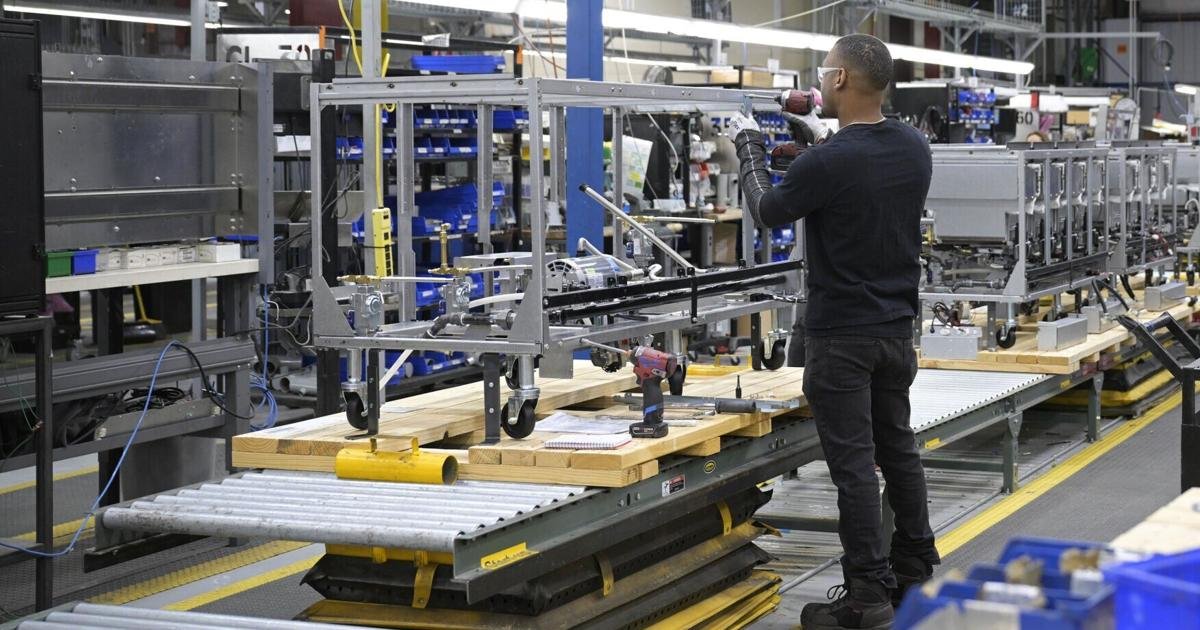
Earlier this year, Frymaster was running 13 different production lines in its 270,000-square-foot facility at 8700 Line Ave. The plant adds another 50,000 square feet for storage and upward of 100,000 square feet for production.
There are 600 employees who staff lines that run seven days a week.
Because the Frymaster facilities, which include the two Line Avenue locations and the partner Lincoln Foodservice in the Shreve Park Industrial Campus, are mostly out of sight, they are also back of mind. Frymaster President Oscar Villa said it’s important that residents know the investments made and jobs created by the companies, which are both part of the multinational Ali Group.
“We do feel like we have been a little bit neglected by the local community because we’ve been here for such a long time. And you know, we are kind of taken for granted in a way,” Villa said.
He said the company has made a variety of capital investments from new equipment and fabrication to a new building. He said they are also hiring and investing in their employees, improving compensation and adding more career opportunities.
“We’re going to be here for a long time,” Villa said. “We are going to grow, and there are lots of long-term opportunities.
“You know, I see some of the other people, they come in, they make a big splash, and then maybe they’re gonna be gone in a few years, or they overpromise and maybe underdeliver, right? I feel like we’re a little bit the opposite. We’re a private company, so we don’t need to show off or do any big proclamation or, you know, come up with any crazy plan, but we are very consistent.”