






A Rapid Action Force officer faces backlash for mocking protesters on social media amidst ongoing demonstrations in New Delhi.
New Delhi: An officer from the Rapid Action Force (RAF) has found herself at the centre of a social media storm following a controversial Instagram post regarding recent protests in the Indian capital. The incident unfolded shortly after the Cockroach Janata Party (CJP) led a demonstration aimed at Parliament, which was obstructed by security personnel two days prior.
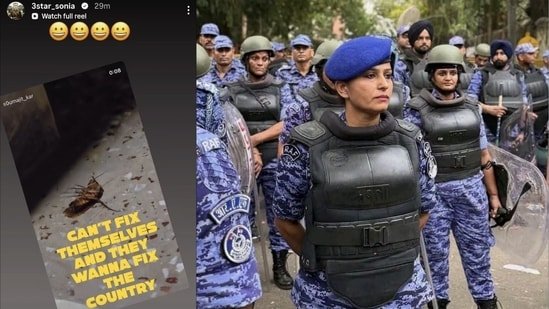
Sonia Sehrawat, the assistant commandant in question, posted a story featuring a dead cockroach along with the caption, “Can’t fix themselves and they wanna fix the country.” This post was widely perceived as insensitive by many, leading to a groundswell of criticism online.
The CJP quickly condemned Sehrawat’s comments, labelling them as “absolutely shocking” and accusing her of equating peaceful protesters with cockroaches. A statement from the CJP shared on X (formerly Twitter) stated, “This RAF official actually sees the peaceful protesters as cockroaches and thinks that the brutality of the police was justified because of that. But you see, we are cockroaches. And cockroaches never die!”
Sehrawat, who has a significant following of over 621,000 on Instagram, subsequently deleted the post after it drew sharp reactions from both the public and political figures. The controversy surrounding her remarks raised concerns about professionalism within the forces. A source mentioned that such political comments, even made on personal accounts while executing official duties, could lead to disciplinary action.
During the CJP’s protest on July 20, party founder Abhijeet Dipke confronted Sehrawat about allegations that RAF personnel had used excessive force against demonstrators, especially targeting women. Addressing her directly, Dipke expressed concern for the treatment of women during the protest and questioned the actions of security forces. Despite the tension, he acknowledged that Sehrawat had listened to his concerns more attentively than others he had encountered.
Sehrawat defended the actions of her team, asserting that no protesters were deliberately harmed under her command. She stated that chaos erupted among the crowd, leading to a stampede-like situation, which caused injuries among protesters. In her defence, she insisted that their primary intent was to maintain safety and manage the crowd without causing harm.
In an interview, Sehrawat further explained her perspective, emphasising her responsibility to protect all individuals present, particularly vulnerable women. She described the day of the protests, asserting that her team urged demonstrators to maintain space for safety. “We are not the enemies, and we are not goons,” she highlighted, explaining that they were not instigating harm but rather functioning under pressure to ensure crowd safety.
Sehrawat’s social media activity, particularly her now-deleted post, has sparked widespread discussions among her peers in the RAF and Central Reserve Police Force (CRPF). Some officers have suggested that such remarks could tarnish the image of the forces dedicated to public safety and law enforcement. A senior officer stated that appropriate action should be considered by higher authorities regarding this incident.
This unfolding controversy highlights the complexities involved in law enforcement and social media interaction, particularly in a politically charged atmosphere. As protests continue, many will be watching how the RAF and CRPF respond to this incident and whether any disciplinary measures will be taken regarding Sehrawat’s statements.