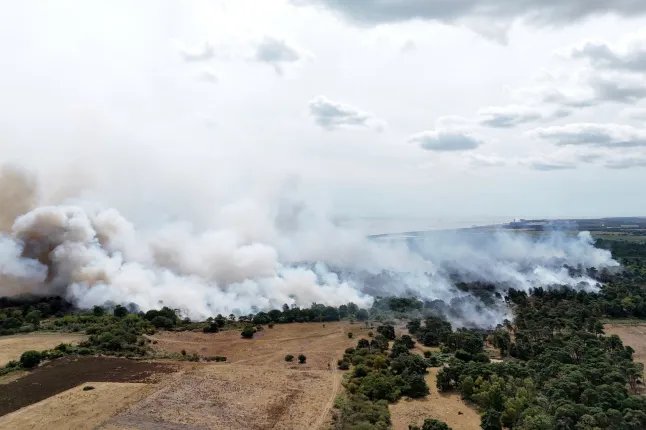
Raging flames are spreading close to houses after a major wildfire forced evacuations across Suffolk.
Homes evacuated have been evacuated and families staying at a holiday park have been told to leave while firefighters spent the night tackling the blaze spreading across Dunwich Heath on the Suffolk coast.
It has been declared a major incident, with the inferno covering 247.1 acres – the equivalent of about 140 football pitches.

Ominous footage showed thick smoke billowing into the sky near homes, turning the sky a dark orange as it blocked out the sun.
Sign up for all of the latest stories
Start your day informed with Metro’s News Updates newsletter or get Breaking News alerts the moment it happens.
The fire is just four miles away from Sizewell B nuclear plant. Suffolk County Council says there is ‘no current risk’ to the site, as has Suffolk Fire and Rescue.


The service said: ‘At this time there is no current risk to Sizewell B, due to the distance from the fire and the direction it is travelling (easterly).
‘However, this is a live and dynamic situation and as a result any further updates will be shared accordingly.’
It is also close to the RSPB Minsmere nature reserve.
One couple slept in their car after fleeing home at around 11.30pm on Wednesday.
Justin North said: ‘I have spent the night in my car with my wife and we’re not quite sure when we will be able to go back or even if our caravan is in one piece.
‘There’s a fire raging on both sides of the road, so it’s an uncertain future.
‘My wife is still in her PJs, it’s been an interesting evening.

‘The Westleton residents managed to accommodate somewhere in the region of 42 couples, children, dogs, babies overnight.
‘They’ve just given us a cooked breakfast, they’re keeping us in touch, but we’re going to be here at least another day.’
The UK has been in the clutches of a fourth heatwave this year and temperatures reached above 30°C in parts of the UK yesterday.
And today it emerged around 2,877 deaths have been linked to excessive heat in May and June – almost double the number recorded last summer.
Startling images of parched grasslands have become all too common in 2026 with much of England and Wales officially in drought. 21 counties are also under a hosepipe ban, affecting 23million people.


It means parts of the country are a tinderbox, prompting widespread wildfire warnings from fire chiefs. Firefighters are tackling several outbreaks, including in Cairngorms in Scotland, which has been burning for two weeks.

Suffolk Fire and Rescue Service said it has focused on protecting properties including Coastguard Cottages, Mount Pleasant Farm and Cliff House Holiday Park, and told people to avoid the area.
The fire broke out shortly after 5.30pm on Wednesday and spread towards St James’ Church, it said.
‘Following the update throughout the night, crews from Suffolk Fire and Rescue are still tackling a large wildfire at Dunwich Heath,” the fire service said in an update on Thursday morning,’ the fire service said.
‘Throughout the night crews have been focused on protecting properties including Coastguard Cottages, Mount Pleasant Farm and Cliff House Holiday Park.
‘All individuals have been evacuated successfully.’
An amber heat-health alert is in place for the East Midlands, the East, South East and London. Thankfully, some respite could be on the way.
Temperatures are expected to fall to average across much of the country from today.
Deputy Chief Forecaster Mark Sidaway said: ‘The forecast is showing potential for more rain than much of the UK has experienced over the last few weeks.
‘However, it looks as though amounts of rain for many will be fairly modest, and won’t balance out the shortfall that we have recorded this summer. It’s still possible that some areas of the south will miss out and see little or no rainfall.’
Areas in France and Spain have been devastated by wildfires raging across Europe. Around 330,000 people were evacuated across the two countries.
In Greece, three firefighters were killed tackling two separate infernos – one in Crete and the other in the southern Peloponnese region.
MORE: The dangerous power adaptors holidaymakers need to avoid this summer
MORE: With a fourth heatwave on its way – will the UK see wildfires like those in France?