







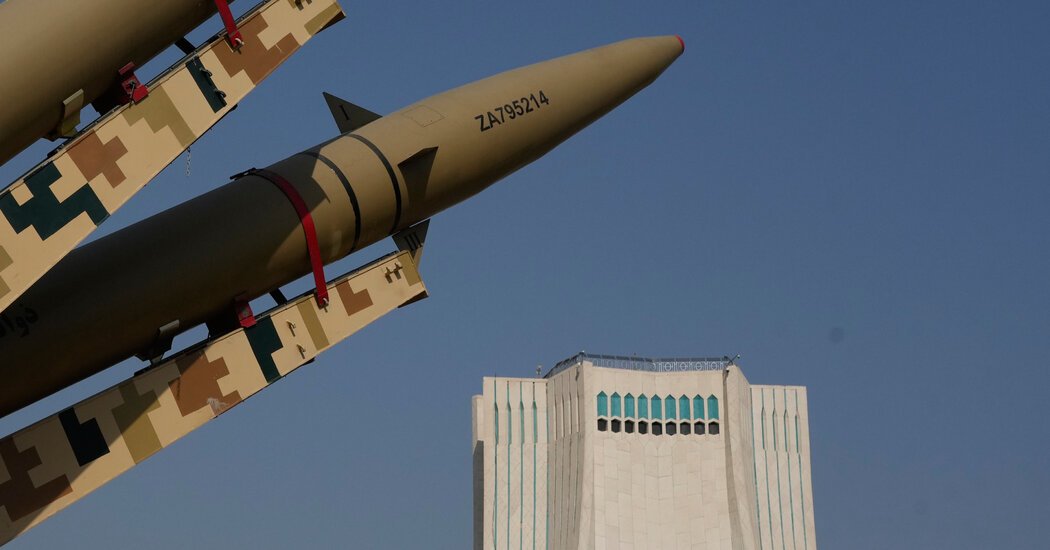
The only thing worse than President Trump starting an unconstitutional war is President Trump losing control of that war.
On Wednesday, NBC News reported that Trump “erupted” at members of his national security team over the Iran War. According to the report, his advisers can’t agree on a path forward. But how could they? Every path to victory risks dangerous escalation, while continuing the present course risks strategic defeat.
This was always the most likely outcome. The president chose to take on a much more powerful country than, say, Saddam Hussein’s Iraq in 2003, while using far less force than we employed to topple the Iraqi government.
What did he expect would happen?
Oh right, we know. He thought he could topple a vicious, deeply embedded authoritarian regime with a few targeted airstrikes and a fantasied popular uprising. As he has said many times, he expected a version of his Venezuela outcome, and when the Venezuela strategy failed, if strategy is the word, there was no real Plan B — other than to bomb Iran more and hope for capitulation.
In fact, we’re planning to do that yet again. Or maybe we’re not.
On Friday, Trump said he was ordering a new round of airstrikes. And what was his reasoning? “You know at some point,” Trump said, “they’re going to say, ‘We just can’t take it anymore.’”
On Saturday, he’d changed his mind. “We have just been asked by Iran, and other Middle Eastern Countries, to hold off any attack,” Trump said in a Truth Social post.
“I have agreed,” he added, “for the future benefit of the WORLD and, likewise, the survival of a successful and prosperous Iran, to cancel the attack, subject to being able to rapidly make a DEAL.”
But the problem we face right now is something well beyond deals. America has been so powerful for so long that we are accustomed to being in control of events. We start wars when we want and — crucially — we believe that we can end them when we want.
When I was in Iraq, as terrible as that war was, we knew it was contained. We were fighting an enemy that had minimal ability to harm Americans outside of Iraq. The same was true in Afghanistan once we and our allies destroyed Al Qaeda’s strongholds.
In both conflicts, the fighting was brutal, and we can and should debate the wisdom of both wars. But our great-power rivals were largely absent.
There is no such thing as a safe war — any war can spin out of control — but the combination of American power, enemy weakness and Russian and Chinese restraint meant that Americans could sleep secure in the knowledge that the chances of a catastrophic escalation were extremely remote.
That is no longer the case. The world is walking a path toward a world war, and no one — including the president of the United States — seems to be in command of events.
Consider recent events. Not only does Iran continue to strike American bases effectively; it has relentlessly attacked American partners across the region. These attacks are doing immense damage to oil and gas facilities and — combined with Iran’s continued control over the Strait of Hormuz — are placing the world economy at risk.
The Houthis have entered the conflict, expanding the fighting into the Red Sea, and now Saudi Arabia is reportedly planning a large-scale attack on Houthi territory, including, potentially, the use of ground forces to attempt to break the Houthi shipping blockade.
Ukraine struck an Iranian ship in the Caspian Sea, the immense body of water that borders both Russia and Iran. Ukraine said it did this because the ship was carrying military equipment between the two countries.
Russia and China may be assisting the Iranian military by providing satellite imagery and other assistance that renders Iranian missile and drone attacks more effective. Reuters has also reported that China is sending Iran hundreds of surface-to-air missiles.
NATO reported last week that a Russian missile crossed the border and exploded (harmlessly, thank God) in Polish territory. Several Russian drones have crossed the border since the start of the Ukraine war, but this is the first known Russian missile impact.
Speaking of Russia, it is reportedly considering whether to try to reverse the fortunes of its war in Ukraine through mass mobilization, which would mean conscripting potentially hundreds of thousands of new soldiers to throw against Ukrainian lines.
And of all this is taking place against the backdrop of two grim military realities for America. First, Iran has demonstrated that American planes and American bases are more vulnerable to attack than many of us imagined. This level of damage to American facilities would have been unthinkable when I was in Iraq.
Al Qaeda had no long-range missile capability, and not even Saddam Hussein, at the height of his powers before Operation Desert Storm, could strike across the region as effectively as Iran has since the start of the war.
Iran has taken grievous losses, including much of its top leadership. But the crucial difference with the United States is that the Iranian regime simply doesn’t care about losses in men or matériel in the same way we do.
Both the United States and Israel have repeatedly decapitated the leadership of jihadist organizations, with little lasting effect. Iran has shown again and again that it will expend the lives of its citizens to retain power or to secure a strategic advantage. In fact, the regime seems to relish slaughtering the almost impossibly brave citizens who do rise up in protest.
Second, we’re running out of interceptors, such as our Patriot antimissile systems, and other advanced munitions. While I don’t want to see a single drone or missile penetrate our defenses and strike an American or allied target, I also know that even a successful intercept can be a mini-defeat.
If you’re using a $4 million weapon that’s difficult to manufacture to destroy a $35,000 drone that can be easily built at scale, it’s only a matter of time before your defenses are degraded and your skies are open to enemy attack.
The Trump administration has put forward two contradictory messages — that there’s no shortage of missiles in the American inventory and that the shortage is Joe Biden’s fault (because he helped to arm Ukraine and launched airstrikes against the Houthis).
The administration is certainly acting as if our stocks of munitions are perilously low. We’re engaged in an on-again, off-again conflict (Friday, on; Saturday, off) that has been filled with unusual pauses.
Let’s put all this together: The initial American strategy failed, the war with Iran is consuming the entire region, Iran and Ukraine are risking a face-off, there is evidence that both Russia and China are escalating their military commitments, American munitions stocks are dwindling and Trump is raging.
I’ve often wondered what it was like to be alive in the summer of 1914, much less in 1938 and 1939. When did people start to realize that the world was on the brink of catastrophe? Speak up too soon or too frequently, and you look ridiculous — like the Chicken Little of world war. Speak up too late, and you live (if you live) with bitter regret.
I’m not trying to predict anything, and I hold out hope for de-escalation. I know there are still serious people in the American government (whether they have Trump’s ear is a different question) and in allied governments across the world.
But we can analyze the events and trends of the moment, and right now all the momentum is toward greater escalation. And we absolutely cannot do what Trump asks, which is to “just sit back and relax” and trust that “it will all work out well in the end.”
I do not think that world war is inevitable, nor do I think it is probable. But it is more possible now than it has been at any time since the end of the Cold War, and the American government is led by the worst rulers in the modern history of the United States.
Congress, the only branch of government that possesses the power to intervene, has been prostrate before the president. The threat of a primary loss is all it takes to completely remove the spine from a typical Republican member of Congress.
It’s often said that your average American voter doesn’t really care that much about foreign policy. In general, that’s true — until there’s a catastrophe. When that happens, though, foreign policy isn’t just the main thing; it’s the only thing that truly matters.
Our future may depend in part on American voters deciding to give Congress a spinal transplant. But that requires us to do something that democracies have rarely, if ever, done successfully — see the catastrophe coming and act decisively before a terrible war swallows the world.